

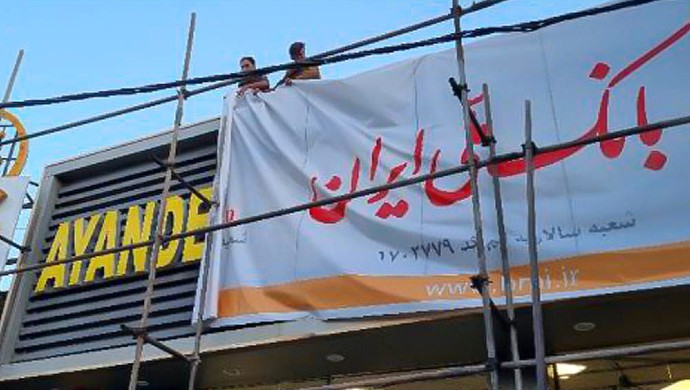

On September 26, a member of the regime’s parliament, Amirhossein Sabeti, triumphantly announced that the dissolution of the “corrupt Ayandeh Bank” was the start of a broader cleanup that would solve the country’s inflation crisis. This is a calculated deception. The spectacular failure of Ayandeh Bank is not an isolated incident but a clear symptom of the terminal illness afflicting the ruling theocracy: systemic corruption.
The regime itself has been forced to admit to the existence of a “seven-headed dragon of corruption” and “unprecedented embezzlement in history” woven into the fabric of its rule. The bank’s collapse is not the beginning of a cure; it is the exposure of a wound that has festered for decades, revealing a system designed for plunder, kept afloat by the silent theft of printing money, and now teetering on the brink of social explosion.
The anatomy of a corrupt collapse
According to the regime’s own Central Bank, Ayandeh Bank’s downfall was the result of “two decades of imbalance and unhealthy performance.” It operated not as a financial institution but as a private slush fund for insiders. An astonishing 90% of its loans were funneled to “related parties”—the bank’s own founders and their affiliates—to finance their own stagnant projects. This blatant self-dealing is a hallmark of the regime’s economic model.
When this Ponzi-like scheme could no longer sustain itself by attracting new deposits to pay off old ones, the bank simply turned to the Central Bank for massive overdrafts. At the time of its collapse, Ayandeh Bank owed approximately 3,200 trillion rials to the Central Bank and 2,450 trillion rials to its depositors, bringing its total debt to a staggering 7,500 trillion rials. In effect, the regime allowed the bank’s corrupt owners to cover their losses by printing money, passing the bill to the Iranian people.
The regime’s ‘silent theft’: printing money to fund plunder
The strategy used to prop up Ayandeh Bank is the same one the regime uses to run the entire country. When faced with massive budget deficits, often caused by the looting of state resources—such as the $100 billion in export revenues that a state-run newspaper admitted has vanished from the official economy—the regime’s only solution is to turn on the printing presses.
According to government-affiliated economist Mahmoud Jamsaz, the situation has reached a critical point. He warned on October 20 that the government must create 106 trillion rials in new liquidity every day just to finance its budget. He called this an “avalanche of 80 percent inflation” waiting to crash down on the economy. This policy is a “large-scale, silent theft from the people’s pockets.” Every new rial printed devalues the savings and wages of ordinary Iranians, systematically transferring their wealth to the ruling kleptocrats.
The human cost: a nation being ‘crushed’
This state-sanctioned theft has tangible, devastating consequences. The price of a carton of eggs, a basic food staple, has skyrocketed from 900,000 rials in June to 2,000,000 rials today. In just three months, the value of a 1,000,000-rial note has plummeted from being able to purchase 34 eggs to now only 15.
This economic destruction is pushing people beyond their limits. As one citizen told the state-run Eqtesad-e Pouya newspaper on October 22, “Every day I leave the house, I’m afraid of what will become more expensive tomorrow. I can no longer plan. I feel like I am being crushed under economic pressure.” The paper explicitly warned of the “danger of the people’s threshold of tolerance running out.”
From economic desperation to a political explosion
The regime’s own media now openly discusses how this widespread economic “desperation” is rapidly transforming into “public anger.” An expert quoted in the state-run Ham-Mihan newspaper on September 21 warned that “anger and rage are the direct product of desperation.” He predicted that the next popular uprising would be ignited by a single “event,” starting with the middle class and quickly propelled by the “anger of the hungry.”
The implosion of Ayandeh Bank is not the beginning of a solution; it is one such event, a glaring milestone on the path to the regime’s inevitable overthrow. The unbridled corruption and the economic war waged against the people are not just policy failures. They are the fuel for the coming “eruption of the anger of the hungry,” an uprising that will finally sweep this rotten system away.