

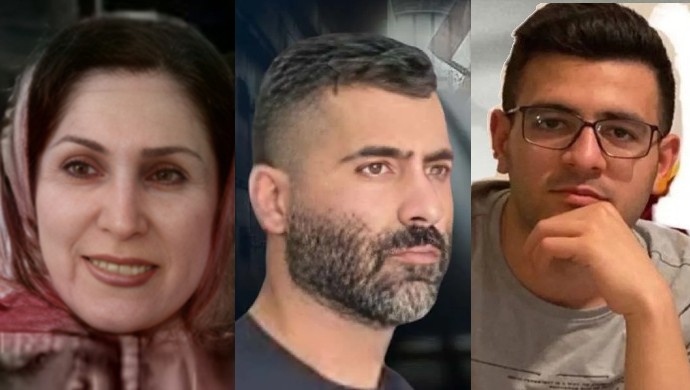

The Iranian regime, cornered by a crisis of legitimacy and terrified by the Iranian people’s growing spirit of defiance, has unleashed a new wave of terror against political prisoners and activists. In a clear sign of desperation, the clerical regime’s judiciary is rapidly issuing and upholding death sentences against political prisoners, especially supporters of the People’s Mojahedin Organization of Iran (PMOI/MEK), in a frantic attempt to silence dissent. The recent cases of Zahra Tabari, Ehsan Faridi, and Manouchehr Fallah are not isolated incidents but part of a systematic campaign of murder aimed at intimidating a nation on the brink of change.
Justice denied: The faces of the condemned
The victims of this state-sanctioned killing spree represent a cross-section of Iranian society united in their desire for freedom. Zahra Tabari, a 67-year-old woman from Babol with a master’s degree in electrical engineering, was sentenced to death for “cooperating with the PMOI.” Her fate was sealed in a 10-minute trial conducted via video conference, during which she was denied access to a lawyer of her own choosing. Her family stated that the entire proceeding was a “pre-determined show.”
The regime’s cruelty is also directed at the younger generation. The regime’s judiciary upheld the death sentence of Ehsan Faridi, a 22-year-old honors student at Tabriz University, on charges of “Corruption on Earth” for supporting the PMOI. His lawyer noted that the request for a retrial was rejected in less than an hour, despite “serious procedural flaws” in the case. According to his counsel, under the regime’s own laws, the maximum sentence for his alleged crime would be five years in prison.
Similarly, Manouchehr Fallah, a 35-year-old PMOI supporter, now faces imminent execution after the Supreme Court upheld his sentence.
The machinery of repression
These cases are not aberrations; they are the logical output of a judicial system designed to crush dissent. The regime routinely uses vague, all-encompassing charges like “Moharebeh” (waging war against God) and “Corruption on Earth” to execute political opponents. The trials are a complete sham, characterized by a lack of due process, denial of independent legal counsel, and verdicts rubber-stamped by higher courts without meaningful review.
These cases are not isolated. There are now 18 political prisoners who are under the imminent threat of execution for their support of the PMOI. The death sentence of another prisoner, Mohammad Javad Vafaei-Sani, was also upheld by the regime’s judiciary last week. In June, the regime executed PMOI members Behrouz Ehsani and Mehdi Hassani.
The regime’s ultimate fear: a rising tide of resistance
This escalation in executions is not a sign of strength but of profound weakness. Khamenei and his cronies are terrified by the unwavering spirit of the Iranian people and the growing appeal of organized resistance. By sending activists to the gallows, the regime hopes to create an atmosphere of fear to prevent further uprisings. The particular focus on sentencing bright, young students like Ehsan Faridi to death is a calculated attempt to terrorize the youth, the very demographic that is courageously defying the regime’s tyranny.
But this strategy is obviously failing as the population of youth defying the regime expands every day. This is most evident in the growing numbers of PMOI Resistance Units.
The people of Iran are set determine their destiny and bring freedom to their country. Meanwhile, the international community has a responsibility to stand against the regime’s barbarity. The Iranian Resistance calls on the United Nations, the European Union, and all human rights defenders to take urgent, concrete action to save the lives of Zahra Tabari, Ehsan Faridi, Manouchehr Fallah, and all political prisoners on death row. The international community must shun this regime of execution and terror and bring its bloodthirsty leaders to justice for their crimes against humanity.