

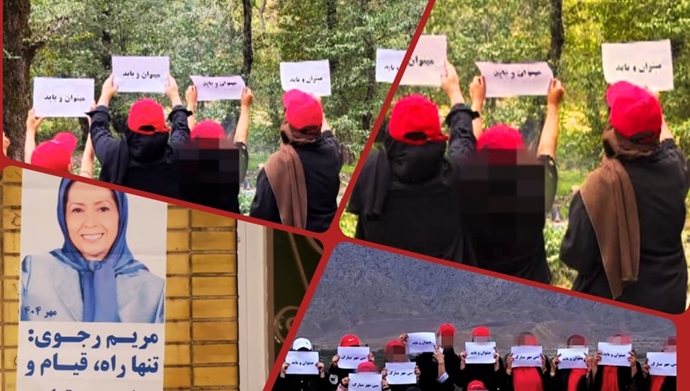

In the days leading up to the anniversary of Mrs. Maryam Rajavi’s election as the president-elect of the National Council of Resistance of Iran (NCRI), the clerical regime’s repressive grip on society was shattered by a wave of audacious and highly coordinated anti-regime activities. Across Iran, from the capital Tehran to cities in every corner of the country, the PMOI’s internal network of Resistance Units launched a multi-day campaign, demonstrating a level of organization and reach that has sent shockwaves through the regime’s security apparatus.
This campaign is far more than a series of sporadic protests; it is a testament to a deep-rooted and disciplined network that is not only challenging the state’s machinery of repression but is also boldly presenting a democratic alternative to the Iranian people. The regime’s own intelligence services have been forced to acknowledge this growing, structured threat, revealing a palpable fear of the viable alternative gaining momentum within the nation.
A calculated campaign of nationwide defiance
The campaign began on October 18, when Resistance Units carried out 23 distinct “revolutionary acts” across 13 cities. These were not minor acts of graffiti but large-scale public displays designed to break the atmosphere of fear. In a striking example, travelers on the highway between Ahvaz and Shushtar were greeted by a massive banner of Mrs. Rajavi hanging from a pedestrian bridge, bearing the message: “The army of women and the oppressed will uproot this regime.”
October 20—Iran
PMOI Resistance Units mark the anniversary of Maryam Rajavi's introduction as president-elect of the National Council of Resistance of Iran (NCRI). pic.twitter.com/zYFZEsuNSq— People's Mojahedin Organization of Iran (PMOI/MEK) (@Mojahedineng) October 20, 2025
Simultaneously, in Kermanshah, another large banner appeared with Mrs. Rajavi’s image and the declaration, “Tomorrow’s Iran with Maryam Rajavi.” In the historic city of Isfahan, Maryam Rajavi’s name was projected in large scale onto landmarks, including the famous Si-o-Se-Pol bridge, bringing moments of joy and hope to citizens. Similar acts of defiance, displaying images of Mrs. Rajavi and slogans such as “We can and we must overthrow the mullahs’ regime,” were carried out in Tehran, Mashhad, Zahedan, Karaj, Sanandaj, Semnan, Kashan, Andimeshk, and Yasuj.
Escalation and organization
While the first day demonstrated broad reach, the events of October 19 revealed a significant escalation in organization and complexity. The Resistance Units conducted 33 coordinated operations across 25 cities, this time operating as visible, disciplined cells. In Tehran, a unit of approximately 20 women boldly displayed Mrs. Rajavi’s messages in a collective action. Elsewhere in the capital, units of at least 10 and 8 members also staged defiant displays.
Shiraz pic.twitter.com/DvUvVyzt5Z
— People's Mojahedin Organization of Iran (PMOI/MEK) (@Mojahedineng) October 20, 2025
This shift from individual acts to group operations was seen nationwide. In Isfahan, a unit stood in the dry basin of the Zayandeh River at the foot of the Si-o-Se-Pol bridge—a potent symbol of the regime’s environmental destruction—and renewed their pledge to Iran’s fallen heroes, chanting, “We swear on the blood of our comrades, we stand until the end.” In Fuladshahr, a unit of at least 15 members chanted “Woman, Resistance, Freedom,” while a unit of 20 men and women in Kermanshah raised placards with Mrs. Rajavi’s words. This organized presence, from Urmia and Tabriz to Shiraz and Zahedan, underscores a sophisticated structure capable of synchronized action.
A clear message
The slogans and messages of the campaign were unequivocal. They moved beyond mere protest to articulate a clear political vision: the overthrow of the theocracy and the establishment of a free and democratic Iran. Slogans like “Iranian women are Khamenei’s endless nightmare” and “The only way is uprising, resistance, and maximum offense” were widely disseminated.
More footage of the activities of PMOI Resistance Units, celebrating a key milestone in the history of the Iranian Resistance with a pledge to continue the fight for a free and democratic republic.pic.twitter.com/naQKdPEMaE
— People's Mojahedin Organization of Iran (PMOI/MEK) (@Mojahedineng) October 21, 2025
Most significantly, the campaign centered on the democratic alternative represented by the NCRI. In cities like Mashhad, Tabriz, and Shiraz, units chanted slogans that endorsed Maryam Rajavi’s Ten-Point Plan and her vision for a free and democratic republic of Iran. This was often met with collective cries of “Hazer, Hazer!” (“Ready, Ready!”), a declaration of readiness to answer the call for a nationwide uprising. The campaign culminated on October 20 with a defiant motorcade in Tehran, where riders on motorcycles flew yellow flags emblazoned with “Simorgh”—the mythical Persian bird of rebirth—and the promise, “We will bring her to Tehran.”
The regime’s admission of fear
The regime’s security forces, despite their vast network of surveillance cameras and informants, were confused and bewildered by the scale and effectiveness of the Resistance Units. However, the most compelling evidence of the campaign’s impact comes directly from the regime itself. In a state of alarm, Khamenei’s IRGC Intelligence issued a warning, published by the state-affiliated Mashregh News on October 16, that laid bare its fears.
The IRGC report stated: “The launch of the Mojahedin’s Resistance Units project… aims to provoke public opinion… to reorganize the network of riots!” By using terms like “project” and “network,” the regime’s own intelligence apparatus admits it is facing a calculated, strategic, and organized force—not a series of spontaneous or random “riots.” This is a terrified acknowledgment that the PMOI’s strategy of building an organized internal resistance is succeeding.