

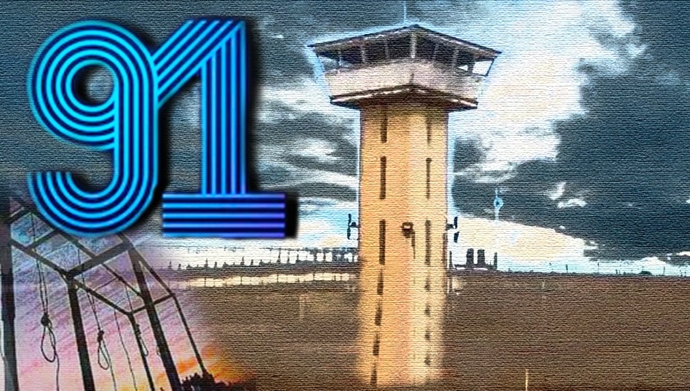

As the “No to Executions Tuesdays” campaign entered its 91st consecutive week on October 21, 2025, the coordinated movement of defiance against the Iranian regime’s use of capital punishment has reached a new peak. This week, the campaign, active across 52 prisons, was marked by a significant victory inside the notorious Ghezel Hesar prison, where a mass hunger strike successfully thwarted the regime’s plans to execute six inmates. This internal resistance was mirrored by widespread street protests in cities across Iran, demonstrating a powerful and growing synergy between prisoners and the public.
The developments come amid a horrifying surge in state-sanctioned killings. According to the campaign’s latest statement, the regime executed 59 people in the week leading up to October 14 alone, including two women and a child offender. The total number of executions since the start of the Persian month of Mehr on September 23 has reached 232, bringing the total for the year (since March 21, 2025) to over 1,087.
The unprecedented victory in Ghezel Hesar prison
The focal point of this week’s resistance was Ghezel Hesar prison, where inmates in Unit 2 staged a week-long hunger strike. Their courageous action, under the slogan “No to Execution,” successfully forced prison authorities to halt the executions of six of their fellow prisoners and return them from solitary confinement to the general ward. The campaign statement underscored the life-or-death nature of this protest, noting, “This widespread strike was, for each of them, in reality, welcoming death,” as the regime could have easily expedited their sentences in retaliation.
91st Week of #NoToExecutionTuesdays | Oct 21, 2025
Prisoners in 52 prisons across Iran joined hunger strikes.
In Qezel Hesar, inmates’ one-week strike saved six cellmates from execution.
232 executed in October, 1,087 so far in 2025.
“The regime breaks new records of cruelty… pic.twitter.com/TwUBDSUruh— SIMAY AZADI TV (@en_simayazadi) October 21, 2025
This act of defiance by prisoners was supported by their families, who gathered outside the regime’s parliament in Tehran on Sunday, October 19, to protest the state’s policy of execution and suppression. The statement from the campaign lauded the inmates’ resolve, declaring: “The death row prisoners of Ghezel Hesar and their families have shown they have nothing left to lose and have resolved to topple the gallows and the despotic relations all at once.”
The streets echo the prisons: Nationwide protests erupt
In tandem with the prison strikes, citizens took to the streets in dozens of cities, including Tehran, Karaj, Tabriz, Rasht, Borujerd, Kangavar, and Bandar Abbas, turning the 91st week of the campaign into a nationwide event. Protesters held placards with powerful slogans such as “This is the final message: if you execute, we will revolt!,” “The executioner’s rope no longer works,” and “We support the striking prisoners of Ghezel Hesar’s Unit 2.”
A prominent feature of these protests was the leadership of the families of political prisoners, particularly the “Justice-seeking mothers.” Holding images of their imprisoned children, they chanted against the death penalty, becoming the moral voice of the movement. This wave of public support demonstrates that the “No to Executions” slogan has transcended prison walls to become a symbol of widespread social and political opposition to the regime’s core policies of fear and suppression.
A direct challenge to the world
The campaign’s organizers argue that the regime’s escalating use of executions is a direct response to its fear of a popular uprising. The statement asserted, “The executioner regime, fearful of uprising and revolution, tries with ruthless suppression to silence the cries and uprisings of the people in the cities of Iran. But what a futile illusion!” The execution of a prisoner in Qom on charges of “communication with hostile states” further highlights the regime’s use of capital punishment as a political tool.
In its 91st weekly statement, the “No to Executions Tuesdays” campaign issued a direct appeal to the international community. It called on global governments and human rights organizations to move beyond condemnation and “take concrete, practical, and executive actions” to stop the massacre of prisoners, such as severing diplomatic ties and launching investigations into those responsible for torture and executions in Iran.
The statement concluded with a stark warning, placing the responsibility squarely on the shoulders of the global community: “Inaction in the face of the crimes of this naked tyranny is, in practice, tantamount to complicity in their crimes.”