

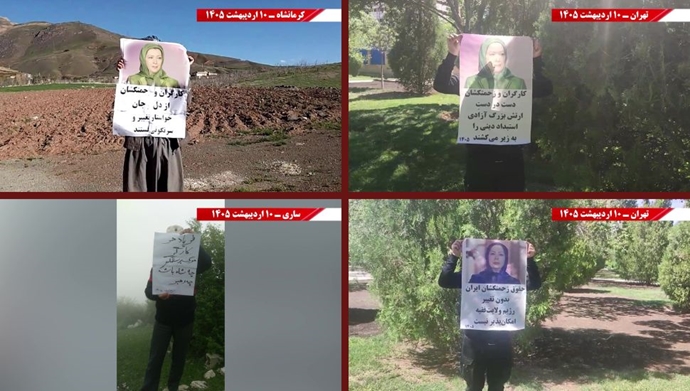

On May 1, 2026, as International Workers’ Day arrives, the Iranian working class finds itself enduring unprecedented economic devastation under the shadow of a fragile post-war ceasefire. Instead of succumbing to the clerical regime’s intensified repression, PMOI Resistance Units have launched a nationwide campaign to echo the true voice of Iranian workers. On April 30, these units marked the occasion by reiterating the Iranian Resistance’s long-standing tradition of fighting for the rights of all hard-working people in Iran.
Tehran
“Workers and toilers, hand in hand with the great Army of Freedom, will bring down religious tyranny.” pic.twitter.com/6kp5YAHBD2— People's Mojahedin Organization of Iran (PMOI/MEK) (@Mojahedineng) May 1, 2026
Across major cities, including Tehran, Karaj, Rasht, Sari, Kermanshah, Bandar Abbas, Khorramabad, Borujerd, Tabas, and Dorud, activists held placards with bold messages of resistance. A core theme of the campaign was the historical continuity of workers’ oppression and the rejection of all dictatorships. In Tehran, Rasht, and Borujerd, placards read, “Every worker’s cry is ‘down with the oppressor, be it the Shah or the Supreme Leader,’” and “Workers are awakened and reject both the Shah and the mullahs.”
Recognizing that the regime will never grant them their rights, Resistance Units in Karaj, Sari, and Khorramabad urged the working class to take matters into their own hands, displaying signs that read, “To defend workers’ rights and secure peace and freedom, you must take up arms.” They reiterated their solidarity with the toilers, with banners in Tehran declaring: “Workers and toilers, hand in hand with the great Liberation Army, will bring down religious tyranny.”
Tehran
“Salute to all the workers of our homeland on International Workers’ Day.” pic.twitter.com/RBaHjZop5k— People's Mojahedin Organization of Iran (PMOI/MEK) (@Mojahedineng) May 1, 2026
The dire reality fueling workers’ outrage
The Resistance Units’ call for the regime’s overthrow is rooted in the unbearable living conditions imposed on the Iranian people. General year-on-year inflation has reached 70 percent, food inflation has surpassed 60 percent, and the US dollar has skyrocketed to an unprecedented 1.8 million rials. Consequently, the average working-class family’s income has plummeted to roughly $200 per month.
The clerical regime is actively weaponizing the recent war and the resulting post-war security environment to further suppress labor rights. Employers are imposing forced unpaid leave, carrying out illegal firings, and converting monthly contracts to daily wages without facing legal consequences. Mass layoffs are widespread, extending beyond military industries; in just one instance in Rasht, approximately 2,000 workers were recently terminated.
Furthermore, while housing rents continue to surge, the regime deliberately delayed the official wage announcement for the Persian calendar year 1405 (2026-2027). Workers are still waiting for the 2026 wage directive while inflation is crushing them. Even the proposed base minimum wage of approximately 160 million rials barely covers the rent for a 45-square-meter apartment in Tehran.
Internet blackouts and the double oppression of women
Unlike past crises, the regime’s ongoing, widespread internet shutdowns have directly targeted the digital economy, destroying over a million online jobs and devastating home-based businesses. This internet blackout disproportionately harms women, completely cutting off their access to the job market.
Karaj
“To defend workers’ rights and secure peace and freedom, you must take up arms.” pic.twitter.com/KiNNyMQzUv— People's Mojahedin Organization of Iran (PMOI/MEK) (@Mojahedineng) May 1, 2026
Even before the war, women’s share of employment was no more than 20 percent. Today, out of only 147,000 people deemed eligible for meager unemployment benefits—which are largely insufficient to even cover rent—women make up just one-third. Half of all workers operate in areas completely outside the protection of labor laws. The situation is even worse for Afghan migrant workers, who lacked any protection even prior to the war.
Furthermore, state-enforced security measures during the war and post-war period have been used to ban union activities and ruthlessly crush all forms of labor protests.
Moving from economic misery to organized resistance
The clerical regime and its Ministry of Labor operate solely to protect the interests of large employers, leaving workers vulnerable to a total collapse in their standard of living. The psychological pressure on workers is the result of years of accumulated economic crises, privatization, temporary contracts, and plummeting purchasing power. This long-term economic instability is pushing the middle class below the poverty line and creating severe psychological distress.
The behavior of the private sector is directly tied to government policies. With many contracts lacking effective legal protection, employers have a free hand to execute mass layoffs, devastating entire regions where small manufacturing units are the primary source of employment.
However, as demonstrated by the PMOI Resistance Units, this unbearable economic and psychological pressure has not led to surrender, but rather to a hardened resolve. The Iranian working class knows well that, as the Resistance Units proclaimed in Tehran, “Iranian workers’ rights cannot be achieved without overthrowing the clerical regime.”