

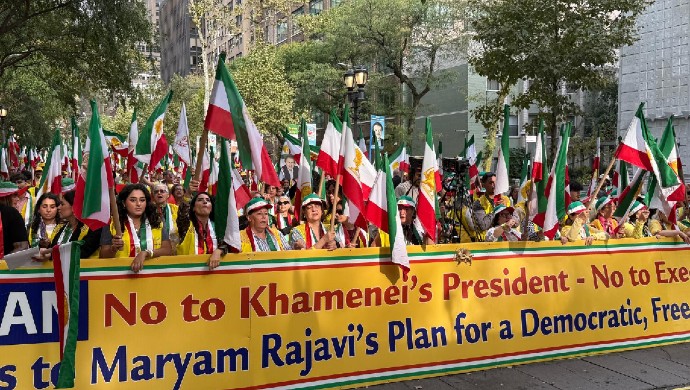

As the 80th session of the United Nations General Assembly convened, thousands of Iranian Americans and supporters of the Iranian Resistance gathered across the street from the UN headquarters for the second day on September 24, 2025. Their protest targeted the presence of Masoud Pezeshkian, the president of the clerical regime, denouncing him as an illegitimate representative of the Iranian people. The rally amplified the voices of a nation demanding freedom and democratic change, showcasing a clear alternative to the current theocracy while firmly rejecting any return to past dictatorships.
Speaker after speaker took to the stage to condemn the regime’s abysmal human rights record, particularly its escalating use of executions as a tool of suppression. They called on the international community to abandon policies of appeasement, enforce existing UN sanctions, and recognize the right of the Iranian people and their organized Resistance to establish a democratic republic.
Maryam Rajavi: The people of Iran are closer than ever to victory
In a keynote address to the gathering, Maryam Rajavi, the president-elect of the National Council of Resistance of Iran (NCRI), delivered a message of resilience and hope. She framed the annual protests as a direct show of support for the “courageous youth and those who spark uprisings inside Iran,” calling this perseverance the Iranian people’s “asset for victory.” Mrs. Rajavi asserted that the message from Tehran to New York is a simple and unified call for “overthrow and democratic change—a democratic republic, with freedom and democratic rights.”
Here’s our message:
-The seat of the Iranian people at the UN must not be given to a regime of executions.
-Refer the case of genocide and crimes against humanity in Iran to the UNSC.
-Khamenei and those responsible for these crimes must be prosecuted in an international court.… pic.twitter.com/s3JXJdjJno— Maryam Rajavi (@Maryam_Rajavi) September 24, 2025
She directly challenged the legitimacy of the regime’s presence at the UN, asking, “What is the representative of such an anti-human regime doing here?” Mrs. Rajavi highlighted the brutal reality of the regime’s rule, citing the execution of 1,817 people in just 14 months under the new administration and pointing to newly revealed figures showing the COVID-19 death toll was at least double the 530,000 previously reported by the Resistance. Her speech concluded with a powerful declaration of the Iranian people’s vision for the future: “We want neither a mullah nor a Shah. The era of all forms of dictatorship, whether religious or monarchical, is over.”
Regime president has no legitimacy at the United Nations
A central theme of the rally was the categorical rejection of Pezeshkian as a representative of the Iranian people. Speakers argued that his presence on the world stage was an affront to the victims of the regime’s brutality. Former U.S. Attorney General Michael Mukasey was blunt, stating that Pezeshkian “represents is the tyrannical regime of the Mullahs that for the moment controls the country.” He dismissed any notion of moderation, pointing out that being a physician is no guarantee of humanity, citing Bashar al-Assad and Ayman al-Zawahiri as other doctors who became mass murderers.
Second day of the #2025FreeIranNYRally, protesting the presence of Iranian regime president Masoud Pezeshkian at #UNGAhttps://t.co/0vXP6xRJFx
— People's Mojahedin Organization of Iran (PMOI/MEK) (@Mojahedineng) September 24, 2025
Hadi Shakibanejad, an Iranian American community activist, articulated the sentiment of the crowd, calling Pezeshkian’s presence “an insult to the victims of state violence, a betrayal of justice, and a stain on the ideals this very institution claims to uphold.” Echoing this, Emma Vali Beigi, a young Iranian American, declared, “He represents a brutal and oppressive regime. Iran does not belong to the mullahs. Iran belongs to its people.”
Condemning a surge in executions and crimes against humanity
The rally powerfully condemned the regime’s horrific human rights record, focusing on its reliance on executions to maintain control. Mani Mansourpour, whose uncle was executed in 1988, highlighted the alarming acceleration of this trend. “Since March, the regime’s brutality has surged,” he told the crowd. “The number of executions has now surpassed 800 over the past six months, an unprecedented figure in decades.” He also noted the recent executions of PMOI political prisoners Mehdi Hassani and Behrouz Ehsani “only because of their political affiliations.”
This brutality was framed not as a recent development but as a continuation of a long-standing policy of state-sponsored murder. Emma Vali Beigi reminded the audience of the 1988 massacre, the regime executed nearly 30,000 political prisoners. Former Congressman Ted Poe said that “not one Iranian official that I know of has ever been held accountable for the murder of the innocent in Iran. Not one.” Judge Mukasey urged attendees to prepare for future justice by “compiling a record—through testimony and documentation—of what they did: the massacres, the phony trials, the executions, so that the evidence is at hand.”
A viable alternative in the NCRI’s Ten-Point Plan
Beyond protest, the rally presented a clear and viable democratic alternative. Soona Samsami, U.S. Representative of the NCRI, highlighted this, stating, “This is not just a protest. This is also a message of hope because there is an alternative… Mrs. Maryam Rajavi, the president-elect of the National Council of Resistance of Iran. Her Ten-Point Plan shows the world that Iran can be a democratic, secular, free, non-nuclear republic where men and women are equal and human rights are respected.”
Thank you for your support. The message is clear: the people of Iran reject dictatorship in all forms. https://t.co/TZlpidJ3nx pic.twitter.com/TFjvP6mdun
— OIAC: Organization of Iranian American Communities (@OrgIAC) September 24, 2025
This vision garnered strong support from international dignitaries. Former Congressman Poe drew a historical parallel, calling the plan a “declaration of independence” for Iran. Former Ambassador Marc Ginsberg praised Mrs. Rajavi as “the true leader of a democratic opposition” and noted that her plan “has been embraced by so many leading Americans and statesmen around the world.” Judge Mukasey endorsed the plan’s core tenets, demanding that any new order must be based on “principles of democracy, equality of all men and women before the law, and a non-nuclear government—principles that are outlined by Mrs. Rajavi in her Ten-Point Plan.”
Resistance Units are the hope of a nation
Speakers emphasized that the drive for change is not an external effort but is powered by an organized network inside Iran. Maryam Rajavi directly addressed the regime’s Supreme Leader’s paranoia, noting his concern about “the ‘dormant cells’ of the Mojahedin (PMOI / MEK) and their roadmap for uprising.” She corrected his characterization with a defiant declaration: “There are no ‘dormant cells.’ The Resistance Units and rebellious youth are the most awake and vigilant fighters of Iran. They are the living, passionate embodiment of a nation’s hope for freedom.” Mani Mansourpour also paid tribute to the “brave men and women in the Resistance Units who have been inspired by 60 years of MEK’s commitment.”
A new generation carries the torch of fallen heroes
The rally powerfully demonstrated the intergenerational nature of the struggle for a free Iran. Young Iranian Americans, born long after the 1979 revolution, spoke of the deep personal connection they feel to the cause through their family histories. Maryam Hosseini, a pre-med student, shared that her father was a former political prisoner and his cousin, a member of the PMOI, was executed by the regime. “Hearing my father’s story and hearing what a strong woman his cousin was has shaped me into the woman I am today,” she said. “Instead of silence, those stories became my strength.”
Visible faces of the young and vibrant youth at the NY rally who stand for a free, non nuclear, secular, republic Iran. pic.twitter.com/POYMQpWp7g
— OIAC: Organization of Iranian American Communities (@OrgIAC) September 24, 2025
Emma Vali Beigi shared a similar story about her father’s cousin Karim, executed in 1988, stating that his loss “continues to echo in the heart of our family in every thought and in every act of resistance.” Mani Mansourpour held up a picture of his uncle, Morad, killed by the regime in 1988. He explained, “He fought for freedom. He gave his life, and he inspires my generation to carry his torch.” These young voices made it clear that the regime’s attempts to extinguish the spirit of resistance have failed; instead, they have fueled a new generation of determined advocates for freedom.
Rejecting all forms of dictatorship: ‘No to the Shah, no to the mullahs’
The speakers were unequivocal in their rejection of all forms of tyranny, past and present. They drew a clear distinction between the democratic future they envision and a return to the monarchical dictatorship that preceded the mullahs. Maryam Hosseini led the crowd in a powerful chant: “No to the Shah. No to the mullahs. Yes to a democratic republic for the people of Iran and by the people of Iran.”
This sentiment was reinforced by American officials. Judge Mukasey explicitly warned against “the suggestion of self-serving fools like the son of the shah” and insisted on making it “clear to the media that he has no standing whatsoever to claim leadership authority.” Congressman Poe reminded the audience that the resistance movement originally began to remove the Shah. “You went and gave your lives to get rid of a dictator because you wanted to be free,” he said. “And now some are talking about replacing that dictator with one of his family members. That is not a good idea.” Hadi Shakibanejad summarized the position of the demonstrators, declaring, “We are sick and tired of the Shah’s and the mullahs’ dictatorships. No to the Shah, no to the mullahs!”