

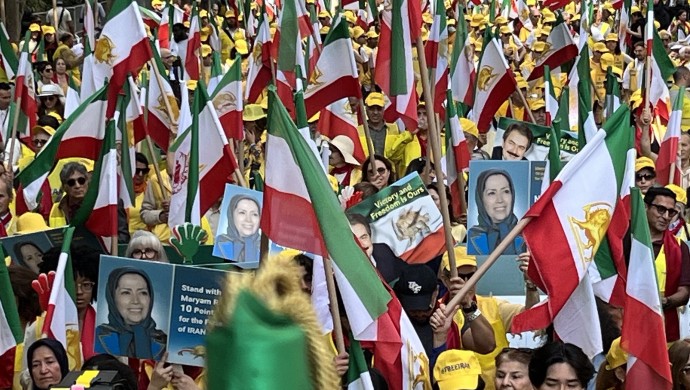

As the 80th session of the United Nations General Assembly convened in New York, thousands of Iranians gathered near the UN headquarters on September 23, 2025. The rally was a vocal protest against the presence of Masoud Pezeshkian, the president of the clerical regime, denouncing his participation as an affront to the values the UN purports to uphold. Speakers from diverse backgrounds, including international dignitaries, former officials, and Iranian activists from across the US, delivered a unified message: the regime in Tehran does not represent the Iranian people, and the international community must recognize the popular and organized resistance movement as the legitimate voice of Iran.
The event highlighted the severe human rights crisis in Iran, particularly the escalating wave of executions, and presented the National Council of Resistance of Iran (NCRI) and its Ten-Point Plan as the viable, democratic alternative to the current theocracy. The rally unequivocally rejected all forms of dictatorship, calling for a secular, democratic republic and opposing both the ruling mullahs and the deposed monarchy.
A message from the president-elect of the NCRI
In a message to the gathering, Maryam Rajavi, the president-elect of the National Council of Resistance of Iran (NCRI), saluted the attendees, describing their perseverance as an asset for the Iranian people’s ultimate victory. She framed the rally as a powerful declaration to the world that the Iranian people are closer than ever to achieving their demand for a democratic republic.
If the Iranian Resistance had not exposed the regime’s secret nuclear project, 23 years ago the mullahs would already have the bomb.
The Resistance has made 133 revelations in this regard; Isn’t this the greatest service to peace and security in the Middle East and the world? pic.twitter.com/FLw3fLQejV— Maryam Rajavi (@Maryam_Rajavi) September 23, 2025
Mrs. Rajavi challenged the legitimacy of the regime’s presence at the UN, questioning why the representative of a regime complicit in crimes against humanity and genocide should be given a platform. Citing over 1,800 executions in just 14 months under Pezeshkian’s presidency, she stated, “The seat of the Iranian people at the United Nations must not be given to a regime of executions and massacres.” She called on the UN to refer the regime’s record of human rights abuses, including the 1988 massacre, to the Security Council for prosecution in an international court.
She also underscored the NCRI’s long-standing position on the regime’s nuclear ambitions, reminding the audience that the resistance’s exposure of secret nuclear sites over two decades ago was the “greatest service to peace and security” and that the regime views nuclear weapons as a strategic guarantee for its survival. Concluding with a clear vision for the future, Mrs. Rajavi rejected all forms of autocratic rule, stating, “We want neither a mullah nor a Shah. The era of all forms of dictatorship, whether religious or monarchical, is over.”
A regime of execution has no place at the United Nations
A central theme of the rally was the categorical rejection of the Iranian regime’s presence at the UN. Speakers condemned the international community for providing a platform to a representative of a government they described as a systematic violator of human rights. Amir Emadi, an Iranian activist and the event’s MC, set the tone by declaring, “This is the truth that the UN inside that building must acknowledge… We are here to show the world that this is the real voice of the Iranian people.”
Former US Ambassador to Denmark, Carla Sands, was blunt in her assessment of Pezeshkian’s presidency. “Let’s be clear,” she stated, “Pezeshkian has no place at the United Nations. And he should not be welcomed in New York City.” She emphasized that the supreme leader and his accomplices must be held accountable “for four decades of crimes against humanity and genocide.” This sentiment was echoed by Linda Chavez, former director of the White House Office of Public Liaison, who directed a message to Pezeshkian himself: “Change is coming.”
Freedom-loving Iranians rally in New York to protest Iranian regime president's presence at #UNGA and condemn human rights violations in Iran.#2025FreeIranNYRally https://t.co/WNdoqeKuKZ
— People's Mojahedin Organization of Iran (PMOI/MEK) (@Mojahedineng) September 23, 2025
Saba Rezaii, a youth activist, articulated the profound sense of injustice felt by many Iranians, asserting that the regime officials are “a stain on Iranian history. Their invitation here today does not equate legitimization, nor does it somehow wash away the sins, the atrocities, the countless deaths that these officials took part in so easily. There is no place for them here, and there never will be.”
Condemnation of rampant human rights violations
The rally served as a powerful indictment of the regime’s abysmal human rights record, with a particular focus on the alarming rate of executions. Multiple speakers cited figures indicating a surge in capital punishment. Ambassador Sands noted that under Pezeshkian, “nearly 1800 executions have already taken place,” calling it “the highest number under any president since the 1988 mass executions.” She added that in August alone, the regime executed 170 people, branding the practice “systemic, state-sanctioned murder by a regime terrified of its own people.”
Amir Emadi highlighted the execution of two MEK members, Mehdi Hassani and Behrouz Ehsani, on July 27 and warned that state media was openly threatening a repeat of the 1988 massacre, in which 30,000 political prisoners were executed. The speakers noted that the UN’s own Special Rapporteur recognized it as “a genocide and a crime against humanity.”
Iranian community youth delegation in New York right now supporting @Maryam_Rajavi
10-point plan for Free Iran.
" Regime change in Iran by the people of Iran"#2025FreeIranNYRally #UNGA80@USABehFarsi @StateDept_NEA @USUN @RepMikeLawler pic.twitter.com/tLhWGbWVnE— OIAC: Organization of Iranian American Communities (@OrgIAC) September 23, 2025
Moslem Eskandar Filabi, member of the NCRI and an Iranian wrestling champion, summarized the situation by stating, “Every voice raised for freedom, every voice raised for justice, is met with imprisonment, torture, and the gallows.”
The NCRI and Ten-Point Plan as the democratic alternative
Amidst the strong condemnation of the regime, speakers consistently pointed to the NCRI as a credible and organized democratic alternative. Maryam Rajavi’s Ten-Point Plan was repeatedly endorsed as a clear roadmap for a future Iran. Gen. Tod Wolters, former NATO Supreme Allied Commander, praised the plan’s “simple, yet strategic and very, very clear” highlights, including “an independent legal system… a non-nuclear Iran and the equal participation of women in political leadership.”
Soolmaz Abooali, a karate world champion, asserted that the NCRI is “the only proven organized alternative to this regime, with real support inside Iran and among former and current world leaders.” Linda Chavez, recounting her 30-year history of supporting the movement, described the Ten-Point Plan as “a road map for a democratic, secular, non-nuclear Iran” that calls for separation of religion and state, universal suffrage, and gender equality.
Thousands of Iranian Americans, freedom fighters, and human rights supporters gathered to be the voice of the voiceless.
We call on the international community to stop the executions, and hold this regime accountable for its crimes against humanity! @UN_HRC @UN… pic.twitter.com/VnFWE1tDLM
— OIAC: Organization of Iranian American Communities (@OrgIAC) September 23, 2025
Youth activists also voiced their strong support for this vision. Hanif Ahadi stated, “That Iran, the one we dream of, is fully reflected in Maryam Rajavi’s Ten-Point Plan.” Setareh Vatan described it as “not only a promise but a practical framework for a democratic and just society.” The collective endorsement from such a wide range of voices underscored the movement’s belief that a coherent and democratic plan for Iran’s future already exists.
Rejecting all forms of dictatorship: “No Shah, no mullahs”
A powerful and recurring chant and message throughout the rally was the rejection of all forms of authoritarian rule, encapsulating the slogan, “No to the Shah, no to mullahs, yes to a democratic republic.” Speakers made it clear that the Iranian people’s struggle is not about returning to a bygone era of monarchy but about moving forward to a future of popular sovereignty.
Soolmaz Abooali stated unequivocally, “Monarchy has no place in Iran’s future. The people won’t accept another form of unelected rule after they once threw it into the dustbin of history.” Ambassador Sands dismissed the notion of a monarchist restoration as a “false alternative,” describing the plan of the former Shah’s son as one for “dictatorship, dressed in modern slogans.” She declared, “The Iranian people have already rejected both the Shah and the Mullahs. They will not go backward. They will not trade a turban for a crown.”
Iranain youth's chants today in New York and across Iran:
"Down with shah."
"Future belongs to the people"
Yes, a free Iran is paved with Iranain people and their organized resistance. #2025FreeIranNYRally#OurChoiceMaryamRajavi@USUN pic.twitter.com/8AQP3UulW4— OIAC: Organization of Iranian American Communities (@OrgIAC) September 23, 2025
This message was powerfully reinforced by the younger generation. Saba Rezaii, after decrying those who “sat on imaginary thrones and call themselves king,” ended her speech with the Farsi slogan, “Death to the oppressor, be it the shah or the supreme leader.” This clear disavowal of both past and present dictatorships framed the resistance movement as a force for a fundamentally new and democratic chapter in Iran’s history.
The role of Resistance Units and a new generation
The rally paid special tribute to the activists inside Iran, known as Resistance Units, who were described as the engine of change on the ground. Maryam Rajavi countered the regime’s narrative of “dormant cells” by describing these activists as “the most awake and vigilant fighters of Iran… the living, passionate embodiment of a nation’s hope for freedom.”
Parsa Aria, a youth activist born in the US, spoke of his connection to Iran through “the courage of the brave young men and women in the Resistance Units. Heroes of my generation.” He emphasized their critical role in organizing protests and giving hope to millions, adding, “Their defiance inspires us, just as much as it inspires all those in Iran.”
Thousands, supporters of @Maryam_Rajavi at a rally in front of UN in New York. #2025FreeIranNYRally #OurChoiceMaryamRajavi pic.twitter.com/7Vv3z0wpGT
— OIAC: Organization of Iranian American Communities (@OrgIAC) September 23, 2025
The presence of numerous young speakers, many of whom are second-generation Iranian-Americans, served as a testament to the movement’s continuity. Hanif Ahadi, the grandson of a martyr from the 1988 massacre, spoke of his “clear-eyed, deliberate, and moral choice to stand with the only force that the regime in Tehran truly fears.” Michelle Shariati, daughter of a former political prisoner, said, “I’m a proud Iranian-American woman, inspired, informed, and unafraid.” Their speeches painted a picture of a vibrant, multi-generational movement united in its goal.
An international call to action
The international speakers at the rally framed the struggle for a free Iran as a global imperative. Former Kansas Governor and Ambassador Sam Brownback highlighted the regime’s fundamental weakness, noting it is “more scared of its own people than of Israel.” He called for the world to support the “women-led revolution” and “youth-led movement” for a free Iran.
Oleks Taran, a Ukrainian activist, drew a powerful parallel between the struggles of his people and those in Iran. “The same hands in Tehran that hang young Iranians at home are the ones that build drones to bomb Ukrainian cities,” he said. He argued that “support for Ukraine weakens Tehran’s regime, and support for Iranians demanding freedom weakens Moscow,” describing it as “one fight, the global fight for a world where no nation lives under the shadow of tyranny.”
Ultimately, the rally’s message was a direct appeal to the international community to shift its policy from appeasement to accountability. As Ambassador Sands concluded, “The solution is not appeasement. The solution is not war. The solution is the Iranian people and their organized resistance.” The thousands gathered in New York made it clear that this resistance has a voice, a plan, and an unwavering determination to bring about a free, democratic, and secular Iran.