

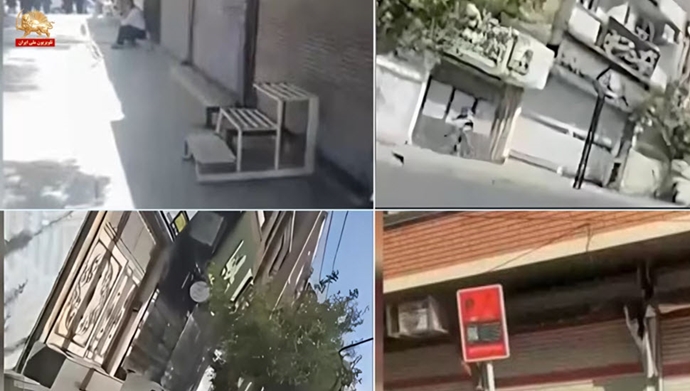

On Tuesday, September 16, 2025, the third anniversary of the state-sponsored murder of Mahsa (Zhina) Amini, the Iranian regime attempted to impose a blanket of silence over the nation. Deploying its full repressive apparatus, the clerical dictatorship sought to erase the memory of the 2022 nationwide uprising—a movement sparked by Mahsa’s death that saw protests in over 282 cities and the killing of at least 750 demonstrators by security forces.
But the regime’s wall of fear was met with a nationwide wave of courageous defiance. From the silent, shuttered markets of Kurdistan to the defiant chants echoing from Tehran’s rooftops, the Iranian people proved that the flame of revolution is not a memory but a living, breathing force. The anniversary was not a day of mourning but a powerful demonstration of a nation unbowed and a regime terrified of its own people.
A regime’s iron fist reveals a fragile grip
The regime’s strategy centered on a massive show of force in Mahsa Amini’s hometown of Saqqez, the epicenter of the 2022 uprising. The city was transformed into a military garrison. The path to the Aychi cemetery, where Mahsa is buried, was completely sealed off by a large deployment of the Islamic Revolutionary Guard Corps (IRGC), making it impossible for citizens to pay their respects.
Military helicopters patrolled the skies, and repressive forces swarmed the streets in a desperate attempt to intimidate the populace into submission. This overwhelming militarization was not a sign of strength, but a clear admission of the regime’s profound fear—fear of a name, a grave, and the enduring power of a people’s quest for freedom.
The power of emptiness: general strikes as mass protest
September 16—Saqqez, northwest Iran
On the third anniversary of the state-sponsored killing of Jina (Mahsa) Amini, the entire bazaar and shops of Saqqez, her hometown, were completely shut down. In a united general strike, merchants honored her memory and expressed their protest… pic.twitter.com/bTCEyqxRBD— People's Mojahedin Organization of Iran (PMOI/MEK) (@Mojahedineng) September 16, 2025
Where the regime used force to fill the streets, the people of Kurdistan responded with the powerful emptiness of a general strike. On the morning of September 16, the cities of Saqqez and Divandareh were gripped by the widespread strike of shopkeepers and bazaar merchants, paralyzing the local economies. This was not merely an economic protest; it was a political statement that resonated across the nation. Reports from local sources indicated that security forces attempted to threaten and pressure business owners into reopening, but they were met with courageous resistance. The empty streets and shuttered shops sent a louder message than any slogan: the people stand united against tyranny.
The unsilenced cities roar in defiance
As darkness fell, the spirit of the uprising erupted across Iran’s major cities, demonstrating the movement’s adaptability and resilience. In the capital, Tehran, rooftops and windows in neighborhoods from Amirabad to Tehranpars and Jordan became platforms of dissent. The night air was filled with chants of “Death to the dictator” and “Death to Khamenei, curse on Khomeini,” a direct challenge to the regime’s supreme leader.
September 16—Tehran, Iran
People hold protest rallies on the third anniversary of the 2022 nationwide uprising and chant anti-regime slogans such as "Down with the dictator"#IranProtests pic.twitter.com/Dih5VLprXJ— People's Mojahedin Organization of Iran (PMOI/MEK) (@Mojahedineng) September 16, 2025
The Sadeghieh district of Tehran emerged as a major flashpoint. Spontaneous gatherings of defiant citizens chanted “Death to the dictator.” In a creative act of protest, drivers created a protest traffic jam, clogging the streets to disrupt the regime’s control. As plainclothes agents and security forces confronted the people, protesters courageously stood their ground, shouting “Bisharaf, bisharaf” (Dishonorable) at their oppressors.
Perhaps the most poignant symbol of the day’s resistance came from Gohardasht, Karaj. There, a lone woman climbed atop a public waste container and, in a voice filled with rage and sorrow, cried out for all to hear: “You have turned Iran into a prison.” Her act encapsulated the suffering and defiance of millions, particularly the women of Iran who have been at the forefront of this struggle.
September 16—Karaj, northern Iran
The people of Gohardasht mark the third anniversary of the 2022 uprising with anti-regime slogans:
"Down with the dictator"#IranProtests pic.twitter.com/VCk6sFqqIH— People's Mojahedin Organization of Iran (PMOI/MEK) (@Mojahedineng) September 16, 2025
Three years after Mahsa Amini’s murder, the regime’s brute force has failed to extinguish the Iranian people’s demand for freedom. The events of September 16, 2025, show a movement that has not faded but evolved—becoming more creative, organized, and deeply embedded in society. The regime’s fear is palpable, visible in every soldier-lined street and every locked cemetery gate. The spirit of Mahsa and the hundreds of martyrs of the 2022 uprising lives on in every strike, every chant, and every act of courage. The struggle for a free and democratic Iran continues, and the people have once again proven that their will is unbreakable.