

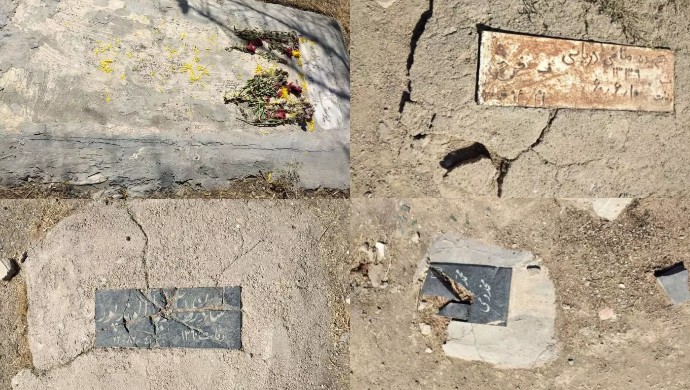

In a brazen act of criminal cover-up, the Iranian regime has dispatched heavy machinery to Tehran’s Behesht-e Zahra cemetery to erase a painful chapter of its bloody history. Since August 11, 2025, bulldozers have been working to completely level Section 41, the final resting place of thousands of members of the People’s Mojahedin Organization of Iran (PMOI/MEK) who were systematically executed in 1981. This is not urban development; it is the frantic work of a criminal regime terrified of its past and desperate to destroy the evidence of its crimes against humanity before its inevitable day of reckoning.
The regime has made no secret of its intentions. In a shameless admission on August 19, Tehran’s Deputy Mayor, Davoud Goodarzi, stated, “Section 41 was just left there, and we needed a parking lot, so we got permission from the officials and turned it into a parking lot.” This confession not only confirms the deliberate nature of the destruction but implicates the highest levels of the state. In the clerical regime’s lexicon, the term “officials” is a clear reference to Supreme Leader Ali Khamenei or those closest to him, proving this crime was ordered from the top.
A panicked response to the tightening noose of international law
The timing of this demolition is no coincidence. It is a direct and panicked response to mounting international legal pressure. In a landmark report in July 2024, Professor Javaid Rehman, then the UN Special Rapporteur on human rights in Iran, officially categorized the mass executions of the 1980s as constituting “crimes against humanity as well as genocide.”
Crucially, the report urged United Nations member states to invoke universal jurisdiction to investigate and prosecute the individuals responsible for these atrocities, noting that many of those who ordered and carried out the massacres remain in power today. With the noose of international law tightening, the regime is desperately trying to destroy the crime scene. As the Iranian Resistance has repeatedly stressed, the obliteration of evidence of genocide is, under international law, a continuation of and participation in that very crime.
A four-decade war on memory
The current operation in Behesht-e Zahra is merely the final, desperate phase of a systematic, nationwide campaign to erase the physical evidence of the regime’s massacres. This war on memory has been waged for decades across Iran.
Even at Behesht-e Zahra, this is not the first such desecration. Between June 2005 and July 2007, the regime leveled an area large enough for 1,700 to 1,800 graves in the same section and converted it into a parking lot. This historical precedent shatters the Deputy Mayor’s recent excuse.
The pattern of destruction is undeniable:
- In Tabriz, in June 2017, the regime vandalized the graves of PMOI martyrs in the Rahmat Valley Cemetery by covering them with 10 centimeters of cement. To conceal the crime, they installed a sign that read, “Leveling the children’s block.”
- In Ahvaz, authorities have repeatedly destroyed graves of 1988 massacre victims under the pretext of urban development. In 2017, signs of a mass grave were uncovered during road construction and quickly covered up. In late July 2018, the regime demolished and cemented over the graves of martyrs to build a boulevard.
- In Khavaran, in April 2021, the regime attempted to destroy the mass graves of 1988 massacre victims by forcing the Baha’i community to bury their dead on top of the martyrs’ resting places, a cruel tactic designed to eliminate evidence of one crime by committing another.
A desperate regime digging its own grave
The mullahs believe that by destroying stone, they can destroy a legacy. They are profoundly mistaken. This act of desecration is a confession broadcast to the world, revealing a regime so weak and brittle that it is terrified of the memory of its victims. It fears that these graves are not just markers of past crimes, but signposts to future justice.
The international community must not stand by while the evidence of a genocide is bulldozed into oblivion. The Iranian Resistance calls upon the United Nations, the High Commissioner for Human Rights, and all relevant international bodies to condemn this inhumane act and take urgent action to halt the destruction. The perpetrators and orchestrators of these crimes, from the massacres of the 1980s to the cover-ups of today, must be held accountable for their decades of crimes against humanity.