

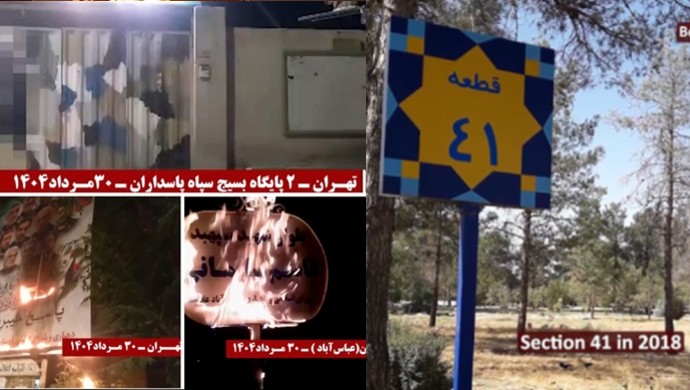

On Thursday, August 21, 2025, Iran’s heroic rebellious youth struck at the centers of oppression and crime belonging to the IRGC and the anti-people Basij militia. This action was in response to the destruction and leveling of the graves of thousands of martyrs of the People’s Mojahedin Organization of Iran (PMOI/MEK) in Section 41 of Tehran’s Behesht-e Zahra cemetery, an act ordered by Supreme Leader Ali Khamenei. In this series of defiant operations, the following bases and symbols of repression and crime were targeted:
- Setting fire to two IRGC Basij bases in Tehran
- Setting fire to two IRGC Basij units in Mashhad
- Setting fire to a center of fundamentalism and crime in Mashhad
- Setting fire to an IRGC Basij base in Urmia
- Setting fire to two IRGC Basij bases in Kerman
- Setting fire to a Basij resistance base in Sib Suran (Sistan and Baluchestan province)
- Setting fire to the sign of IRGC Square in Kazerun
- Setting fire to signboards for the IRGC’s espionage headquarters in Borkhar (Isfahan province) and in the city of Sarbaz (Sistan and Baluchestan province)
- Setting fire to government banners bearing the images of regime founder Ruhollah Khomeini, supreme leader Ali Khamenei, terror master Qassem Soleimani, and commanders of the IRGC in Tehran, Mashhad, Kerman, Shahrekord, Delijan, Saravan, and Mehrestan.
On August 11, 2025, the National Council of Resistance of Iran (NCRI) reported the destruction of Section 41 in Behesht-e Zahra cemetery, the burial site of thousands of PMOI/MEK martyrs who were executed in 1981 by the henchmen of regime founder Ruhollah Khomeini. The NCRI emphasized that destroying the evidence of genocide and crimes against humanity is tantamount to participating in these barbaric crimes.
Then, on Tuesday, August 19, regime media outlets published remarks by Davood Goudarzi, the deputy to Alireza Zakani, Tehran’s mayor. In a shameless justification and admission, Goudarzi said: “Section 41, where the Monafeghin [a derogatory term used by the regime for the PMOI/MEK] were buried in the early days of the revolution, had just been left as it was, and we needed a parking lot. We obtained a permit from the authorities and turned it into a parking lot.”
Following the Iranian Resistance’s global exposure of the regime’s history of executions and massacres, and after the July 2024 report by Javaid Rehman, the then-UN Special Rapporteur on human rights in Iran, which described the executions of 1981 and 1988 as clear instances of crimes against humanity and genocide, the regime’s supreme leader, fearing retribution for these crimes, ordered the destruction of the martyrs’ graves.
Previously, in 2017—following a call by the NCRI’s President-elect and a series of justice-seeking campaigns—Khamenei’s agents attempted to erase the evidence of their crimes and genocide by destroying mass graves and the burial sites of martyrs from 1981 in Tabriz, Mashhad, Ahvaz, and other Iranian cities.
A section of the NCRI Secretariat’s statement from June 27, 2017, reads: “Last month in Mashhad, northeast Iran, mass graves of PMOI/MEK martyrs in the Beheshte Reza cemetery were also vandalized. In the city of Ahvaz, southwest Iran, city authorities have been widening a road near a cemetery in order to vandalize martyrs’ graves. Signs of tumbled bodies in a mass grave previously covered with cement were seen as the digging began in the area of phase 2 of Padadshahr and the Bankdar Boulevard in this city. Authorities quickly covered the mass grave with dirt and continued to widen the road.”
In response to the ongoing crime against humanity manifested by the destruction of the graves of PMOI/MEK martyrs, the rebellious youth set fire to the images of Khomeini and Khamenei and attacked the centers of suppression and crime of the executioner regime. By doing so, they lit the guiding beacon of a “fiery response” to the executioners, illuminating the path for rebels to achieve freedom.