

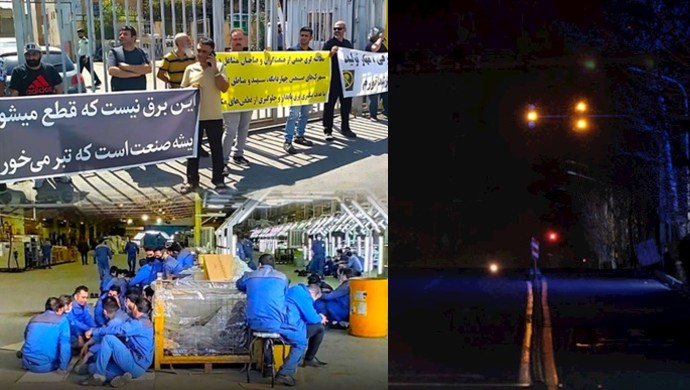

On August 6, 2025, residents of Rasht rallied in Sabzeh-Meydan against water shortages and blackouts, facing a violent crackdown. The same day, locals in Benlar and Zivdar blocked the Khorramabad–Poldokhtar road over cuts to water and electricity. Nightly chants of “death to the dictator” and “death to Khamenei” have echoed from the darkness in Karaj, while even regime media carried citizens’ complaints of four to six hours without power in summer heat.
August 6—Rasht, northern Iran
Residents rally at Sabzeh Meydan to protest constant and prolonged electricity and water outages and the regime's lack of mitigation measures.#IranProtestspic.twitter.com/ukMKpylRWc— People's Mojahedin Organization of Iran (PMOI/MEK) (@Mojahedineng) August 7, 2025
A nationwide shutdown reveals systemic failure
By August 6, authorities shuttered the country except for three provinces—an extraordinary move that domestic outlets tied to environmental and infrastructure crises. On August 5, Reuters reported that extreme heat and the water–power emergency forced closures of government offices and banks in Tehran and other provinces, as the meteorological agency placed nine provinces on orange alert and forecast highs above 50°C for several days. Provincial directives extended closures across more than 20 provinces, including Tehran, with additional midweek shutdowns and telework in others.
Blackouts deepen despite promises
Despite earlier assurances to limit cuts, outages expanded. On August 6, regime-aligned media reported daily electricity cuts of four hours, warning citizens to “be ready,” while others openly asked how long blackouts will persist. The government spokesman admitted on July 29 that “we are in a water and electricity crisis” and later told Hamshahri that the “slope of blackouts will decrease” in coming years—no promise to end them. On August 5, an official of Tavanir (the Power Generation, Distribution, and Transmission Company) official even pledged to make next year’s blackouts “fair,” implying broader, not fewer, cuts.
Crypto mining siphons power from households
State-linked outlets and experts point to a hidden network of industrial crypto mining as a central drain on the grid. On May 17, 2025, Mashregh News cited Tavanir’s estimate of roughly 3,000 MW of unauthorized consumption by unidentified miners—equivalent to three Bushehr nuclear units. On August 5, the state-run Farhikhtegan reported 263,000 miners discovered since 2019, equal to the consumption of 2.6 million homes, underscoring organized operations. The Court of Audit’s prosecutor previously noted that in 2022–23 a single Tehran farm guzzled power comparable to 13 provinces; an economist warned on July 30 that “mafia” interests are swallowing energy resources. The reporting links these profits to IRGC-controlled networks.
Economic pain and a warning of unrest
The blackout crisis is throttling an already weak economy. On August 2, the regime-run Bazaar outlet reported that repeated outages are reducing factory efficiency, raising production costs, and driving up final prices. Social pressure is acute: a lawmaker told Dideban-e Iran that livelihoods are “very worrying,” with some families lacking even daily bread as inflation erodes purchasing power. Even the IRGC’s Tasnim warned on August 2 that recurring power cuts are causing severe public dissatisfaction that could broaden—an implicit admission of the regime’s political vulnerability.