

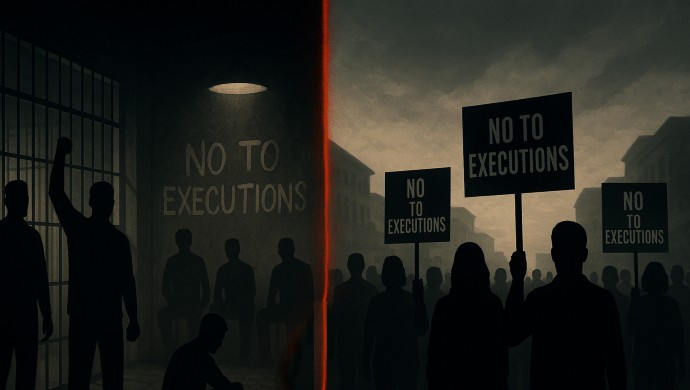

As the Iranian regime escalates its use of capital punishment to suppress dissent, a coordinated, two-front resistance movement is gaining strength both inside and outside prison walls. On Tuesday, July 1, 2024, the “No to Executions Tuesdays” campaign marked its 75th consecutive week of protest, highlighting a horrifying surge in state-sanctioned killings.
According to the campaign’s latest statement, the regime’s execution machine has reached a pace unseen in recent years. In the last week of June alone, at least 18 prisoners were executed. From June 22 to 25, 2025, 17 inmates, including one woman, were sent to the gallows. This brings the total number of executions to at least 424 since the beginning of the Persian year in March 2025, a figure that lays bare the regime’s reliance on terror to maintain its grip on a restive population.
Week 75 of #NoToExecutionTuesdays:
47 prisons in Iran join hunger strike as executions surge—424 since mid-March, 18 just last week.
Campaign warns: "The regime sacrifices the right to life to survive." pic.twitter.com/GCjdVl1U5P— SIMAY AZADI TV (@en_simayazadi) July 1, 2025
A policy of terror to silence a volatile society
The campaign statement directly links the surge in executions to the regime’s fear of popular uprisings. It points to a recent bill passed by the regime’s rubber-stamp parliament designed to intensify suppression and executions, particularly against political opponents. This legislative move, combined with the spike in hangings, reveals a government that sees violence as its only tool for survival. “The oppressive and illegitimate regime, in order to preserve its survival, is sacrificing the citizens’ ‘right to life,’” the statement declared.
This policy was brutally demonstrated with the recent execution of three Kurdish porters (kolbars), Azad Shojaei, Idris Ali, and Rasool Ahmed Mohammad, who were hanged on fabricated espionage charges following an opaque and unjust trial. Their deaths are a stark reminder of how the regime uses the judiciary to eliminate perceived threats and intimidate ethnic minorities.
Resistance from within: 47 prisons join hunger strike
In a remarkable display of organized defiance, political prisoners across the country are leading the resistance from within. The “No to Executions Tuesdays” campaign now encompasses hunger strikes in 47 different prisons, from Ghezel Hesar and Karaj Central Prison to facilities in Zahedan, Ahvaz, and Tabriz. The movement’s resilience is evident in its adaptability; following the closure of parts of Evin Prison, prisoners were transferred to Greater Tehran and Qarchak prisons, and the campaign immediately added Qarchak to its list of protesting facilities, ensuring the chain of resistance remains unbroken.
Families and citizens take to the streets
The protest is not confined to prison walls. On July 1, the 75th week of the campaign saw families of prisoners and supportive citizens take to the streets in cities like Tehran, Rasht, Tabriz, Babol, and Shahriar. Protesters carried banners with powerful slogans that directly challenged the regime’s authority, such as, “This is the final message: execution will be met with uprising,” and “Fire is the answer to execution.”
In a moving act of public defiance, the family of political prisoner Vahid Baniamerian, a political prisoner on death row, released a video, holding signs that read “No to Execution” and “Release Political Prisoners.” They condemned the catastrophic health and safety conditions in prisons and made a direct plea: “No to execution. Do not execute. Release political prisoners… Support the No to Executions Tuesdays.”
By escalating executions, the Iranian regime intended to project strength and terrorize the public into submission. Instead, it has fueled a disciplined, dual-front resistance that grows more defiant each week. The campaign’s statement ends with an urgent plea, calling on the world to amplify the voices of those on death row. “The ‘No to Executions Tuesdays’ campaign calls on the international community, human rights institutions, and awakened consciences to be the voice of the prisoners on death row.”