

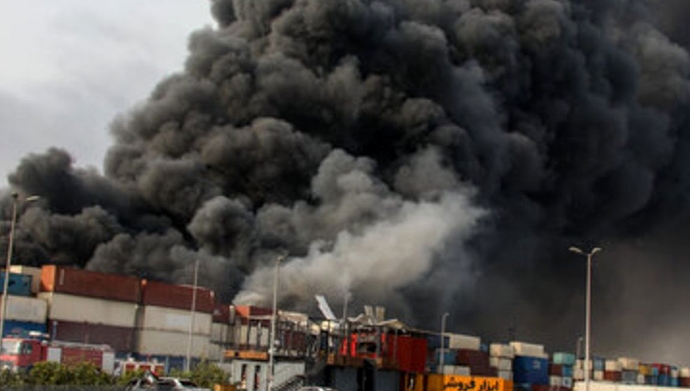

The deadly explosion in Bandar Abbas on April 26, 2025, which resulted in numerous deaths and injuries among Iranians, once again exposed the depth of the structural disaster in Iran under the rule of the criminal mullahs’ regime. The regime attempted to downplay the explosion as a mere “safety defect,” but multiple reports from eyewitnesses, port workers, expert investigations, and media accounts suggest otherwise. From the first day, the Iranian Resistance pointed to the haphazard accumulation and storage of explosive materials by the Islamic Revolutionary Guard Corps (IRGC). News media, including the Associated Press, also reported that the smuggling of large quantities of IRGC missile fuel and their hasty stockpiling were the primary causes.
It is abundantly clear that this tragedy was not a simple accident or error, but a direct consequence of the dominance of the IRGC and institutions controlled by regime supreme leader Ali Khamenei. By seizing control of the country’s economy and trade, they have driven the nation’s infrastructure and all preventive safety measures and regulations to ruin, thereby causing such deadly catastrophes.
The timeline of incidents below highlights a fraction of this institutionalized criminality, which is the sinister legacy of the mullahs’ rule in Iran:
- April 2025: Massive explosion in Bandar Abbas with hundreds killed and injured, and vast destruction.
- September 2024: Major explosion at the Tabas mine, killing 52 hardworking miners and injuring 20.
- November 2023: Fire at the Langarud addiction treatment center, resulting in 30 deaths and 17 injuries.
- June 2022: Collapse of the 10-story Metropol building in Abadan, burying 43 Iranians under the rubble and injuring many others.
- May 2017: Huge explosion at the Yurt mine in Golestan province, claiming the lives of 44 deprived miners.
- January 2018: The Sanchi oil tanker fire, resulting in 32 deaths. Only the bodies of three crew members were recovered.
- November 2017: Fire at the Tehran oil refinery, killing eight workers due to severe burns.
- January 2017: Complete burnout of the Plasco building in Tehran, with 22 fatalities, including 16 firefighters, and 235 injuries.
- December 2016: Train collision on the Semnan-Damghan route, killing 47 and injuring 103.
- December 2012: Fire in a girls’ classroom in the village of Shinabad. Two innocent girls died, and 29 others suffered severe burns. Twelve students suffered amputations and other irreversible complications.
- November 2012: Derailment of the Zahedan-Tehran train, resulting in 4 deaths and 26 injuries.
- July 2009: Crash of the Tehran-Yerevan flight, killing all 168 people on board, and in 2011, the crash of an airplane near Urmia, killing 78 (just examples from a series of plane crashes in Iran).
- July 1999: Collapse of a seven-story building in Saadat Abad, Tehran, killing 17 hardworking laborers.
- February 2005: Fire at the Arg Mosque in Tehran, resulting in 78 deaths and 350 injuries.
- And a chain of other deadly incidents…
These tragedies are the outcome of an anti-people regime that has maintained its illegitimate rule over Iran through war, crime, executions, and the massacre of dissidents, especially PMOI members and supporters. It has squandered national resources on warmongering policies, exporting terrorism, regional interference, and nuclear and missile programs aimed at preserving the regime. As long as this regime remains in power, this cycle of death and destruction will continue. However, the people of Iran, with growing awareness, are standing up against these destroyers. Relying on the strategy of uprising and overthrow, guided by the slogan “No Shah, No Mullahs,” they are determined to end the cycle of dictatorship and criminality in Iran and build a free and prosperous future for Iran.