

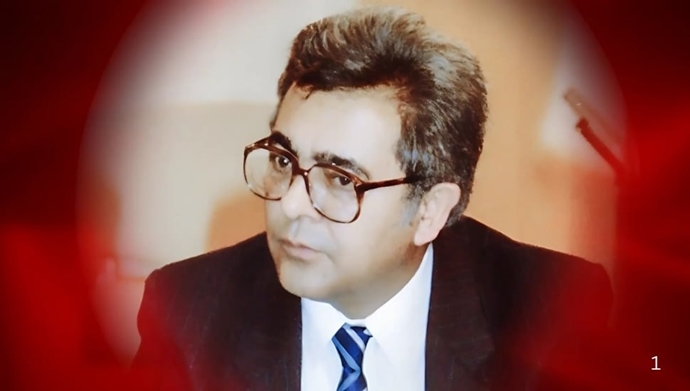

Great loves lead to great choices, and these choices can only be fulfilled through great sacrifices.
This is the story of Kazem Rajavi. A dignified, cultured, passionate, noble, deeply emotional, and influential figure who, out of love for the cause of freedom in Iran, paid the ultimate price and was assassinated by the agents of the mullahs’ regime in 1990.
The Great Martyr of Human Rights
Dr. Kazem Rajavi, given his reputation, academic standing, and recognition, could have attained the highest positions in Iran after the 1979 revolution. However, he relinquished all of them to wear the ultimate title, the “Great Martyr of Human Rights,” like a rare medal on his bullet-riddled chest, securing a place of honor and integrity in the historical memory of the Iranian people.
Being Iran’s ambassador to the United Nations in Geneva, and later ambassador and head of Iran’s political mission in Senegal and seven West African countries, he naturally could have secured top positions within the Iranian regime. It is written that before departing for his diplomatic mission at the UN, Ruhollah Khomeini, the founder of the mullahs’ regime, summoned him to Qom and told him: “Tell your brother Massoud to declare his position.” Khomeini aimed to create a division between Kazem and Massoud by granting Kazem the ambassadorship. By implicitly conditioning the continuation of this post and higher positions on confronting Massoud, Khomeini intended to turn Dr. Kazem into a pressure tool against Massoud Rajavi and the PMOI. However, Dr. Kazem resolutely rejected this. His own words testify to this honorable and principled stand:
“There are moments in every person’s life where compromising means accepting dishonor. Besides, when I was an ambassador at the UN or elsewhere, I was never like other ambassadors. I was a combative ambassador; I often protested, showing my objection against instances of repression and so on. That is why I joined the opposition a few weeks ago.”
A Burning Love for the Resistance
Dr. Kazem had a deep love and respect for Massoud Rajavi, and not just because he was his brother. As he had said:
“I am proud of this brother, not from the aspect of kinship, meaning blood relation, but because of Massoud’s social actions, personality, resistance, and stances.”
It was because of this burning love that he endured taunts and overcame many difficulties to make the “impossible” possible: saving Massoud’s life from the threat of execution in the Shah’s prison in 1971.
Undoubtedly, if Kazem Rajavi had only performed this single service for the people and the resistance, his name would deserve to shine.
Dr. Kazem from Mashhad to Geneva
Kazem Rajavi was born on February 18, 1934, in Mashhad, a city with a rich cultural heritage. His primary and secondary education in this city, combined with teaching experience in schools, provided a foundation for shaping his views on social justice. Influenced by the National Movement of Iran led by Dr. Mohammad Mosaddegh (the Prime Minister who nationalized Iran’s oil industry), he was drawn towards political activity, a motivation reinforced during his law studies at Tehran University. Writing the book “An Introduction to the Political Psychology of Iran” during this period testifies to the depth of his analysis of Iran’s socio-political dynamics.
Continuing his studies at universities in France and Switzerland, Kazem Rajavi became one of the few Iranian intellectuals who could link academic knowledge with political activism. Obtaining multiple doctoral degrees in law, political science, and international relations, and completing his doctoral thesis at the Graduate Institute of International Studies in Geneva, established him as a global thinker. This academic background strengthened his ability to use the language of diplomacy and legal discourse to advance human rights goals. Authoring over 120 books and dissertations in Persian and French, and teaching at the University of Geneva, made him one of the most influential Iranian intellectuals.
We honor the memory of Prof. Kazem Rajavi, the great martyr of human rights, who was assassinated in Geneva in 1990 by terrorists dispatched by the clerical regime. He once said, “We write the history of human rights with our own blood,” and he fought for human rights until his… pic.twitter.com/65I1TF4A9t
— Maryam Rajavi (@Maryam_Rajavi) April 24, 2025
Bridging Ethics and Action
After the 1979 Revolution, Kazem Rajavi was appointed as Iran’s first ambassador to the United Nations office in Geneva under the new regime. However, due to incompatibility with the repressive policies of the new clerical regime, he resigned from this position and joined the National Council of Resistance of Iran (NCRI. This decision was a turning point in his life: prioritizing ethical principles over political positions, a decision where many politicians fail their first test.
From then on, as the representative of the National Council of Resistance in Switzerland, Dr. Kazem played a pivotal role in exposing systematic human rights violations in Iran by the regime.
One of his most prominent achievements was his role in the adoption of United Nations resolutions against the mullahs’ regime. In 1983, he traveled to New York and laid the groundwork for the appointment of a Special Representative to examine the human rights situation in Iran. These efforts led to the adoption of the first UN resolution condemning human rights violations by the Iranian regime in 1985. This success put the regime under global pressure.
A Martyrdom with Global Resonance
The regime, unable to tolerate the exposing activities of this great human rights defender, resorted to its only and final weapon: assassination and killing.
On April 24, 1990, Dr. Kazem was targeted near his home in Coppet, Switzerland, by the gunfire of terrorists dispatched to Geneva by the Iranian regime.
His death did not silence his voice and mission; it amplified it a thousandfold, for it established the tradition of seeking justice for the blood of martyrs. He was fully aware of the dangers and importance of the struggle he had chosen; he had previously said: “We write human rights with our blood.”
The condemnation of this assassination by 162 members of the US Congress, a statement by the European Parliament, and the installation of a memorial plaque by a Swiss mayor demonstrated Dr. Kazem’s global standing. In 2020, the proposal by the prosecutor of the Canton of Vaud to investigate his assassination case as a crime against humanity underscored the importance of this issue in international legal discourse.
An Unsilenceable Mission
Although Kazem Rajavi rests in a corner of the soil of Karbala, he is present in every call for justice. His beloved face is now more radiant than ever. What he cultivated is now bearing fruit. The recognition of the Summer 1988 massacre of political prisoners as “genocide” and a “crime against humanity” is one such fruition. This fruition continues and must continue. The magnitude of Dr. Kazem’s blood and the lineage of martyrs following this path keep the seekers restless and fervent until the dawn of freedom.