

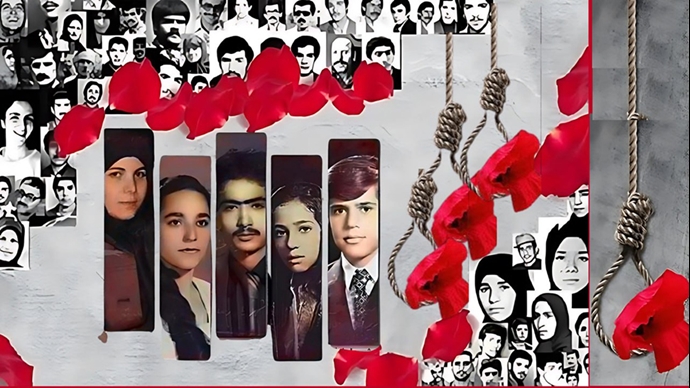

The 1988 massacre of political prisoners represents one of the most criminal chapters of the mullahs’ rule in Iran. This crime is so extensive that new dimensions continue to be revealed even after many years. The release of audio tapes in recent years, documenting meetings between Ayatollah Montazeri, the designated successor to regime founder Ruhollah Khomeini at the time, and members of the “Death Committee,” has uncovered shocking truths about this horrific crime. These tapes testify to a crime against humanity and an organized genocide against members of the People’s Mojahedin Organization of Iran (PMOI/MEK) and other political groups.
Historical Context of the 1988 Massacre
In the summer of 1988, under the direct order of Khomeini, thousands of political prisoners from the PMOI and other dissident groups were hanged. This horrific genocide is known in political literature as the “1988 massacre.” In an explicit fatwa, Khomeini ordered that PMOI members who remained steadfast on their positions be executed as “Mohareb” (those waging war against God/the state). Death Committees, composed of Sharia judges, representatives from the Ministry of Intelligence, and prosecutors, were formed in prisons to implement this fatwa.
The Montazeri audio tapes, initially released in 2016 and with more emerging in the Spring of 2025, document his meetings with members of the Death Committee on August 15, 1988, and a second meeting later that year. These documents reveal horrifying details about the planning and execution of this crime, demonstrating that the executions were not merely a reaction to the PMOI’s Operation Forough Javidan (Eternal Light), but part of a pre-planned, organized scheme to eliminate political opponents that had been on the regime’s agenda for a long time.
Role of Ahmad Khomeini and the Ministry of Intelligence
In the audio tapes, Montazeri highlights the key roles of Ahmad Khomeini (Ruhollah Khomeini’s son) and the Ministry of Intelligence (MOIS) in the massacre. He explicitly states that Ahmad Khomeini had been demanding the execution of all PMOI supporters for years, including even those who had merely read the organization’s publications or leaflets. According to Montazeri, Ahmad Khomeini told him: “These Monafeqin [a derogatory term used by the regime for the PMOI], even those 10,000 who just read their pamphlets, must all be executed.”
These statements confirm that the massacre was pre-planned by the regime to eliminate the steadfast members of the PMOI.
Public Hatred of Velayat-e Faqih
A prominent point in Montazeri’s remarks is the reference to the growing public hatred towards the mullahs’ rule. In the second tape, he says: “Velayat-e Faqih has become repulsive to the people; people are fed up with them.” These statements indicate the deep chasm between the regime and Iranian society at that time.
Montazeri warns that the widespread executions have not only failed to eliminate opponents but have actually strengthened the social base of the PMOI. He adds: “The very families whose members we have now killed are all saying now that the Monafeqin [PMOI/MEK] were right.”
These words testify to the resilience and impact of the PMOI’s resistance against the regime. Despite the brutal repression, the executions failed to extinguish the spirit of resistance among the prisoners and their supporters.
Vengeance Against Female PMOI Members
One of the most shocking parts of the Montazeri tapes is the reference to the extensive execution of female PMOI members. He specifically mentions the arrest of 300 women during Operation Eternal Light in Kermanshah, all of whom, according to Sadegh Khalkhali (a notorious judge under Khomeini), were executed.
“Mr. Khalkhali was sitting right here, he said they brought 300 girls who were supposedly involved in Mersad [Mersad is the term used by the regime to refer to the National Liberation Army’s Operation Eternal Light.], in Bakhtaran [Kermanshah], and two of them were French. Khalkhali actually said he was there. I [Khalkhali] said, ‘Now execute them all.'”
Montazeri also mentions another example of a young woman executed in Shiraz merely for supporting the PMOI. He describes her last will as having “light emanated from it,” indicating her deep faith in God, the Quran, and the Nahj al-Balagha (a revered collection of sermons, letters, and sayings attributed to Imam Ali). He then questions this barbaric crime: “This girl who believes in God, believes in the Prophet, believes in the Quran, only says this Islamic Republic is not to my liking, can she be executed?!”
These statements highlight the regime’s hysterical misogyny towards female PMOI members. They were the primary targets of this massacre due to their steadfastness. Montazeri even questions the execution of women under the title of “Mohareb” within the regime’s accepted jurisprudence, saying: “A female Mohareb cannot be executed… Many of them, in reality, had just read a leaflet, then ended up in prison.”
Jurisprudential Contradictions in Khomeini’s Sharia
In his remarks, Montazeri repeatedly points out indefensible contradictions in the jurisprudence of Khomeini and his criminal decree. He believes that many of those executed were not guilty, even according to the Sharia laws concocted by this regime. According to him, individuals executed merely for reading a leaflet or supporting a political group could not be condemned as “Mohareb” or “Murtad (apostate).” These words are explicit testimony to the invalidity of the so-called Islamic penal laws and the disregard by Khomeini himself and his executioners for legal and human standards.
However, Montazeri still speaks within the framework of preserving the integrity of the regime. He says:
“I wished for the face of Velayat-e Faqih to remain respected with the sanctity it had when Mr. Khomeini first came to Iran and was a source of hope for everyone; everyone truly loved him. We wished he would remain that way.”
The Need for Prosecution and Accountability of Perpetrators and Masterminds
The 1988 massacre has been described by the former UN Special Rapporteur on the situation of human rights in Iran, Professor Javaid Rehman, as a “crime against humanity” and “genocide” against the PMOI. He emphasizes that those involved in this crime, from the Supreme Leader himself down to the judges, prosecutors, and prison guards, must be held accountable. Many of these individuals still hold government positions, and their impunity is a major obstacle to achieving justice.
The second Montazeri audio tape has once again opened a window into one of the greatest crimes in Iran’s contemporary history.
Today, more than three decades after this tragedy, the need to prosecute and hold accountable the masterminds and perpetrators of this crime is felt more strongly than ever. The voices of the justice seekers and the families of those massacred in this crime must be heard. The masterminds and perpetrators of this crime against humanity and genocide must be brought to justice.
“We neither forgive nor forget.”