

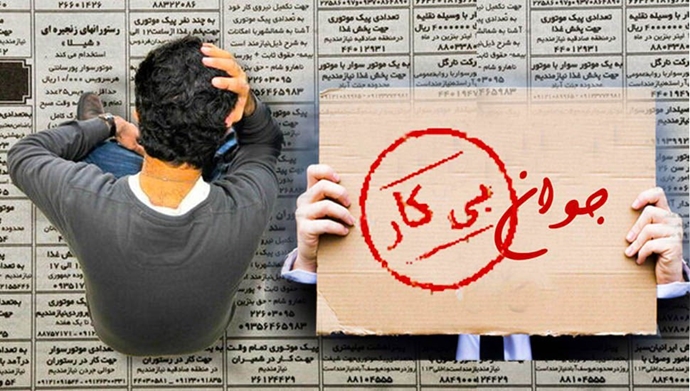

The mullahs’ regime in Iran has led Iranian universities to produce the highest gender gap and the highest unemployment rate among university graduates.
The ruling clerics view universities not as academic institutions but as ideological, seminarian, and instruments of regime control. As a result, universities in Iran, much like other scientific, cultural, and specialized domains, are never in their rightful and proper place. Consequently, the output of such universities fails to contribute meaningfully to politics, economy, culture, and science for the advancement of Iranian society. The clerical regime sees universities as just another governmental branch and expects the same kind of efficiency and yield from them.
A university graduate in Iran, having come from an environment constantly monitored by the regime’s ideological-political apparatus, enters a society where the primary issues are livelihood and high prices. However, before anything else, this graduate must secure a job to sustain a living cycle. According to a March 6 report by Iran Open Data website, over 27.2% of university graduates are unemployed. In such a society what real value does the institution of the university hold for such a society?
Does the impact of such statistics remain confined to employment and livelihood issues, or do they corrode the morale, capability, hope, energy, and motivation of graduates? How should a graduate assess the value, credibility, and effectiveness of their university degree? And if the graduate is a woman, how should she cope not only with the regime’s misogynistic stance but also with the formal and so-called legal gender gap that even affects her everyday life? These statistics speak for themselves:
“The unemployment rate for female graduates is reported at 41.3%, while for male graduates, it is 23.2%, indicating a deep gender gap in employment among educated individuals.” (Ibid)
Under the clerical regime, numbers often speak louder than words in illustrating the catastrophe this system has inflicted upon Iran and its people to sustain its grip on power at any cost. What could be a clearer disaster than the ineffectiveness of university graduates and their exclusion from the country’s economic cycle?
“It is noteworthy that 58.3% of university graduates are classified as economically inactive, meaning they are not participating in the labor market. This indicates that university education has had no significant impact on increasing economic participation, whereas graduates are expected to have a higher economic participation rate compared to the national average.” (Ibid)
Driving out intellectuals or forcing the brightest minds, elites, and future assets of the country into migration is an irreplaceable expertise of dictatorships in general and, more specifically, the monopolistic and totalitarian nature of the clerical dictatorship. It is well known that Europeans and Americans are grateful to the mullahs’ regime for compelling many skilled, educated, and competent Iranians to migrate and contribute to their economies. This is what an inverse relationship between universities and scientific participation in economic progress looks like in Iran:
“In developed countries, university graduates typically have a higher economic participation rate than the general population, as they possess better skills for entering the job market. However, in Iran, this difference is negligible, which may be due to the lack of effective connection between universities and the actual needs of the job market.” (Ibid)
The fundamental problem of universities in Iran is inseparable from the broader crisis of life for other segments of society. In the cleric-dominated Iran, every crisis is chained to another, forming an interconnected web of crises. This fusion of crises has now grown into a monstrous, unsolvable crisis confronting the regime.