

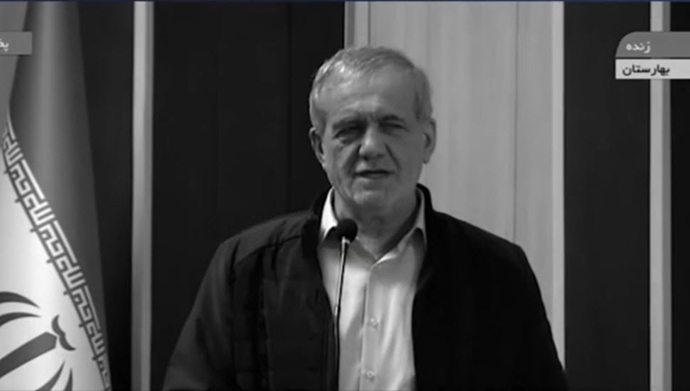

On Tuesday, February 25, in a public session of the Iranian regime’s Majlis (parliament), MP Hamid Rasaee, in a remarkable move, played an audio clip of regime president Masoud Pezeshkian’s voice through the official parliament microphone, in which he says: “All the policies related to the bank and money that have happened were decided in the meeting of the heads of the branches, and it has nothing to do with the minister at all.”
Rasaee then said to Majlis speaker Mohammad Bagher Ghalibaf: “Mr. Ghalibaf, he said these things in the same meeting that you called confidential. I came and told you, Mr. Ghalibaf, he is talking about you! I am saying from here, Mr. Mohseni Ejei [Gholamhossein Mohseni Ejei, head of judiciary], he also talked about you, he said that the situation of the 900,000 rial dollar is the product of us heads [of branches], plus the head of two commissions and his deputies.”
Rasaee continued by warning the heads of the branches: “This situation is the result of the decision of the heads, that is, Your Excellency (Ghalibaf), Mr. Mohseni Ejei, and Mr. Pezeshkian. If you really think that if you remain silent, the nation will let go and pass, it is not like that.”
The power struggle and looting in the mullahs’ regime are not new, of course, but this warning has a different direction, color, and smell. The broadcast of Pezeshkian’s voice in the parliament and the screams of cleric Rasaee have two clear meanings:
First, it expresses the fear of the uprising and demands of the exasperated people who no longer “let go” and “do not pass.”
Secondly, it indicates a sign of impasse and falling into the swamp of a “situation” so critical that its issues are inevitably tied to the meeting of the heads of the three branches, and the ministers cannot do anything.
Continuing the warning to the heads of the branches, the next day (February 26), one of the MPs called on the regime’s president to immediately dismiss his minister of economy, Abdolnaser Hemmati, “before the decisive impeachment that, God willing, the respected representatives will vote on next week.”
In the same meeting, MP Mojtaba Zonnuri accused Pezeshkian and his ministers of lying and hypocrisy and, while implicitly raising the impeachment of the Minister of Oil, said: “Your institutions should speak to the people honestly. Do not say it is closed due to the cold weather. Because tomorrow it is closed due to the heat, we have the same situation in unfavorable conditions and in moderate conditions. Tell the people that in addition to the past reasons, due to the incompetence of the Minister of Oil, my fuel has not been stored, our power plants are ready to work, but they do not have fuel, and the people have to pay for it.”
On the other hand, on the same day (February 26), Mohammad Jafar Ghaem Panah, Pezeshkian’s executive deputy, while admitting the critical situation of the regime, warned: “The conditions in the country are not such that our ministers should be impeached.” He added: “God willing, the respected members of the parliament will help to prevent an impeachment from taking place or the impeachment will not be approved because the conditions in the country are really not such that our ministers should be impeached, God forbid, and lose a vote of no confidence. Probably, the respected members of parliament understand the national interests better.”
It is impossible to describe the deadlock and impasse of the regime in the explosive conditions of society more clearly than this. In this impasse, some see the way out of the crisis in the “immediate dismissal” and “impeachment” of the minister, and some describe “impeachment” as dangerous in the “conditions of the country.” Meanwhile, the desperate supreme leader of the regime has repeatedly warned the parliament and the government about the bitter and dangerous consequences of internal warfare. But the infighting cannot be contained.
While the talk of “consensus” has become worn out, the conflicts have also spread to within Pezeshkian’s cabinet, including between the Minister of Oil and the Minister of Energy. In this regard, it is noteworthy that Khamenei, on February 19, in a meeting with the Ministry of Intelligence officials, called for “cooperation between the Ministry and the government” and said: “The cooperation of the Ministry of Intelligence with the government means doing good intelligence work.”
In order to make the intelligence officers understand, Khamenei points to the multitude of problems in all sectors and says: “For every part of the country, whether it is the economic sector, the political sector, the social affairs sector, the social harms sector, the culture sector, and the like, we have problems.”