

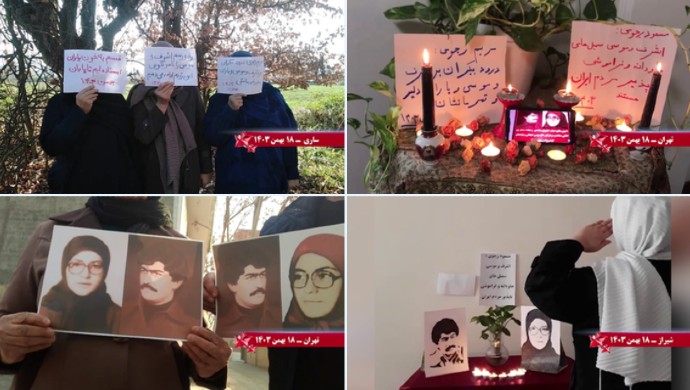

The Resistance Units, an underground network of supporters of the People’s Mojahedin Organization of Iran (PMOI/MEK), have organized various activities across Iran to commemorate the legacy of Ashraf Rajavi, Mousa Khiabani, and other prominent members of the PMOI were killed by the Iranian regime on February 8, 1982, in an attempt by the regime to crush the resistance.
Marking the anniversary, Resistance Units placed posters and banners with images of the martyrs in major cities, paying tribute to their sacrifice. Messages accompanying these images described Ashraf Rajavi and Mousa Khiabani as “eternal symbols of freedom in Iran,” emphasizing the continuation of their struggle against the ruling theocracy.
Tehran
Images of Mousa Khiabani and Ashraf Rajavi pic.twitter.com/AuauBqApaG— People's Mojahedin Organization of Iran (PMOI/MEK) (@Mojahedineng) February 7, 2025
In Tehran, posters of Ashraf Rajavi and Mousa Khiabani were displayed in public places, accompanied by messages such as:
- “The blood of Ashraf and Mousa and their comrades is the torch that lights the path to the freedom of our nation.”
- “Ashraf and Mousa are eternal and unforgettable symbols of Iran’s people.”
- Images of Maryam Rajavi, the President-elect of the National Council of Resistance of Iran (NCRI), were also displayed, with messages in commemoration of the martyrs of February 8, 1982.
Tehran
Photos of Maryam Rajavi with messages in commemoration of the martyrs of February 8. pic.twitter.com/TQqhuIgHnc— People's Mojahedin Organization of Iran (PMOI/MEK) (@Mojahedineng) February 7, 2025
In Isfahan, Resistance Units honored the legacy of the MEK leaders with statements reinforcing the persistence of their movement:
- “We have truly traveled a glorious path, and we have an even more glorious future ahead.”
- “Now, Ashraf and Mousa have been multiplied in a thousand Ashrafs and the young generation.”
- “We will continue the path and tradition of Ashraf and Mousa until the overthrow of this regime.”
Isfahan
Image of Massoud Rajavi with the message:
"Ashraf and Mousa are eternal and unforgettable symbols of the Iranian people." pic.twitter.com/CTkDamMC8c— People's Mojahedin Organization of Iran (PMOI/MEK) (@Mojahedineng) February 7, 2025
Other cities across Iran, including Karaj, Shiraz, Rasht, Qazvin, Hamedan, Lahijan, Kerman, and Kermanshah, witnessed similar commemorative activities. Resistance Units displayed banners reading:
- “Honoring February 8”
- “Ashraf, Mousa, we freedom fighters continue your path.”
- “Endless salutes to Ashraf and Mousa and their brave and heroic comrades.”
Isfahan
"We will continue the path and tradition of Ashraf and Mousa until the overthrow of this regime." pic.twitter.com/KJIhVYrvkZ— People's Mojahedin Organization of Iran (PMOI/MEK) (@Mojahedineng) February 7, 2025
Ashraf Rajavi and Mousa Khiabani were political prisoners during the reign of the Shah. After the 1979 revolution, both ran as PMOI candidates for the first parliamentary elections, but the newly established regime under Ruhollah Khomeini systematically blocked the organization from political participation. The PMOI continuously exposed the regime’s growing authoritarianism, particularly its repression of women, ethnic minorities, and opposition groups.
On June 20, 1981, the PMOI held a peaceful demonstration in Tehran with more than 500,000 participants to demand basic democratic freedoms. The Khomeini regime responded with extreme violence, ordering the Revolutionary Guards to open fire on unarmed protesters. Dozens were killed, hundreds wounded, and thousands arrested. In the following days, thousands of PMOI supporters were executed in summary trials, marking the beginning of a brutal crackdown on the opposition.
Karaj pic.twitter.com/S4nBDcFc5R
— People's Mojahedin Organization of Iran (PMOI/MEK) (@Mojahedineng) February 7, 2025
Between 1981 and 1988, the Iranian regime carried out mass executions of political prisoners, especially those affiliated with the PMOI. The campaign culminated in the 1988 massacre, during which 30,000 political prisoners—mostly PMOI members and supporters—were systematically executed in just a few months.
Despite the regime’s relentless repression, Khomeini failed to eliminate the Iranian Resistance. The sacrifice of Ashraf Rajavi, Mousa Khiabani, and their comrades laid the foundation for the ongoing struggle for a free Iran. Today, the Resistance Units, composed of young activists, continue their fight for democracy and human rights.