

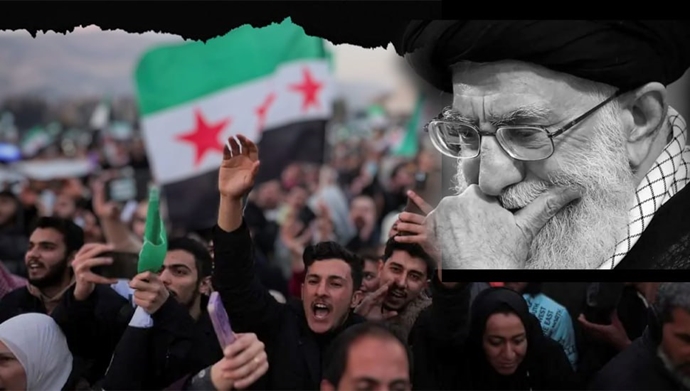

The collapse of strategic depth of the Iranian regime has shaken its resolve. All state-run media outlets are discussing various aspects. Everyone is trying to interpret this defeat in their own way.
On the one hand, the Supreme Leader Ali Khamenei and the regime’s officials are attempting to cheer for the regime’s increasing power to cover up their disastrous defeat. On the other hand, the strategic collapse is so palpable and evident within the regime that even its insiders are reflecting on Khamenei’s statements.
On January 12, in an interview with the state-run Didar News website, Mohammad Ali Jannatkhah, a regime strategist said:
“This strategy, with its so-called approach of strategic depth and such nonsensical rhetoric, cannot survive. One could say it was a slap from history for not studying history well enough, repeating our past historical mistakes. In my opinion, the country is on the verge of a new entropy discharge, and this time, it’s truly unclear what the outcome of this entropy discharge will be.”
What does he mean by “entropy discharge” other than the regime led by the Supreme Leader and its affiliated factions? It marks the end of the political functionality and the acceleration of ideological retreat from the “slap from history.” Jannatkhah further said, “The most significant issue in Iran is the governing ideology. I believe that the country’s problems cannot be solved by either the so-called Principlists, who are utterly inaccessible, or by the Reformists.”
The regime’s officials, from the leadership to its three subordinate branches, often resort to threatening rhetoric, which only reveals the emptiness of such slogans during shifts in the balance of political power.
As noted, the poisoned sword of strategic collapse cuts through all components of the structure, with its fragments penetrating every corner of the regime. The social ramifications of the strategic collapse in Syria compelled Khamenei to shelve the chastity and hijab bill, which had been pushed forward to suppress and loot. When a strategy collapses, the social impacts such a bill also reflect the nature of the collapse. In the interview, the reporter asked Jannatkhah, “If the chastity and hijab law is handed over to the government for enforcement, what will be the outcome for society?”
To which he responded, “Bashar al-Assad! That will be the outcome. I think the Supreme National Security Council also recognized what happened in Syria, intervened, and postponed this directive. I believe implementing this law would very quickly replicate Bashar al-Assad’s fate here.”
A decisive political event becomes like embers scattered by the wind, influencing everything in society and inevitably sparking interactions between the people and the regime. In a society exasperated by a totalitarian religious dictatorship and monopolistic political authority, such events represent a desire for final resolution with the current regime and the creation of a future free from any dictatorship. Today, these very interactions are active and ongoing in Iranian cities, causing more fear and scrutiny from the regime than ever before. As Jannatkhah said, “People on the metro and buses or in their conversations and tweets seem to be waiting for something to happen, ready to act. Everyone is waiting for a major event in which they will likely participate.”