


A society prone to sudden and explosive uprisings imposes significant costs on an illegitimate regime.
A society that has decided against a totalitarian regime creates inevitable hardships and irreparable deadlocks for the ruling system.
The Iranian regime’s new “Chastity and Hijab” bill, passed by the Majlis (Parliament), has become so controversial at this critical juncture that some regime officials and media are warning that “Now is not the time for this bill.”
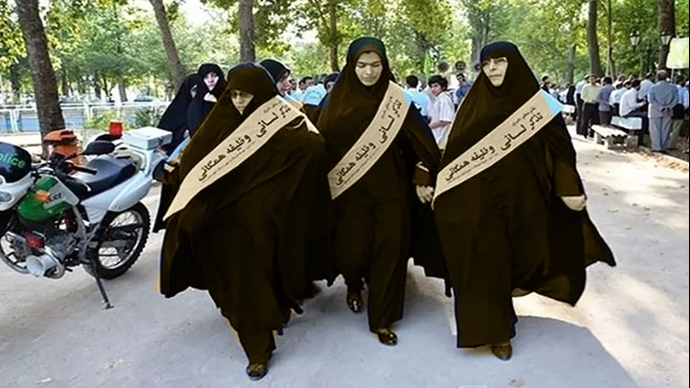
The inhumane “Chastity and Hijab” bill is the clerical regime’s ultimate misogynistic weapon to enforce maximum social repression and shift the heavy costs of its crises and deadlocks onto Iranian society.
The Chastity and Hijab bill is among the dead-end policies of the clerical regime, its fate intrinsically tied to the regime’s survival. These profoundly anti-human—yet foolish—policies have alarmed even the regime’s insiders, who sense the existential threat they pose.
Reviewing state-run media from December 7, 2024, reveals that after the passage of the Chastity and Hijab bill, the deep wounds between Iranian society and the clerical regime became glaringly evident to officials. Deliberately or otherwise, they remind each other of the regime’s path to destruction hidden within the provisions of this bill.
The state-run Setareh Sobh newspaper quoted Ali Akbar Salehi, former head of the Atomic Energy Organization, as saying: “Raising the issue of the hijab law in today’s conditions, where we face problems domestically and internationally, is a mistake.”
He implicitly points to the disintegration of the oligarchic structure: “There is no unity of command in the country, and everyone with power speaks out.”
The state-run Shargh newspaper described the Chastity and Hijab bill as reopening deep wounds between the people and the regime, considering it a risk for a “new front” following uprisings.
The Etemad newspaper quoted regime analyst Abbas Abdi openly admitting that the clerical regime even struggles with its “supporters,” a “small minority,” and resorts to passing measures that “have nothing to do with morality or chastity” and “signal the end of the road for those drafting them.”
From these analyses, it is evident that controversial legislation has not only alienated the regime from the general populace but also exacerbated divisions within its own ranks, creating a perilous situation for its survival.
Etemad continued, “One of the points made by proponents of such plans is that the state must satisfy its supporters. However, this group is a small minority that cannot envision a place for itself in a free and progressive Iran. This legislation marks the end of the road for its drafters. This political game has not the slightest connection to religion, morality, family, or chastity.”
In the wake of two decades of uprisings and a shift in the balance of social power against the regime, neutralizing the potential and determination for overthrow among most Iranians has become a constant concern for the regime Supreme Leader Ali Khamenei and its officials. The latest and final arrow in this strategy is the Chastity and Hijab bill, which uses women as a pretext but aims to dismantle family relationships and societal trust to prolong the disgraceful existence of a corrupt politico-religious structure.
The social repercussions of such a reality compelled a writer in the Arman-e Melli newspaper to post on X: “They want to turn the Iranian nation into spies and informants. Shopkeepers, doctors, company managers, and apartment building supervisors must provide camera footage to the police to identify and fine women using artificial intelligence. Ride-hailing drivers are officially becoming informants on their passengers.”
This analysis precisely illustrates a society prone to sudden and explosive uprisings, imposing such costs on the illegitimate clerical regime. At a minimum, this cost involves creating deepening fractures within the regime’s leadership. With this bill, regime president Masoud Pezeshkian is now faced with tough choices.