

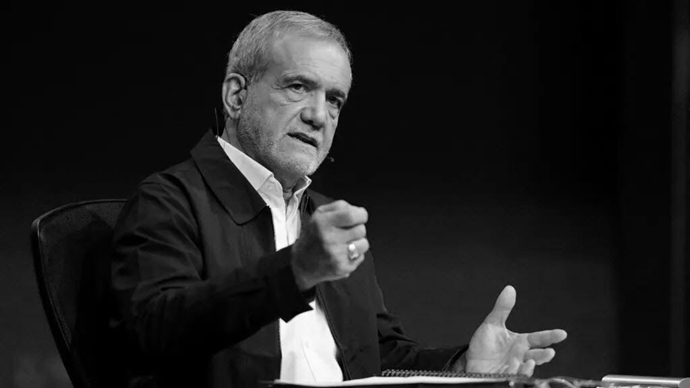

The Iranian regime’s budgetary bankruptcy, empty treasury, acute economic and social crises, and repeated regional failures have intensified internal conflicts over various issues, including the enforcement of mandatory hijab laws and fuel price hikes. On Tuesday, December 3, the Majlis (parliament) witnessed fierce attacks against regime president Masoud Pezeshkian and his advisor Javad Zarif.
Parliament member Mehdi Kouchekzadeh, referring to Zarif, stated: “This man claims we are willing to negotiate with the U.S. beyond [the JCPOA]. Who do you think you are in this country?! I don’t care if this position [Pezeshkian’s Strategic Advisor] was acquired legally or not! We will not let you force this country into America’s hands.”
In the same session, MP Ghassem Ravanbakhsh criticized Pezeshkian for his televised comments on the “Chastity and Hijab” bill, stating: “He swore to uphold the Constitution and implement the laws passed by parliament. Why does he appear on official TV and say, ‘I am not convinced; I have doubts…’? This is the law.”
Ravanbakhsh then shifted his focus to Zarif, stating: “If the 2022 law prohibits dual nationals from holding sensitive positions, how can someone without legal legitimacy occupy this role and openly make strategic decisions for the regime, saying, ‘We are ready to negotiate beyond nuclear issues’? What does ‘beyond nuclear’ mean? Are they planning to discuss missiles again? What is happening in Vienna right now?”
The attacks on Zarif continued. MP Hamid Rasai posted on X: “Besides Zarif, whose children hold U.S. citizenship and who, by law, cannot hold sensitive positions due to conflicts of interest, even Vice President [Mohammad Reza] Aref is legally barred because of his child’s citizenship. According to the law, he is no longer the Vice President.”
It is increasingly evident that figures like Zarif are being used as excuses, while Pezeshkian is the real target—to force him out of his cautious dual stance and make him fully align with their agenda.
This situation arises from Pezeshkian’s own remarks, where he explicitly stated that he has no plans beyond implementing the agenda of regime supreme leader Ali Khamenei, adding, “Why create another plan when we are aligned with [Ebrahim] Raisi’s administration’s program?”
This stance left even less-experienced so called “reformists” confused, with some describing his “Coalition Cabinet” as Raisi’s second administration.
Nonetheless, the regime faction aligned with Khamenei remains unyielding. This is because Pezeshkian has sought to benefit from the regime’s corrupt institutions while also maintaining populist claims, portraying himself as blameless while blaming scandals on the rival faction. Notably, none of his electoral promises or optimistic visions—such as lifting internet filtering, reducing repressive measures against women, or pursuing détente and lifting sanctions—have materialized. Instead, inflation, rising costs, and the public’s livelihood conditions have worsened.
In this context, internal conflicts amid domestic, regional, and global crises inevitably intensify. Promises of unity and the maneuvers of the regime’s leader and president fade, while hostile factions escalate their attacks on one another.
The conflict has escalated to the point where this faction has threatened to dismiss Pezeshkian’s Vice President and Strategic Advisor. Just days ago, Mohammad Bagher Ghalibaf, the Speaker of the Majlis, openly stated at a press conference: “If I were Zarif, I would ‘delicately’ tell Pezeshkian that it would be better if I resigned.”