


The latest statistics and estimates on the economic crisis in Iran reveals the helplessness of the ruling regime. What was called a “super-crisis” yesterday is now referred to as “imbalance.” This includes everything from budget deficits and crises in water, electricity, and gas to the skewed ratio of exports to imports, shortages of schools, teachers, and students, as well as the exodus of doctors and nurses from hospitals. These imbalances also include banking issues, income-expenditure gaps, declines in the active workforce, brain drain, inflation, and unemployment. It seems nothing remains but to witness the collapse and decline of the remnants of an ancient and proud civilization.
We need money, not talk!
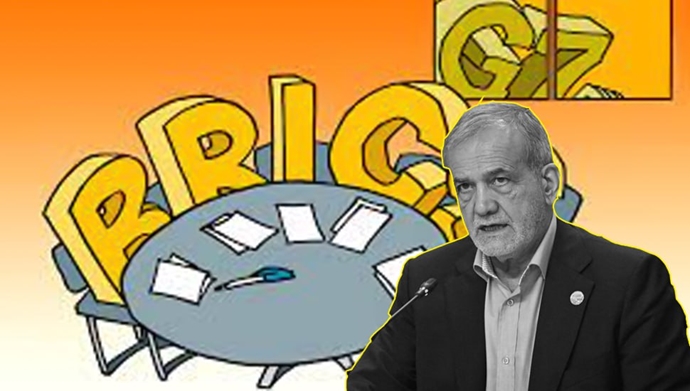
Regime President Massoud Pezeshkian arrived in Kazan, Russia, with a suitcase full of demands. His goal was to secure understandings, agreements, and joint projects with BRICS members. On October 26, Rouydad 24 news website wrote, “[Pezeshkian] said, ‘BRICS should not be merely a club for discussions. BRICS decisions must have enforcement guarantees and assume greater responsibility for financing its member countries. But does BRICS currently have this capacity, or does it still have a long way to go to move beyond being a discussion club? While Iran’s membership in BRICS can be an important opportunity, it does not mean that the official members and observers can assist Tehran at this critical economic and even security juncture.’”
Even the “Comprehensive Cooperation Agreement between Iran and Russia,” which was hoped to be signed in Kazan during this trip, was postponed to another time, and Pezeshkian returned to Iran empty-handed.
The Minister of Economy had previously stated, “For the first time, Iran is officially participating in the BRICS summit at the leadership level, and I hope these efforts in various political, security, cultural, and popular dimensions will lead to economic and financial achievements and that Iran’s economic relations with BRICS member countries will develop.” (Source: Eco Iran news website – October 24)
Pezeshkian’s Mission: Navigating Economic Aftershocks
Domestic and international reports have highlighted Iran’s severe economic crisis. Citing a report from the Atlantic Council, Eghtesad News wrote on October 25, “One of Pezeshkian’s goals in attending the BRICS summit is to gain support from member countries to withstand the aftershocks of sanctions targeting Iran’s economy and energy sector.”
The report, like other independent assessments, notes that Iran’s economy is in a very difficult situation, with GDP growth reduced to about 2% and inflation at 34%, posing serious economic challenges. According to local media reports, the prices of bread and other essentials such as water and housing have also risen.
The crises of the mullahs’ regime are beyond counting
As energy plants operate at a maximum of 70% capacity and steel exports have been halved, a persistent energy shortage and a 17-gigawatt electricity deficit are evident. In these circumstances, the state-owned Tavanir electricity company is forced to export electricity abroad at higher prices for a few extra dollars.
Even the so-called reformists are now defending the “Look to the East” policy promoted by regime supreme leader Ali Khamenei. “The Minister of Economy had stressed that Iran’s membership in BRICS is an opportunity to develop economic and political relations with member countries through bilateral and multilateral cooperation and improve the economic situation” (Source: Farhikhtegan newspaper – October 26).
Meanwhile, the mafia-like factions supporting Khamenei also operate full-speed on the “Look to the East” path, saying, “Iran’s membership in BRICS and the Shanghai Cooperation Organization was an achievement that helped cement Iran’s position in the international system and advance the policy of balanced foreign relations” (Same source).
Without FATF membership and lifting sanctions, BRICS is closed
Despite its awareness of resources and capital shortages, the clerical regime continues its warmongering and support for terrorism, leading to sanctions by the global community that prevent it from accessing international resources. University professor Fereydoun Majlesi says, “What makes BRICS access impossible for Iran is that banking cooperation with BRICS countries requires compliance with FATF guidelines. If Iran does not accept these protocols, regular banking operations will not be established, and without this cooperation, escaping economic difficulties is nearly impossible.” (Source: Arman news website- October 26).
The Minister of Economy also admitted, “The two issues of sanctions pressure and FATF prevent our banks from connecting with BRICS member banks.” (Source: Abrar newspaper – October 26)
Last year, the South African Central Bank president said, “If you want a BRICS currency, you need a banking union and must achieve macroeconomic convergence.”
On October 27, The IRGC-affiliated Fars News Agency wrote, “Along these lines, experts say there is still a long way to go before such a currency is created, and as economic researcher Majid Shakeri notes, the only form of BRICS common currency might resemble SDRs (Special Drawing Rights), which certainly won’t start with physical banknotes.”