

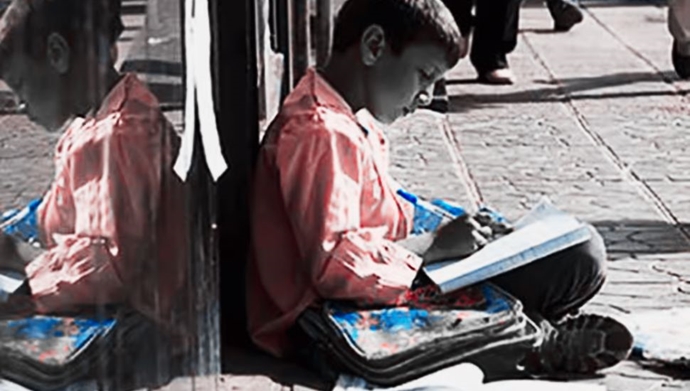

Iran has become a class-based country with class-based provinces, class-based cities, class-based neighborhoods, class-based schools, class-based students—all under the control of a regime that promotes and perpetuates class divisions.
Students are among the prime victims of the corrupt rule of the mullahs. children who once played and befriended each other are separated into distinct groups when confronted with class differences. Some of them will eventually attend expensive private schools, while others are pushed into the child labor market, and sometimes even into scavenging.
On October 2, the state-run Etemad newspaper, reciting the words of a few drop-out children: “We sort trash as long as there is daylight, meaning until five or six o’clock. We have carts, and sometimes we pick up clothes, shoes, bags, and things that people leave by the roadside. There’s also a shop that leaves leftover fruit for us, and besides that, we collect plastic from garbage bins. We left the sacks where we met up. At night, a van comes and takes everything, and also drives us home, because we’re all from the same neighborhood.”
This is just one example from a neighborhood in Tehran. Hundreds of thousands of children face similar situations across Iran, creating a crisis of children who are spending their youth outside of schools.
There is a deliberate expansion of poverty and deprivation from one administration to the next under the clerical regime. What is the material basis for this? It lies in the year-on-year increase in school dropouts, while on the flip side, there’s a growing budget for regime religious institutions, military organizations, and the regime’s regional proxy groups. The latest official statistics on the rising forced drop-out rates over the past seven years, as acknowledged in the same Etemad newspaper report, state: “A report from the Parliamentary Research Center says that in 2016, there were 778,000 children who had dropped out of school in the country. This number rose to 911,000 in 2021. An analysis of data from the Iranian Statistics Center shows that in the 2022-2023 school year, the number reached 929,798. ”
According to the same report, the number of dropouts in 2024 is as follows: “Official statistics from the Ministry of Education state that there are around 930,000 school dropouts in the country… Leaving the education system without completing schooling has become a serious issue. Last year [2023], the 15-17 age group had the highest number of dropouts.”
It is worth noting that the nature of reports from regime newspapers and media outlets is that they focus on filtered government statistics and the crisis in unemployment, inflation, livelihoods, housing, etc., but deliberately avoid addressing the causes and the source of these statistics and crises. For example, in this same report on student dropouts, it’s acknowledged that “all roads lead to political economy,” but it never approaches the root of the ruin and plundering in the political economy. Why? Because doing so would point to the source of all political, economic, and social corruption in the system ruling Iran. It would point to the office of the Supreme Leader, the Islamic Revolutionary Guard Corps (IRGC), state-run religious foundations like Astan Quds Razavi, state-affiliated private companies, and the billions of dollars and rials spent on the regime’s proxy terrorism.
Therefore, the nearly one million school dropouts in 2024 have an entirely political cause, as it ties back to the regime’s priorities. Iran is a land full of resources and wealth, but it is held hostage by a religiously driven policy, all spent to maintain the occupying clerical regime’s hold on power.
The solution to save Iran’s youth from the ever-deepening whirlpool of poverty and dropping out is to link this crisis with the social and economic struggles of other sectors and with the political crisis between the Iranian society and the ruling clerical regime. In a society where every detail is politicized and dependent on the regime’s policies, the answer and solution to everything is political and contingent upon removing the main obstacle—the regime itself.