

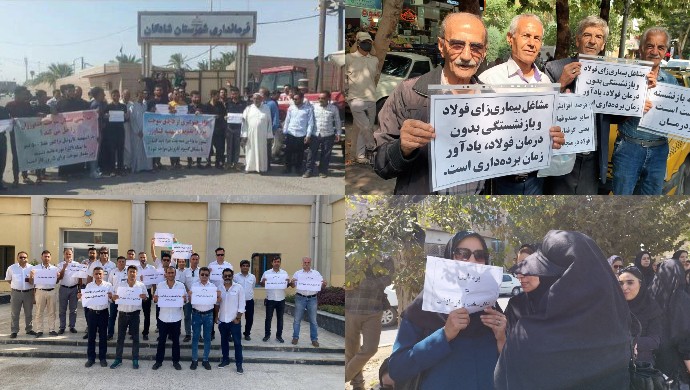

As the political and economic crises at the top of Iran’s regime continue to deepen, the Iranian public has increasingly taken to the streets in protest. The culmination of the recent farcical election and the subsequent inauguration of a new government has only further highlighted the regime’s inability to resolve its mounting challenges. The new administration, handpicked by Supreme Leader Ali Khamenei, has yet to provide any meaningful solutions to the systemic issues plaguing the country.
In September 2024, at least 412 protest rallies were documented throughout the country.
– Workers: 159 protests
– Pensioners: 112 protests
– Business Owners: 11 protests
– Nurses: 10 protests
– Farmers: 6 protests
– Educators: 6 protests
– Taxi Drivers: 3 protests
– Truck Drivers: 2 protests
– Cattle Farmers: 1 protest
– Other Sectors: 102 protests
Workers’ Protests
At least 159 protest actions were organized by workers across the country. Their grievances primarily revolved around job insecurity, mass layoffs, mistreatment by management, lack of benefits, the absence of compensation for hazardous jobs, unpaid wages, and low salaries. Protests were also observed in the oil and gas sector, where workers complained about the failure to implement previous agreements concerning leave policies, equitable job classification systems, and adequate working conditions. Other issues included delays in paying camp allowances, unfair salary caps, and the failure to separate job classifications in operational zones. Furthermore, workers voiced concerns over the rampant involvement of contracting companies that exploit the workforce.
September 30—Kangan, southern Iran
Protest rally by employees of Pars Oil and Gas Company who demand changes to retirement rules, removing the salary ceiling, and other needs.#IranProtests pic.twitter.com/rulwE2mI4j— People's Mojahedin Organization of Iran (PMOI/MEK) (@Mojahedineng) September 30, 2024
The protests spanned a wide range of sectors, including refineries, petrochemical plants, and the broader oil and gas industry. Notable locations included oil and gas workers at the Pars platforms PD6, PD9, PD12B, and other platforms in the South Pars Gas Field, such as SPD15 and SPD8. Workers at the oil platforms in areas like Bushehr and Asaluyeh, along with contractors and temporary workers at several major refineries, were among those who participated in the demonstrations. These protests underscored the widespread dissatisfaction with employment conditions in the energy sector.
In industries beyond oil and gas, steelworkers, miners, and other laborers also protested against inadequate wages, poor working conditions, and job instability. Workers from steel factories in Anzali and mining facilities in Tazareh were among those who took to the streets in demand for better conditions.
Pensioners’ Protests
Pensioners held at least 112 protests across the country. Their demands centered on the lack of income equalization, delays in receiving their pensions, and the denial of various benefits. These protests have been persistent, with pensioners consistently demanding the government address their dire economic situation. They expressed frustration over the declining value of their pensions amid rising inflation and economic mismanagement.
September 29—Isfahan, central Iran
Retirees of the steel sector resume protest rallies, demanding higher pensions and other basic needs. #IranProtestspic.twitter.com/YS6lj8RJBA— People's Mojahedin Organization of Iran (PMOI/MEK) (@Mojahedineng) September 29, 2024
Business Owners’ Strikes
Protests among business owners were concentrated in cities such as Sanandaj, Saqqez, Marivan, and Kermanshah, primarily to mark the anniversary of last year’s nationwide uprising. Additionally, merchants in Iranshahr staged protests against local authorities for closing roads, which negatively impacted their businesses.
Nurses’ Protests
At least 10 protest rallies were organized by nurses in cities like Behbahan, Qom, and Isfahan. They rallied against poor living conditions, delayed overtime payments, and the failure of authorities to meet their demands for wage increases. These protests highlighted the broader issue of neglecting healthcare professionals who have been under immense strain due to both the economic crisis and inadequate healthcare infrastructure.
September 26—Yazd, central Iran
Large rally by nurses at Yazd Medical Sciences University, protesting unpaid wages, lack of reform in tariff rules, lack of implementation of regulations for harsh work, forced overtime work, & other problems.#IranProtests pic.twitter.com/Fh3HEjWdrM— People's Mojahedin Organization of Iran (PMOI/MEK) (@Mojahedineng) September 26, 2024
Farmers’ Protests
Farmers, particularly in regions such as Shadegan and Dezful, held at least six protest rallies. Their demands were largely related to a lack of fuel supplies and water shortages for agricultural purposes. In some cases, farmers protested the state’s seizure of water resources, which further exacerbated the already difficult farming conditions in rural areas.
September 8—Dezful, southwest Iran
Farmers rally to protest low fuel rations for their machinery.#IranProtestspic.twitter.com/0iei2tzl7h— People's Mojahedin Organization of Iran (PMOI/MEK) (@Mojahedineng) September 8, 2024
Educators’ Protests
Teachers in Tehran, Shiraz, and other cities organized six protest actions in September. These protests centered on unresolved employment issues, including their demand for permanent contracts and their dissatisfaction with the Ministry of Education’s policies. Many of the teachers also protested for fair wages and improved working conditions.
Other Sectors
Protests in other sectors included grievances from taxi drivers in Tehran who gathered to demand better management and financial assistance, particularly regarding electric vehicle charging stations. Truck drivers in Lamerd protested the government’s neglect of their demands, while cattle farmers in Yazd voiced their concerns over the low purchase prices of milk set by the government.
Furthermore, significant public demonstrations took place in Zahedan, where worshippers held a memorial march for those killed in the Bloody Friday of Zahedan in 2022. Autistic children and their families in Isfahan also protested the lack of support from the state. Meanwhile, families of prisoners in Iranshahr gathered to denounce corrupt practices in the prison system, including demands for bribes in exchange for visits with their incarcerated relatives.
The protests in September 2024 reflect the growing discontent in various sectors of Iranian society. From workers and pensioners to farmers and business owners, the common thread across all these protests is the government’s failure to address the economic and social crises gripping the nation. With at least 412 documented protests, the regime faces increasing pressure from all sides.