

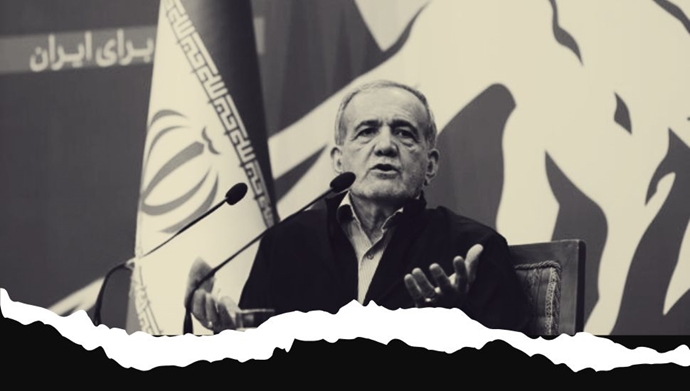

Months after Masoud Pezeshkian emerged from the Iranian regime’s rigged presidential election, Supreme Leader Ali Khamenei finally agreed to allow his president to hold a press conference. Pezeshkian had originally planned to hold the conference on the first day of his presidency, but it was canceled when he was summoned by Khamenei.
On September 16, at the press conference, Pezeshkian tried to avoid giving clear and direct answers to any questions, resorting to vague statements and jokes. This led to immediate criticism from Raja News website, affiliated with the Saeed Jalili, a former presidential candidate and Pezeshkian’s rival. On the same day, Raja News wrote, “Pezeshkian’s press conference in three words: weak, divisive, and cartoonish.” The pro-Khamenei newspaper Farhikhtegan also criticized Pezeshkian, attributing the disaster to his advisors with the headline: “Strategic mistake of the president’s advisors.”
Despite his vagueness, Pezeshkian was forced to make some remarks and admissions which, when pieced together, paint a grim picture of the disintegrating regime in crisis.
Pezeshkian said: “In this situation, whether it’s energy, gas, electricity, the environment, or money, we are heading towards collapse.
“If we fail to manage resources and continue increasing consumption, we will definitely face destruction one day.
“This trend is unsustainable, just like the many imbalances we are creating, which we are sinking deeper into every day! We keep saying, ‘Don’t touch it, or there will be objections.’”
Evident in these statements are the regime’s insoluble crises and its lack of solutions, as well as the fear of a popular uprising.
The question is, in the face of these crises engulfing the regime from all sides, what will Pezeshkian—or more accurately, Khamenei—do? The only somewhat clear statement Pezeshkian made in response was his description of the regime’s economic illness and the need for further cutting into the people’s livelihood as a solution.
He said: “The patient is the economy we have; it needs medication, sometimes surgery, and sometimes anesthesia. Iran’s economy requires interventions.” He then called on the media, academics, and politicians to help him implement these interventions, “and not scare and warn him every time an intervention is planned: ‘Don’t touch it, or there will be objections.’”
Thus, the meaning of “consensus” and “national consensus,” which Pezeshkian repeatedly mentions and referred to in this press conference as a “megaproject,” becomes clearer: Consensus, in Pezeshkian’s terms, means that everyone should unite behind him to administer the bitter medicine and “anesthetize” everyone to eliminate “this atmosphere of despair that has been created.”
However, this “megaproject” has already backfired, and the infighting among the ruling factions has escalated to new heights, proving that “the cure has worsened the ailment.” Both sides of the regime now mock the slogan of “consensus.”
MP Amirhossein Sabeti, member of “Paydari” faction, sarcastically remarked, “Consensus for the return of division!” Another member of this faction, Ghassem Ravanbakhsh also said, “This is not national consensus, but national division.”
Hossein Shariatmadari, editor of Kayhan newspaper, Khamenei’s mouthpiece, also lashed out at Pezeshkian, saying that “people with divergent views are placed in key positions under the code name of national consensus.”
Even reformists close to Pezeshkian are grumbling. Former MP Rasoul Motajebnia said: “National consensus does not mean a mishmash… People voted for ministers to change, for Raisi’s cabinet to change, for policies to change. So, when people voted for change, why shouldn’t we make changes and instead try to bring them back under the banner of national consensus?”
All signs indicate that after the death of former regime president Ebrahim Raisi, the regime is in a deadlock and has not managed to regain its balance.
After the death of Raisi, the mullahs’ regime suffered a heavy blow, pushing the entire system toward a path of irreversible decline. Evidence suggests that within this chaotic regime, various factions are now tearing each other apart in a bid to gain a larger share of the looting and plundering. The regime attempted to introduce a reformist faction, but such reforms are ineffective in halting the inevitable collapse, especially as the regime continues its anti-people policies with increasing intensity. Social conditions are now ripe for an uprising stronger than the one in 2022, a fact the regime is acutely aware of, which is why it seeks to buy time and distract the public with economic hardships. However, with the presence of Resistance Units, this time is becoming shorter and shorter as society moves towards the overthrow of this regime.