

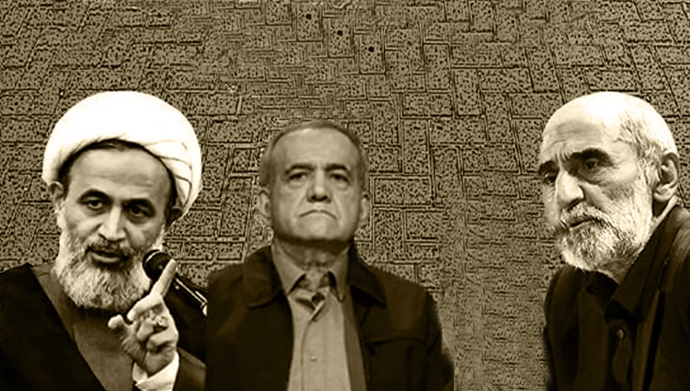

On September 3, during a mourning ceremony in Mashhad attended by the Majlis (parliament) speaker Mohammad Bagher Ghalibaf and Iranian regime president Masoud Pezeshkian, cleric Alireza Panahian accused Kayhan newspaper, a known mouthpiece of regime supreme leader Ali Khamenei, of lying and creating polarization. He said, “Government-funded newspapers, from Kayhan to Ettela’at, from Jomhouri-e Eslami to other media outlets… they have no right to play the polarization game…” Panahian then called on the speaker of the parliament to pass a law against the media inciting polarization and to “shut down these newspapers. Lying is bad, but polarization by newspapers is worse than spreading falsehoods.”
However, the issue of “polarization” is not something that can be solved through legislation, and Panahian’s remarks opened the door to a new conflict within the regime. During the days when newspapers were not being published due to official holidays, one of Kayhan’s writers called Panahian’s remarks “unwise and inappropriate,” claiming that he “misjudged and fired at his own side” (Source: Khabar Online, September 5).
On September 7, seizing the first opportunity, Kayhan published an article sharply attacking Panahian, subtly referencing an instance of theft involving him, in Kayhan had defended him. They reminded him: “On September 9, 2020, when we wrote to defend Mr. Panahian… and advised adherence to ‘fairness’ and ‘ethics,’ we never thought that four years later, Mr. Panahian would take this path.” The article concluded with a threat: “Kayhan will not turn back from this path. Mr. Panahian, will you retract your incorrect statements?”
As the division spread within Khamenei’s inner circle, former MP Hossein Naqavi Hosseini referred to presidential candidate Saeed Jalili’s faction and the so-called “Endurance Front”, as a “deviant movement” and, taking a jab at Jalili and his shadow government, wrote: “Our friends have not come out of the shadows into the light.” On September 4, Khabar Online quoted him as saying, “We principlists need to give a red card to the extremists… The extremists don’t even follow the leadership of the senior principlists.”
Subsequently, according to Mashregh News website, affiliated with the Intelligence Organization of the Islamic Revolutionary Guard Corps (IRGC), stepped in to support Panahian and warned the “Endurance Front” that “polarization is political antagonism” and that “these actions are a reproduction of the polarization of the 1980s, which ultimately leads to standing against the Supreme Leader.”
On the other hand, on September 8, Farhikhtegan newspaper quoted MP Hamid Rasaee as saying: “Make no mistake! Not every polarization is invalid… Some polarizations are real and must be preserved, such as the struggle between Islam and infidelity, or the confrontation between compromise and resistance, dignity and humiliation. Some of these polarizations were founded by the late Imam [Regime founder Ruhollah Khomeini].”
MP Mahmoud Nabavian seized on Khamenei’s claim that he didn’t know most of the cabinet members beforehand. He attacked Pezeshkian for securing votes in the parliament for the selected cabinet and said: “Mr. Pezeshkian’s words were a lie. Why didn’t the senior members of the parliament, who knew this, refute his statements?” Nabavian also called some of the government ministers’ murderers who should not have received votes, according to Khabar Online on September 7.
The intensifying infighting after Panahian’s remarks, in which he called for legislation to curb conflicts, led Mehdi Fazaeli, a member of Khamenei’s office, to express the Supreme Leader’s concern on his X account, wrote, according to Khabar online: “Let’s be careful that the debate over polarization doesn’t itself lead to polarization.”
What the regime refers to as “polarization” is the manifestation of the widening rifts within the ruling establishment and the inevitable result of the collapse of Khamenei’s purification efforts following the death of president Ebrahim Raisi. The claims of “unity” by Pezeshkian and Panahian’s call for legislation cannot hide or whitewash these conflicts. On the contrary, the cracks are being intensified by the heavy blows of mass boycott of the regime’s election, the replacement of one corrupt official with another, and increasing public protests.