

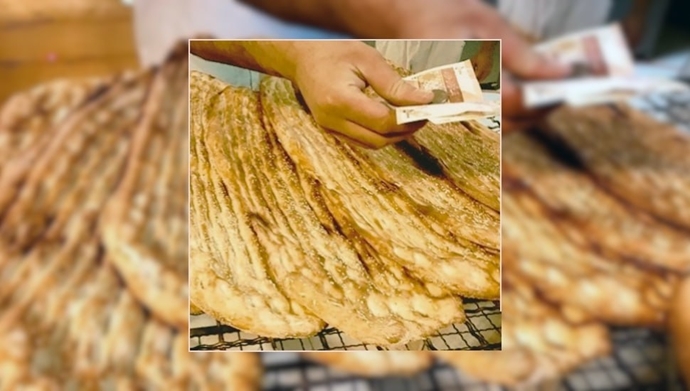

Bread prices in ten provinces of Iran have increased by 25%. This is making living even harder for a population that was struggling to put food on their tables in the first place.
In a resource-rich country like Iran, earning a loaf of bread has become a dire challenge for people. The economic abnormality stems from Iranian regime’s incompetent policy spoused with plundering the nation’s wealth to keep its hold on power.
Asr-e-Iran news website claims that the sudden 25 percent increase in bread prices caught everyone by surprise. However, investigations show that the government and the state were not surprised at all. The decision to raise bread prices was made about six months ago, was very calculated, deliberate, and is fundamentally a political strategy.
On August 6, Hamshahri news website quoted Mehdi Jafari, Deputy Coordinator of Economic Affairs of South Khorasan Province, as saying: “The adjustment of bread prices has been on the agenda since the end of last year, and the expert pricing of bread has been determined based on analyses.”
The main issue is why the regime decided to increase bread prices “based on analyses” in February or March 2024 and then announced and implemented it only after the recent sham election. The delay in the price-hike of bread coincides with other opportunistic measures by the regime, including a short reprieve in repressive measures during the election season. The goal was to convince the people in the regime’s staged elections.
The plundering policy combined with totalitarianism, along with incompetence in management and administration, has exacted enormous costs on the lives, livelihoods, and well-being of the Iranian people over the past 45 years. The widespread corruption among officials and ministers appointed by the regime Supreme Leader Ali Khamenei is one of the reasons for the ongoing economic abnormalities in Iran. The increase in bread prices is also one of the outcomes of this policy and its destructive impact on people’s livelihoods.
In this context, on June 24, the state-run Donya-ye Eghtesad newspaper quoted the head of the Inspection Commission of the Tehran Traditional Bakers’ Union as saying: “We don’t have a specific authority in the bread sector; one day it’s the Ministry of Economy, the next day it’s the Flour and Bread Task Force, and the next day it’s the Ministry of Interior that takes responsibility.”
The regime’s policies and management supposedly aimed at improving people’s lives and livelihoods have no discipline or accountability other than plundering and exploiting the people. On the other hand, billions upon billions are spent on religious goals, managed under the direct supervision of Khamenei.
When the people of Iran wake up in the morning, they suddenly must pay 25 percent more to buy a loaf of bread. Meanwhile, a regime that constantly talks about the burden of sanctions spends “120 trillion rials on the Arbaeen pilgrimage route and constructs 320 kilometers of road.”
What does it mean to spend this amount on religious goals, which have nothing to do with the beliefs of the Iranian people? This spending is over one-third of the 400 trillion rials that the new president authorized his deputy to spend on Arbaeen (the 40th day of the martyrdom of Imam Hussein, the grandson of the prophet Mohammed) pilgrims.
The regime drains the lifeblood and sustenance of the people by raising the prices of bread and essential goods, but they steal billions from the lives of the 70 percent of the population living below the poverty line and spend it on ceremonies that do not need such deceptive extravagance. So, what is the goal of this contradictory behavior and layered hypocrisy?
The goal is clear: Most of society boycotted and rejected the entire regime in three electoral shows over four months. Now, the regime seeks to exploit the Arbaeen ceremony, which has no connection to the Islamic Republic of Iran, for its benefit to deceitfully claim that it still has support.
In both the bread price increase and the Arbaeen ceremony, the regime is humiliating the people of Iran. In both cases, the essence of the matter is the regime’s schemes of plunder and robbery, accompanied by the maximum humiliation of the Iranian people.
A conclusion worth noting that after the nationwide boycott of the July 28, 2024, electoral show, the regime faces more than ever the threat of another uprising and revolt within Iranian society. Regarding both issues, many media outlets and regime officials constantly warn about the concentrated anti-regime anger and the complete rejection of the mullahs’ rule.