

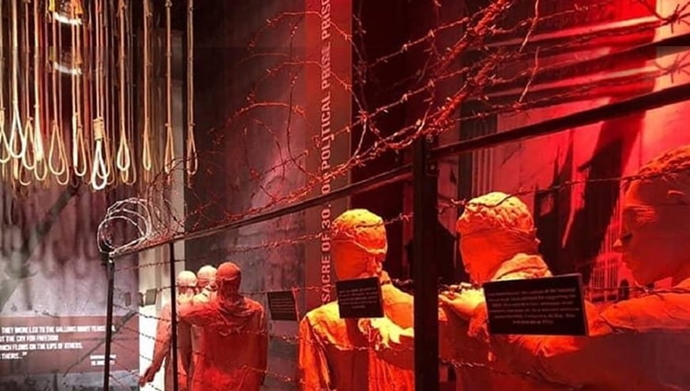

The 1979 revolution marked an end to the despotic rule of the shah in Iran and the beginning of a new chapter for the struggles of Iran’s people. The people of Iran, eager to achieve freedom and liberation from the yoke of despotism, stood firm to realize the spring of freedom in Iran.
But this spring soon turned into a cold autumn and winter, with all hopes fading away as the mullahs hijacked the revolution. Freedom vanished, and prisons, chains, torture, and executions spread throughout the country. Those brief moments of sweet victory were suddenly crushed by corrupt, thieving, and criminal mullahs, and poverty and misery prevailed.
The climax of the brutality in the history of the mullahs’ religious fascism was the massacre of more than political prisoners in 1988, most of whom were members and supporters of the People’s Mojahedin Organization of Iran (PMOI/MEK). The regime carried out this massacre under a fatwa by regime supreme leader Ruhollah Khomeini, who made it clear that anyone who stood steadfast in support for the PMOI should be killed.
The executions were carried out swiftly and without any due process. Prisoners were taken to a group of so-called judges, who became known as the “death commission,” and they were asked a simple question: Would they disown their support for the PMOI. Those who denied would immediately be taken to the gallows. Knowing what fate awaited them, more than 30,000 political prisoners stood by their convictions defiantly and set a glorious example of resistance that continues to inspire the youth today.
The Justice-Seeking Movement
The regime made every effort to hide and deny the 1988 massacre for decades. But after three decades of continuous effort and the exhausting struggles of the Iranian Resistance and Maryam Rajavi, the President-elect of the National Council of resistance of Iran (NCRI), a massive body of evidence was gathered about this crime against humanity and the wheels of justice were set in motion.
A vast lineup of witnesses, lawyers, and experts, on one hand, and international human rights figures, institutions, and organizations, on the other, engaged in documenting and compiling hard-to-find evidence to confirm “genocide” and “crimes against humanity. ”
Silenced Voice of the Blood-Soaked
Now, after more than three decades of continuous struggle and the passage of resolutions that explicitly and implicitly reflected the countless crimes of the religious fascism ruling Iran, Javaid Rehman, the UN Special Rapporteur on Human Rights in Iran, in the final days of his mandate, presented a landmark report titled, “Atrocity Crimes and Grave Violations of Human Rights Committed by the Islamic Republic of Iran (1981–1982 and 1988).”
The UN Special Rapporteur, in his report, called for the establishment of an international mechanism to investigate and prosecute those responsible for the “atrocity crimes” in Iran, including the extrajudicial killing of thousands of prisoners who were arbitrarily detained and suppressed in the 1980s.
He identifies the brutal crimes, including hasty, arbitrary, and extrajudicial executions in the years 1981-1982 and 1988, as “crimes against humanity” and “genocide,” and emphasizes that the continued concealment of the fate of thousands of political opponents and the location of their remains constitutes the crime against humanity of enforced disappearance.
Per the report: “The Special Rapporteur notes that the ‘atrocity crimes’ as reported – which took place all across Iran – represent the commission of the worst and the most egregious human rights abuses of our living memory whereby high-ranking state officials connived, conspired and actively engaged to plan, order and commit crimes against humanity and genocide against the nationals of their own state. Notwithstanding the availability of overwhelming available evidence – to this day – those with criminal responsibility for these grave and most serious violations of human rights and crimes under international law remain in power and control; the international community has been unable or unwilling to hold these individuals accountable. Indeed, many of the individuals implicated in these ‘atrocity crimes’ continue to enjoy the official, governmental privileges and impunity from international justice and accountability.”
Justice After 40 Years
The international echo of the voice of the justice-seeking movement in the report of the UN Special Rapporteur is the result of the steadfastness of the Iranian Resistance in pursuing the goals of the justice-seeking movement. As has happened throughout the history of the Iranian Resistance, resilience and conviction have brought us this far. But this is a fight that will continue until justice is served.