

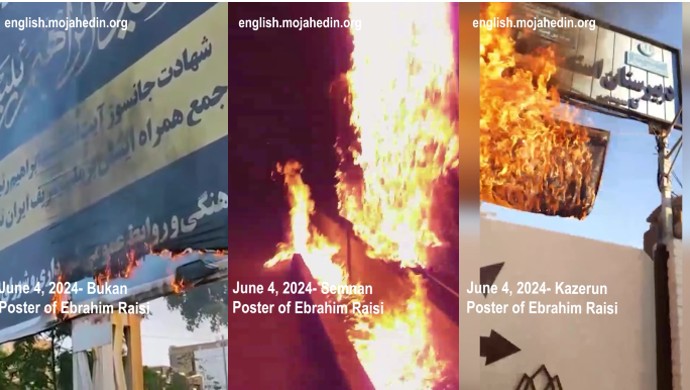

The Iranian regime continues to reel in the aftermath of the death of its president, Ebrahim Raisi, notoriously known to Iran’s people as the “Butcher of Tehran” for his role in the execution of tens of thousands of dissidents. As the regime grapples with this significant loss, it has intensified its repressive measures against workers, teachers, retirees, and all segments of society in a desperate attempt to maintain control. However, the people are fighting back. Iran’s rebellious youths are responding to the regime’s oppression with courageous acts targeting the regime’s centers and symbols of repression, corruption, and propaganda.
On June 4, rebellious youths set fire to images of Raisi in multiple cities, including Borujerd, Rasht, Shiraz, and Mashhad, in response to the murder of a Kurdish porter (kolbar) in Sarasht, Kurdistan province, by regime security forces. Kolbars, impoverished people who carry loads across borders to make a meager living, often face brutal crackdowns from the regime. The regime’s security forces often open fire on them in border areas. Every year dozens get killed and injured as they attempt to provide for their families.
The same day, in a show of solidarity with workers and laborers rising up in various cities to demand their basic rights, rebellious youths in Borujerd, Rasht, Shiraz, and Mashhad set fire to images of Raisi. These workers have been at the forefront of protests against the regime’s exploitative practices and economic mismanagement, which have plunged many into poverty. From factories to railroad, municipalities, and other sectors, workers often hold protest rallies as economic pressure piles up on them and their wages and working conditions continue to deteriorate.
In Yazd, on June 4, an arson attack at the City Hall in District 2 occurred in response to the murder of two oppressed Baluch compatriots in Iranshahr by the regime’s security forces on June 1, 2024. The Baluch people, like the Kurds, face severe discrimination and violence from the regime, which has always been brutal toward Iran’s ethnicities. This attack by the rebellious youth was a direct response to the brutal killing and a call for justice.
Earlier, on June 2, an arson attack at the City Hall in District 2 of Shahin Shahr, and the headquarters of the Khomeini Relief Committee in Delgan, Sistan and Baluchestan province, were set on fire. These attacks were in retaliation for the killing of an impoverished Baluch fuel porters (sukhtbar) and the injuring of two others after the regime’s security forces opened fire, causing their vehicle to overturn on the Nehbandan road on May 30, 2024. Fuel porters also make meager living by transferring fuel across border areas. They work through perilous and rough conditions to provide for their families. They are often targeted by regime security forces and many get killed every year.
These acts of defiance by Iran’s rebellious youth are significant not only for their bravery but also for their symbolic resistance against the regime’s oppressive apparatus.
Despite the regime’s harsh crackdowns and relentless efforts to quash dissent, the rebellious youth of Iran continue to challenge the status quo. Their actions bring hope to millions of Iranians who long for regime change and the establishment of a democratic republic. By targeting symbols of oppression and corruption, these youths embody the spirit of resistance and inspire a nation yearning for freedom and justice.