


Through their defiant acts, the youth are embodying the resilient spirit of uprising and resistance
The Iranian regime, already grappling with multiple crises, is now facing a new wave of defiance from the nation’s rebellious youth following the death of its President, Ebrahim Raisi. Known to the people of Iran as the “Butcher of Tehran” for his role in the execution of tens of thousands of dissidents, Raisi’s death has been met with both propaganda efforts by the regime and celebratory acts of resistance by the populace. While the regime has been attempting to glorify Raisi through banners and ceremonies, Iran’s rebellious youths are expressing the true sentiment of the people with their bold activities against the regime’s centers and symbols of repression, corruption, and propaganda.
Setting fire to Basij bases and images of regime leaders continued unabated. Basij bases and images of Khomeini, Khamenei, Raisi, and regime terror master Qassem Soleimani were set ablaze in cities including Tehran, Tabriz, Mashhad, Esfahan, Karaj, Qazvin, Zahedan, Zanjan, Semnan, Dezful, Nishapur, and Kazerun. The Basij, primarily tasked with repressing dissidents and protests, has been a significant target due to its active role in nationwide crackdowns and spying on dissidents. It has played an especially important role in the recent wave of repressive measures against women and girls under the pretext of hijab rules.
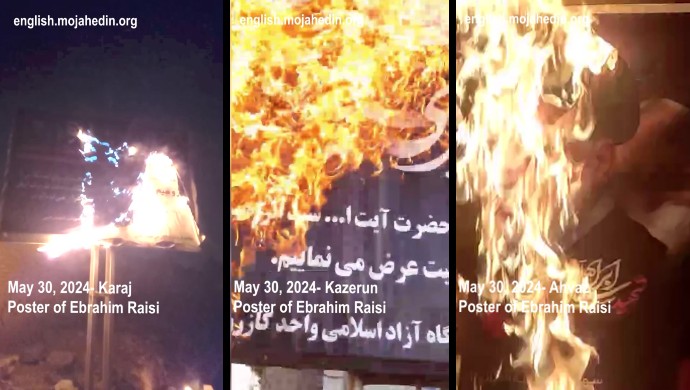
In a powerful display of dissent, rebellious youths burned and tore images of Raisi in 22 separate incidents following his death across cities including Tehran, Mashhad, Karaj, Isfahan, Qazvin, Zahedan, Khorramabad, Sabzevar, Nishapur, Boukan, Shushtar, Ahvaz, Arak, Lahijan, and Babolsar. These acts were in response to the regime’s repression, arrests, and threats against citizens who celebrated Raisi’s death.
In Tehran, Raisi’s banner was set aflame on the Kurdistan highway bridge and in front of Basij bases of the Revolutionary Guards. Similar acts occurred in Mashhad, Isfahan, Karaj, Qazvin, Zahedan, Khorramabad, and Shushtar, where banners depicting Raisi were burned. The youth of Nishapur, Sabzevar, Bukan, and Shushtar also participated by burning Raisi’s banners. Additionally, Raisi’s banners were torn down in Tehran, Mashhad, Ahvaz, Arak, Lahijan, Sabzevar, and Babolsar.
In Tehran, an explosion targeted the suppressive security forces of the regime’s municipality in solidarity with pensioners protesting in Ahvaz, Isfahan Steel, Tehran Steel, and Kermanshah. In Shiraz, the Khomeini Foundation was bombed in response to the Revolutionary Guards’ shooting and killing of oppressed Kurdish porters at the Baneh border on May 14, 16, and 19. The Khomeini Foundation is one of the main state-backed institutions that loots the people wealth to help the regime fund its terrorist activities in the region and its repressive apparatus at home.
In reaction to the suppression of prisoners in Ghezel Hesar on the morning of May 29, rebellious youths set fire to and tore up images of Raisi across multiple cities, including Tehran, Karaj, Qom, Mashhad, Esfahan, Shiraz, Ahvaz, Kerman, Zahedan, Sabzevar, Kazerun, Shushtar, and Konarak Chabahar. The political prisoners of Ghezel Hesar have been holding hunger strikes every executions in protest to the growing wave of executions by the regime. The rebellious youths are expressing their support for these prisoners with these activities.
Another explosion rocked a regime building in District 3, Region 16 in Tehran in response to the shooting and killing of a hardworking Kurdish porter at the Baneh border on May 28. In Gorgan, a center of fundamentalism and regime propaganda was bombed in support of the rightful protests and gatherings of bakers in Qom, the looted people of Qazvin, and the pensioners of Kermanshah.
Despite the regime’s relentless efforts to clamp down on dissent, Iran’s rebellious youth are braving the odds, bringing hope to millions of Iranians who long for regime change and the establishment of a democratic republic. The regime’s internal feuds and growing crises, exacerbated by the death of Raisi, have only united the people of Iran further in their quest to overthrow the mullahs’ tyrannical rule. Through their defiant acts, the youth are not only challenging the regime’s centers of oppression and corruption but also embodying the resilient spirit of resistance that continues to inspire the nation.