


As days passed since the death of Iranian regime president Ebrahim Raisi, it has become undeniably clear that it was a “major strategic blow” for the regime. Re-emphasizing this point can clarify many assessments regarding the state and characteristics of religious fascism in the post-Raisi era. We had previously written that Raisi, with his infamous record of crimes and killings, was not just a person for regime supreme leader Ali Khamenei; he represented a line—the line known in government parlance as “purification.” Under Khamenei’s leadership, the regime concluded that to confront the successive uprisings of the Iranian people, the most loyal and brutal elements must be placed in key positions. It was with this policy that Khamenei elevated the most notorious executioner of his regime and installed him as president. He paid a hefty price for this, having to remove many of his old pawns. Therefore, replacing Raisi is not a simple task for the regime.
One day before the official announcement of Raisi’s death, Khamenei, told his loyalists that “they should not worry, no disruption will occur in the country’s affairs.” However, in a meeting with Raisi’s family, he retracted his previous statement and said, “No matter how much I think about it, I feel that there is no compensation for me, for the country, and especially for the family. It is a heavy loss, a great sorrow.” (Source: Telegram channel of the Supreme Leader’s news, May 27, 2024)
The phrase “there is no compensation” should be underlined, as it translates to the same “major strategic blow.” This major blow has increasingly weakened Khamenei and, consequently, the entire regime in the face of the explosive situation of society. One manifestation of the impact of this blow showed itself in the election of the speaker for the new Majlis (parliament).
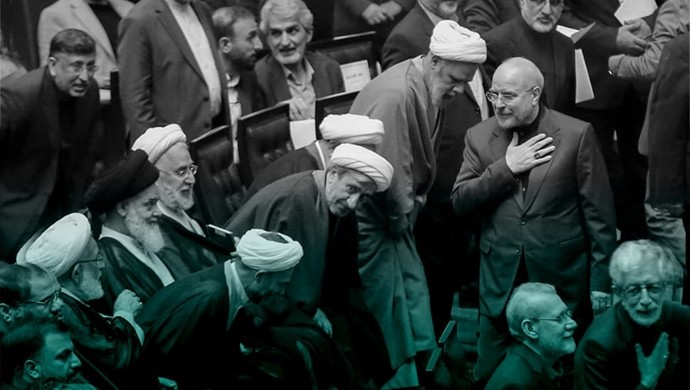
The factionalism and the creation of factions within the purified Majlis, which has passed through various filters, indicate a turbulent period for Khamenei’s rule. While this Majlis was neither stable nor functional, cleric Hamid Rasaee, in the “9 Dey Weekly,” wrote in bold headlines: “With the announcement of the second round of election results and the majority of the anti-corruption reformist faction in Majlis: Ghalibaf’s removal is certain.”
Government media wrote that, given the revelations by the opposing faction about a trip by the son of Majlis speaker Mohammad Bagher Ghalibaf to Canada and the travel expenses distributed by his deputy, Ghalibaf had no chance of being re-elected as the Speaker of the Majlis. However, Khamenei preferred to keep him in his position. In clearer terms, in the post-Raisi era, Khamenei does not have the capacity or capability to replace Ghalibaf as the Speaker of the Majlis. If he could manage the crisis and tension without Ghalibaf, he would undoubtedly appoint another person to this position. Therefore, the reappointment of Ghalibaf to the position of Speaker should be seen because of Khamenei’s strategy.
In his message, Khamenei warned the Majlis members against “turmoil and confusion.” In this message, which was read by Mohammad Mohammadi Golpayegani, the Chief of Staff of the Khamenei, it stated: “The point I always emphasize is that the Majlis should be a source of calm and hope… inviting solidarity and brotherhood in the public environment of the country. Within the Majlis itself, useless media competitions and harmful political debates should not consume the short period of responsibility; otherwise, the valuable capacity of the representatives in this high position will be wasted, and this is a great loss.”
What’s worth noting is the repetition of the terms “great loss” and “heavy loss” in Khamenei’s words. These adjectives refer to the same “major strategic blow.”
In fact, by reappointing Ghalibaf as the Speaker of the Majlis, Khamenei temporarily covered the tensions arising from the power struggle within his own faction, and with this measure, indirectly excluded Ghalibaf from participating in the presidential race. It is evident that the course of events might turn out differently, but as far as Khamenei is concerned, he has pursued this inclination out of desperation and helplessness.
The message of reappointing Ghalibaf to his previous position signifies Khamenei’s increased weakness and fragility in facing crippling crises.
It is predictable that Khamenei will face serious challenges in appointing his next president.