


As Iran’s regime approaches its sham elections, scheduled for March 1, 2024, officials are afraid of potential crises that might break out. Regime Supreme leader Ali Khamenei has made public remarks twice in recent days and expressed concerns about the consequences of a widespread election boycott.
In an address to regime loyalists on December 23, Khamenei complained about rivaling factions who have been questioning the elections. Ironically, Khamenei said, “If there are no elections in the country, it is either a dictatorship or chaos; what prevents the emergence of dictatorship in the country is elections. What prevents chaos, turmoil, and insecurity is elections… Elections can choose and bring about the Supreme Leader, meaning it ensures Islamism… If we want problems to be resolved, we must increase participation.”
In another meeting with a group of women, Khamenei said, “Dear ladies, you can play a role, and the most important role for you is inside the home. Mothers can play a role, influence their children, influence their husbands! In order to be active in the field of elections… you can play a role both inside and outside the home, in the presence at the ballot boxes.”
In these two speeches, Khamenei showed his concern about the outcome of the sham elections.
Others in the clerical establishment like Ahmad Khatami, a member of the regime’s Assembly of Experts, and Ali Ehtesham Kashani, a prominent cleric in the regime, have expressed concern about the outlook of the March elections.
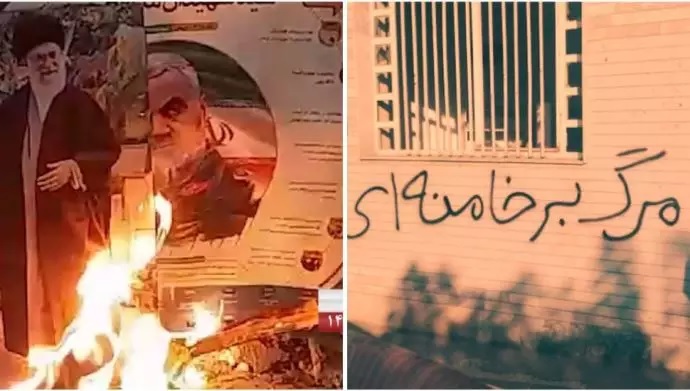
Ahmad Khatami warned about protests whose slogans are directly targeting Khamenei, including the nationwide uprising that spread across Iran last year.
“Their attacks were directed at the leader, did you see what they wrote on the walls?” Khatami said, referring to a slew of slogans that called for the ouster of Khamenei and his regime.
Khatami also highlighted the main reason for Khamenei’s fear of the outcome of the elections: “Those who instigated the disturbances want to achieve what they failed to achieve in the unrest during the March 2024 elections! They wish for… the opportunity to say that this system is not a democratic system, but rather a referendum against the system!”
In referring to uprisings that pushed each regime to the brink of collapse, Ehtesham Kashani said, “If the clerics had properly interpreted the 1999 sedition [uprising], the 2009 sedition would not have happened. If the 2009 sedition was properly interpreted, the 2017 sedition would not have happened. If 2017 was interpreted, then 2019 would not have happened. And if that was properly interpreted, 2022 would not have happened.”
He added, “If our parliamentary elections had a turnout of 42.5% in the previous term, and God forbid, God forbid, God forbid, if there is a decrease in turnout this time and the election results are lower, who is responsible?! Right now, we are in a critical situation where the enemy wants to create another turmoil for us and decrease the turnout.”
These remarks from senior regime officials indicate that the regime is deeply afraid of uprisings. They can see that dissatisfaction and explosive conditions of society have significantly increased. And politically, the main enemy of the regime has been standing against them since the 1980s and the era of Ruhollah Khomeini, the founder of the mullahs’ regime until today.
The relentless propaganda of the regime against the PMOI, the theatrical display of mock trials of the PMOI, and the significant expenses allocated to produce films and documentaries demonizing the PMOI on television all reflect the regime’s concerns about the threat of an uprising and the main enemy of the clerical regime.