

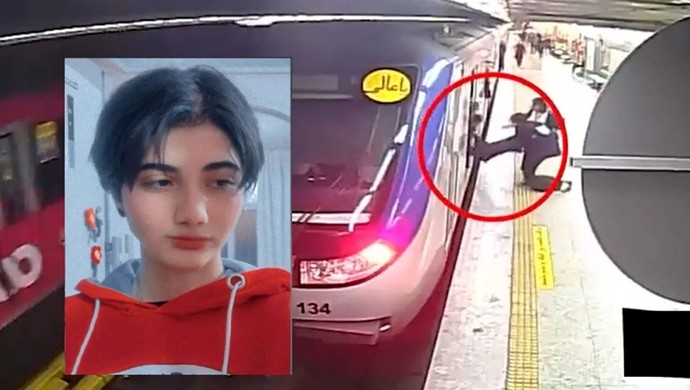

This morning, Iranian government news agencies reported the death of Armita Geravand, who was in a coma in hospital.
Government news agencies wrote on Saturday, October 28, that she died after failing extensive medical treatment and 28 days in intensive care unit.
Armita Geravand, 16, was on her way to school on October 1 when a morality police agent at Tehran’s Shohada metro station attacked her for not wearing the compulsory hijab. According to witness reports, she lost consciousness after the agent pushed her and her head hit a metal bar. She was transferred to Tehran’s Fajr hospital, where she remained in a state of coma until her death 28 days later. In fear of protests, the regime established heavy security presence at the hospital and restricted access to Armita, even to her family. One journalist was arrested when she tried to write a report about the incident.
A witness who spoke to The Guardian claimed that soon after Armita entered the carriage a female hijab enforcer started arguing with her because she wasn’t wearing a headscarf. “The chador-clad woman screamed at her asking her why was she not covered,” the witness told the Guardian. “Armita then told her ‘Do I ask you to remove your headscarf? Why are you asking me to wear one?’ Their argument then turned violent. The hijab enforcer started physically attacking Armita and … violently pushed her.”
Another witness said Armita was still conscious when she fell on the ground. Witnesses claimed they spotted the same hijab enforcer waiting behind the ambulance that took Armita to the hospital.
The regime’s media never released the videos recorded by security cameras inside the metro wagon. Instead, they released edited and grainy videos that only showed far off recording of the incident after Armita had lost consciousness. They also brought select witnesses and friends to state TV to give testimonies that were in line with the government’s narrative. Reports indicate that regime authorities had threatened the witnesses and instructed them to refrain from giving real accounts of the events that happened on October 1. Armita’s parents were also put under pressure by regime authorities.
On October 24, Javaid Rehman, the UN Special Rapporteur on the situation of human rights in Iran, told the UN General Assembly’s Third Committee, expressed concern about the news that the 16-year-old Armita Geravand was brain dead. He also expressed concern about more than 13,000 students, mostly girls, have been affected by suspected poisoning in over 100 schools without any effective Government response. The right to democratic participation in public life is limited through “politically engineered ‘Islamic criteria’ or the application of State ideology,” which exacerbates existing constitutional and legislative limitations, Rehman said.
Amnesty International had previously stated that according to published reports and citing numerous evidence about the secrecy of Islamic Republic officials in this regard, Armita Geravend was plunged into a coma after an attack by an officer wearing the compulsory hijab.
Mrs. Maryam Rajavi, the president-elect of the National Council of Resistance of Iran (NCRI), expressed her condolences for the death of Armita Geravand. “Once again, the religious fascism ruling Iran has taken an innocent girl from us under the bogus excuse of improper veiling,” she said. “The repressive forces aim to prevent people’s uprising and protest by besieging the hospital and employing oppressive measures. Yet, they are unaware that the people, especially the youth of Iran, as well as my fellow Iranian girls and women, remain determined to overthrow the mullahs’ regime and replace it with democracy and people’s sovereignty.”
I offer my sincere condolences for the loss of #ArmitaGaravand .
Once again, the religious fascism ruling #Iran has taken an innocent girl from us under the bogus excuse of improper veiling.
The repressive forces aim to prevent people's uprising and protest by besieging the… pic.twitter.com/O3CmairqQ0— Maryam Rajavi (@Maryam_Rajavi) October 28, 2023
Armita Geravand is the latest victim of the mullahs’ regime and the criminal Revolutionary Guards Corps (IRGC). Last year, in a similar incident, the regime’s morality police murdered Mahsa Amini, a 22-year-old girl, in Tehran. Amini’s death triggered the anger piled up from decades of repression on the most basic freedoms of the Iranian people. A nationwide uprising ensued that lasted for months and called for the overthrow of the mullahs’ regime.