


In a recent television interview, the Foreign Minister of Iran’s regime, Hossein Amir-Abdollahian, said, “If we don’t defend Gaza today, tomorrow we will have to defend against these bombs in our own children’s hospitals in our cities.” These statements echo the words of regime supreme leader Ali Khamenei, who has repeatedly stated that if there is no war in Syria, Iraq, and beyond Iran’s borders, the regime will have to fight in Iran’s own cities against the “enemy,” by which he means the people and rebellious youth of the country.
Furthermore, acknowledging the Lebanese people’s opposition to their country’s involvement in the war, he added, “Seyyed Hassan Nasrallah [leader of the Lebanese Hezbollah] had a very accurate interpretation. He said, ‘Yes, it is possible that some in Lebanese society may say we should not engage in this conflict, but if we do not take proactive action as Hezbollah in Lebanon today, if necessary, we will have to fight in Beirut against the Zionist regime, Israeli agents, and Israeli military forces tomorrow.’”
All the people in the region, especially countries like Iraq, Syria, Yemen, Lebanon, and Palestine, who have directly been exposed to the terrorism and warmongering of the Iranian regime and its proxy forces, are well aware of the sinister intentions of religious authoritarianism ruling Iran. These sinister intentions are concealed under deceitful labels such as “resistance,” “Islam,” “holy Muslim sites,” “Quds Day,” “defense of shrines,” “confrontation with Zionism,” and the like. However, their outcome is nothing but slaughter, destruction, death, corruption, and devastation.
This criminal policy, which the Khamenei refers to as “strategic depth,” is nothing more than using innocent people as shields to preserve his oppressive regime’s hold on power.
The situation in each of these countries serves as an example of the criminal behavior of Iran’s regime and the Islamic Revolutionary Guards Corps (IRGC). But here, we will only focus on Syria.
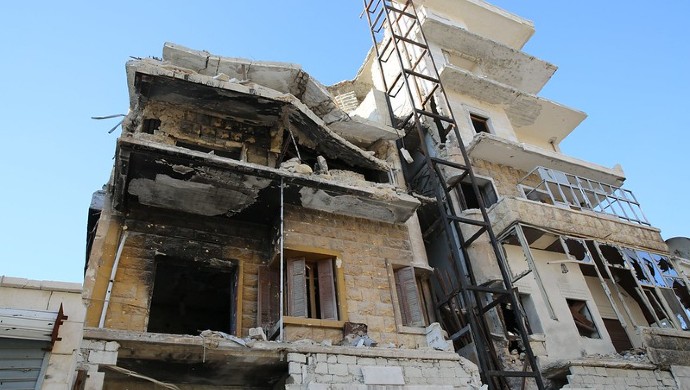
The people of Syria rose up against the oppressive regime of Bashar al-Assad in January 2011, during the Arab Spring and uprisings in Arab countries, from Egypt to Tunisia, and Algeria. The Syrian resistance, with thousands of martyrs, progressed towards the threshold of overthrowing the Bashar al-Assad regime. However, in this situation, Khamenei intervened to save his ally by sending a massive deployment of IRGC forces, led by Qasem Soleimani, the commander of the terrorist IRGC Quds Force, along with significant amounts of weapons, equipment, and ammunition. The Iranian regime and the IRGC played a major role in the atrocities that took place during the Syrian civil war. According to estimates by the Syrian Observatory for Human Rights, until June 2018, over 650,000 people were killed in seven and a half years. Five million people migrated to other countries, 7.6 million people lost their homes and shelter and became internally displaced within Syria. In short, Syria turned into a ruin.
The destruction of the city of Aleppo, with a population of over two million people, is just one example of the criminal massacres and devastation carried out by IRGC in Syria. In an exclusive interview with Simaye Azadi television in June 2016, Riaz Nassan Agha, the official spokesperson for the Syrian opposition’s High Negotiations Committee and former official of Syrian Radio and Television, said, “We are astonished by the brutal assault of the IRGC on Aleppo. It is incomprehensible why they have the intention to destroy such a historic and ancient city.”
During the battles in Aleppo, Hossein Hamedani, the deputy of Qasem Soleimani, also met his demise, and the Khamenei regime buried his body with great fanfare as a “defender of the shrine,” despite the distance between Aleppo and the shrine of Hazrat Zainab in Damascus being over 350 kilometers.
In addition to the people of Syria and the region, the people of Iran are also victims of the oppressive policies of the criminal Khamenei regime. The most cautious estimate by Heshmatollah Falahatpisheh, former chairman of the Security Commission of the regime’s Parliament, indicates that the regime spent between 20 and 30 billion dollars on its intervention in Syria before 2020.
The clerical regime has spent billions of dollars from Iran’s wealth and resources on warmongering, massacres, and exporting terrorism to other countries in the region. This has resulted Iranian people experiencing unprecedented poverty and misery in Iran’s contemporary history. It is not without reason that people in their protests against the regime cry out, “Let go of Syria, think about us!” Accordingly, people in Syria, Iraq, and Lebanon also chant for the downfall and expulsion of the Iranian regime and IRGC in their own protests, calling for an end to destruction.
In tandem with his heavy-handed crackdown on domestic protests, Khamenei is pursuing a policy of warmongering and exporting terrorism in the region to prevent the collapse of his regime. However, he is now facing waves of popular uprisings and the anger and resentment of the masses in the countries of the region. People in the region are increasingly realizing that the source of all wars, destruction, and crises that have engulfed the region over the past four decades is Khomeinism, which has its headquarters in Tehran and in the offices of Khamenei. The region will not witness peace and tranquility unless this regime is totally vanished.