

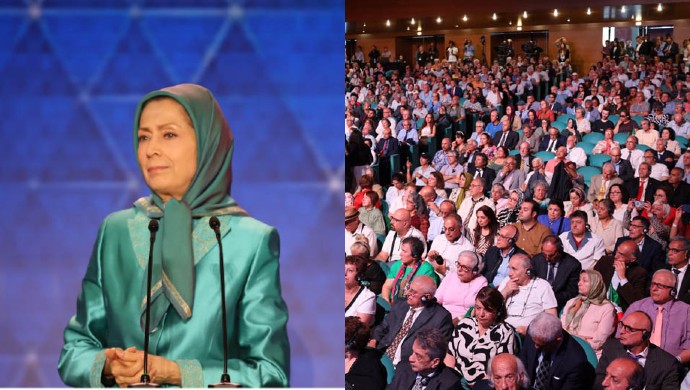

Against a backdrop of escalating human rights abuses in Iran, prominent political figures from across Europe and the United States gathered in Rome for the Free Iran World Summit 2025. The conference, held on July 31, 2025, focused on the intensifying crisis within the clerical regime and the international community’s role in supporting a democratic alternative. The event days after Iran’s regime executed political prisoners Mehdi Hassani and Behrouz Ehsani, members of the People’s Mojahedin Organization of Iran (PMOI/MEK), whose steadfastness in the face of torture and death was a recurring theme throughout the day’s discussions.
Speaker after speaker condemned the regime’s brutality, highlighting its internal fragility and its reliance on terror to maintain its grip on power. The conference championed the “Third Option”—a path that rejects both foreign military intervention and the failed policy of appeasement, advocating instead for regime change led by the Iranian people and their organized resistance movement.
A clear roadmap for a democratic republic
Today, our country stands on the threshold of a profound transformation.
This change is being shaped by the people of Iran and their resistance—a nationwide movement that, through the highest sacrifices, including 100,000 martyrs, and with a clear roadmap and vision, heralds the… pic.twitter.com/T2l0rLMY6q— Maryam Rajavi (@Maryam_Rajavi) July 31, 2025
In her keynote address, Maryam Rajavi, the president-elect of the National Council of Resistance of Iran (NCRI), laid out a comprehensive vision for a future democratic republic. She began by honoring the recently executed PMOI members, Behrouz Ehsani and Mehdi Hassani, describing them as heroes who “remained proud and unwavering, honoring their pledge to God and to the people.”
She described their execution not as a sign of the regime’s strength, but of its desperation in the face of growing popular dissent and organized resistance. “It is no coincidence that Khamenei fears the pivotal role of this movement in igniting uprisings and advancing the overthrow of his regime,” she stated.
Mrs. Rajavi emphasized that Iran stands on the threshold of a profound transformation, driven by a nationwide movement with a clear plan for a free, secular, and non-nuclear republic. She argued that the regime thrives on manufacturing crises, from the Iran-Iraq war to its export of terrorism, to ensure its survival. However, today it is engulfed in a “crisis of overthrow,” making it weaker than at any point in its history.
She presented a clear solution to the multiple crises emanating from Tehran, one that serves both the Iranian people and global security. “With the regime’s overthrow by the Iranian people and resistance, Iran will move toward democracy, and a major regional war will be averted,” she declared.
Mrs. Rajavi firmly rejected any return to the past dictatorships of either the mullahs or the monarchy. “The march of time does not allow a return to the past. No one goes back to yesterday,” she asserted, dismissing the notion that the son of the deposed Shah could offer a viable future.
Concluding her address, she highlighted the crucial role of the NCRI as an organized and enduring democratic alternative, whose primary mission is to transfer sovereignty back to the Iranian people through free elections. “This time, there is someone who has stood, and will continue to stand, in the way, ensuring that the Iranian people’s right to freedom and democracy cannot and will be stolen,” she affirmed, positioning the NCRI as the guarantor of a future democratic process.
Condemnation of the regime’s human rights atrocities
A central theme of the conference was the international condemnation of the Iranian regime’s horrific human rights record. Speakers expressed outrage over the surging number of executions, which former US Ambassador Stephen Rapp noted was on track to set a new record, with 700 hangings in the first seven months of 2025 alone. He described the judicial process as a sham, with prisoners convicted of “phony crimes like ‘enmity against God’ or ‘corruption on earth,’ based upon confessions elicited under brutal torture.”
.@JavaidRehman: The regime weaponizes the death penalty to crush dissent. My 2024 findings documented arbitrary executions, torture, and abuse of tens of thousands of political opponents since 1979. This brutality must end.
https://t.co/4Pq6VIwwUZ— NCRI-FAC (@iran_policy) July 31, 2025
Professor Javaid Rehman, former UN Special Rapporteur on the situation of human rights in Iran, delivered a powerful video message detailing the secret executions of Mehdi Hassani and Behrouz Ehsani. He highlighted an alarming editorial from the IRGC-affiliated Fars News on July 7, 2025, which praised the 1988 massacre of 30,000 political prisoners as a “successful historical experience” and openly called for its repetition. “These state-sponsored statements present a dangerous prognosis of the regime’s intention to repeat the atrocity crimes,” Professor Rehman warned, urging the international community to establish an accountability mechanism. “The international community failed to act in 1988. It must not fail again.”
This fear was shared by many. Charles Michel, former President of the European Council, warned, “This rhetoric fuels fears of a repeat of the summer of 1988.” The younger generation also voiced their pain and defiance. Nazli Afshar, an Iranian youth raised in Italy, shared a personal connection to the regime’s brutality: “My uncle was also one of these young people. He was executed by the regime during the 1988 massacre.”
Broad support for the NCRI’s Ten-Point Plan and the Third Option
International speakers voiced strong and unified support for the NCRI as a credible democratic alternative and endorsed its Ten-Point Plan for a future Iran. Former Italian Prime Minister Matteo Renzi captured the sentiment, stating, “When you state, ‘No to foreign war, no to appeasement, yes to regime change by the people of Iran and their Resistance,’ this is the only way.”
.@matteorenzi: Last year proved freedom in #Iran cannot come from foreign war or appeasement. “No to war, no to appeasement, yes to regime change by the people and their Resistance”—this is the only way, even if it is the hardest way.#IranThirdOption
https://t.co/ZUBoKkf9l1— NCRI-FAC (@iran_policy) July 31, 2025
Charles Michel forcefully argued against inaction, stating that the policy of appeasement “will never work” and that silence is complicity. He identified the NCRI as the solution, declaring, “There is an alternative. There is a democratic alternative. That’s the only way, the Third Way: the recognized, organized opposition and its resistance.” He praised Mrs. Rajavi’s Ten-Point Plan as a “blueprint, an oath for a democratic republic where people choose their leaders and reject dictators.”
This endorsement was echoed by Carlo Cottarelli, a former Italian Senator and economist, who called the Ten-Point Plan “an excellent blueprint of what Iran should become,” and by former US Ambassador Carla Sands, who detailed its promises of gender equality, separation of religion and state, and a non-nuclear Iran.
.@CharlesMichel: Madam @Maryam_Rajavi, you lead by example. Your leadership, resilience, determination, and sincerity inspire us all. I commend you, your team, and the incredible commitment of the people of Ashraf 3.#NCRIAlternative
https://t.co/ycSwVknCUs— NCRI-FAC (@iran_policy) July 31, 2025
The pivotal role of Resistance Units inside Iran
Speakers highlighted the critical role of the PMOI’s Resistance Units, networks of activists inside Iran who are challenging the regime’s repressive atmosphere. Andrin Mohseni, a young Iranian from Switzerland, dedicated his speech to these activists. “They are young men and women who fight for freedom in Iran,” he said. “In a country where even a whisper of protest can lead to torture and death, their courage and determination carry a message of hope.” He described how their actions, such as hanging banners and displaying messages from Mrs. Rajavi, “break the barriers of fear” and show that change is possible.
Former German Ambassador to Afghanistan Hans Ulrich Seidt: A broad coalition of democratic forces is needed against Tehran’s regime. The NCRI and PMOI, seen by the mullahs as their greatest threat, offer real prospects for change in #Iran.
https://t.co/Zr9B9ai9Bj— NCRI-FAC (@iran_policy) July 31, 2025
Former German Ambassador Hans Ulrich Seidt noted that the Resistance Units “explicitly demand an end to the mullahs’ regime. They target its centers of repression and hope to break through the wall of resignation and hopelessness.” This internal network was presented as tangible proof that the opposition is not merely an external force but a deeply rooted movement with legitimacy on the ground.
Confronting the regime’s campaign of demonization
Speakers at the summit also shed light on the clerical regime’s intense and coordinated demonization campaign against the Iranian Resistance. Former Colombian Senator Ingrid Betancourt recounted her personal experience with a wave of “coordinated disinformation” after first supporting the PMOI, concluding that the campaign was rooted not in facts, but in “fear from a regime that doesn’t just see the MEK as an opposition, but as a credible alternative.” She explained that the regime labels the highly structured organization a “cult” because “an effective opposition unmasks what they really are.”
.@IBetancourtCol: The MEK has paid the ultimate price—120,000 imprisoned, executed, tortured, or exiled. This is not a movement for power but a principled force for freedom. The world must recognize it as the only way out of #Iran’s tyranny.
https://t.co/ifrSoAqsrJ— NCRI-FAC (@iran_policy) July 31, 2025
This point was echoed by Charles Michel, who argued that the regime’s propaganda efforts are a sign of its weakness. “They can keep saying you are not a credible alternative, but their relentless obsession to oppress and target you shows the exact opposite,” he stated. This tactic extends to the regime’s victims. Samira Ardalani noted that after executing freedom fighters, the regime “attempted to portray them as terrorists so that no one would dare condemn its crimes.”
Rejecting a return to the tyranny of the Shah
The conference was resolute in its rejection of all forms of dictatorship, drawing a firm line against any attempt to replace the theocracy with the former monarchy. Senator Terzi stated the position clearly: “It is in your motto, Madam Rajavi, and we fully agree with it. Your motto is: ‘Neither the Shah, nor the Mullahs.'”
.@chavezlinda: The Shah’s son claims he can lead #Iran, but no one inside the country is calling for his return. Iranians don’t want SAVAK, torture chambers, or executions under another Shah. They want freedom and true change.#IranThirdOption
https://t.co/ZpjfrYOVon— NCRI-FAC (@iran_policy) July 31, 2025
Former director of the White House Office of Public Liaison, Linda Chavez, dismissed the notion of a monarchist restoration. “We do not want SAVAK back. We do not want more torture chambers,” she said, questioning the credentials of the Shah’s son.
Rudy Giuliani, former Mayor of New York City, was even more direct, calling the Shah’s son the “son of a mass murderer” who has “lived off your money all his life.” The consensus was that Iran’s future must be a democratic republic, not a recycling of past tyrannies.
Unanimous call to designate the IRGC as a terrorist organization
A clear policy demand emerged from the summit: the designation of the Islamic Revolutionary Guard Corps (IRGC) as a terrorist organization. Senator Giulio Terzi, former Italian Foreign Minister, was unequivocal: “The inclusion of the IRGC on the list of international terrorist organizations cannot be postponed, and that is a common endeavor for the European countries. It must happen.” Samira Ardalani, representing Iranian professionals, framed it as a key expectation of the international community, second only to recognizing the Iranian people’s right to resist. This call underscored the belief that the IRGC is the central apparatus of both domestic oppression and international terrorism, and that dismantling it is essential for regional and global security.
A future determined by the people of Iran
Ultimately, the message from Rome was one of hope and empowerment, grounded in the conviction that the Iranian regime is in its final phase and that the future of Iran must be determined by its own people. As former UK Foreign Secretary James Cleverly stated, “A leadership imposed upon a nation cannot be a truly sustainable solution… The leadership of a nation must come from its people.”
.@JamesCleverly: I admire the courage of #Iranian women and young people risking persecution and even death for what others worldwide take for granted—a voice, respect, and equality. Their fight for freedom is truly inspirational.
https://t.co/5ja0i6oc5M— NCRI-FAC (@iran_policy) July 31, 2025
The conference concluded with a unified call for the international community to stand on the right side of history by recognizing the legitimacy of the Iranian people’s struggle and their organized resistance. As speaker after speaker affirmed, the path forward is not through war or appeasement, but by empowering the people of Iran to reclaim their sovereignty and build the free, democratic, and secular republic they have long fought for.