

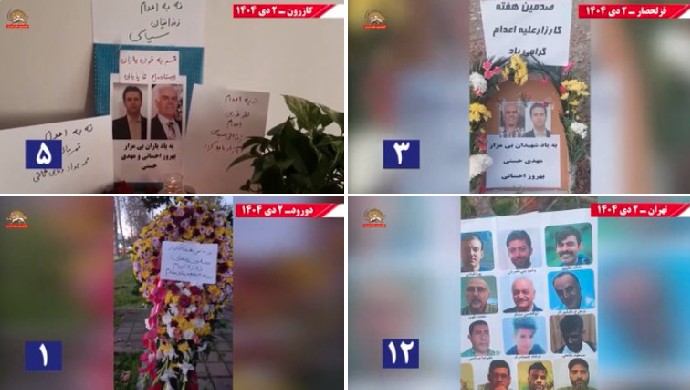

On December 23, 2025, the nationwide movement against the Iranian regime’s use of capital punishment reached a historic milestone. Marking the 100th consecutive week of the “No to Executions Tuesdays” campaign, Resistance Units affiliated with the People’s Mojahedin Organization of Iran (PMOI/MEK) launched a massive, coordinated wave of anti-regime activities. Across the country, brave activists carried out 116 protest actions in 80 cities, signaling that the regime’s strategy of intimidation through the gallows has failed to silence the call for freedom.
From prison cells to city streets
The “No to Executions Tuesdays” campaign began as a protest within the walls of Ghezelhesar Prison but has since expanded into a resilient network spanning 55 prisons. For one hundred weeks, political prisoners have organized weekly hunger strikes and issued statements to challenge the state’s “machinery of death.” The Resistance Units have now amplified this voice beyond the prison walls.
Dorud
“In memory of martyred comrades Behrouz Ehsani and Mehdi Hassani in the one hundredth week of the Tuesdays No to Executions campaign" pic.twitter.com/c6bIcUo2yc— People's Mojahedin Organization of Iran (PMOI/MEK) (@Mojahedineng) December 24, 2025
In their latest activities, Resistance Units honored the perseverance of these prisoners. In Tehran, placards appeared in public spaces declaring, “We stand with political prisoners and will be your voices,” and “One hundred weeks of protest, one hundred weeks of crying out against executions and tyranny.” In Shahriar, banners saluted the prisoners who have endured 100 weeks of hunger strikes, demanding the release of all political detainees.
Honoring the martyrs denied a grave
A central theme of the 100th-week protests was the commemoration of PMOI supporters recently executed by the regime. In cities like Dorud, Kazeroun, and near Ghezelhesar Prison, Resistance Units paid tribute to Mehdi Hassani and Behrouz Ehsani, who were executed in July 2025.
The regime, in a cruel attempt to erase their memory and torture their families, buried them in secret and denied them proper funerals—a tactic repeatedly used against the opposition. Defying this erasure, Resistance Units laid flowers and displayed signs reading, “In memory of the martyrs who were denied graves.” In Kazeroun, activists swore by the blood of their comrades to “stand till the end.”
Kazeroun
"In memory of the martyrs who were denied graves, Mehdi Hassani and Behrouz Ehsani"
"No to execution of political prisoners"
"We swear by the blood of our comrades that we will stand till the end" pic.twitter.com/WbOg0O0Oi5— People's Mojahedin Organization of Iran (PMOI/MEK) (@Mojahedineng) December 24, 2025
A national demand for the abolition of the death penalty
The scope of the protests illustrates that the abolition of the death penalty has become a national demand. In Tehran, Bam, and other cities, posters called for halting the execution of specific political prisoners, including boxing champion Mohammad Javad Vafaei Sani, as well as Karim Khojasteh and Ehsan Faridi.
Even during Yalda Night—an ancient Persian festival celebrating the longest night of the year—supporters in Karaj gathered in freezing temperatures to chant, “No to executions.” From inside Tabriz prison, political prisoner Ehsan Faridi sent a voice message expressing his love and solidarity with the movement.
Tehran: “Marking the 100th week of the ‘No to Executions Tuesdays’ campaign in solidarity with prisoners”
"We stand with political prisoners and will be your voices" pic.twitter.com/tl7KZvq4tu— People's Mojahedin Organization of Iran (PMOI/MEK) (@Mojahedineng) December 24, 2025
The failure of the machine of repression
The regime, engulfed in crises, has accelerated its execution machine in a desperate bid to prevent public anger from erupting. However, the 116 distinct actions carried out across 80 cities prove that this tactic has backfired. Instead of instilling fear, the executions have fueled organized resistance.
As one slogan in Ardabil poignantly stated, “The hangman’s noose has no effect on Damavand,” referring to the iconic mountain that symbolizes Iranian resilience. The 100th week of this campaign stands as a testament to the regime’s inevitable defeat in the face of a resistance that refuses to bow.