

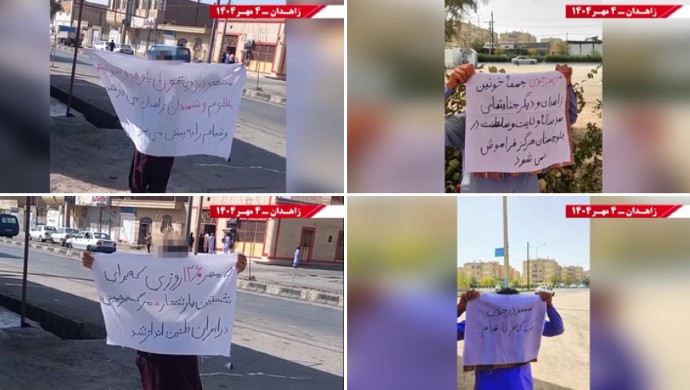

On Friday, September 26, 2025, in the southeastern city of Zahedan, PMOI Resistance Units took to the streets in a bold display of defiance, demonstrating the unwavering spirit of the Iranian people’s struggle for freedom. Their activities commemorated two pivotal moments in Iran’s history of resistance: the third anniversary of the “Bloody Friday of Zahedan” and the 44th anniversary of the historic September 27, 1981 demonstration. By linking these events, the units sent a clear message that the fight against the clerical dictatorship is part of an unbroken chain of sacrifice and resistance, vowing to continue the struggle for a free and democratic republic in Iran.
"The Bloody Friday of Zahedan and other century-long crimes of the monarchy and clerical rule in Baluchestan will never be forgotten" pic.twitter.com/H4KEE5BFKa
— People's Mojahedin Organization of Iran (PMOI/MEK) (@Mojahedineng) September 27, 2025
Honoring the martyrs of Zahedan’s bloody Friday
The commemoration of Zahedan’s Bloody Friday serves as a raw and powerful reminder of the regime’s brutality. On September 30, 2022, inspired by the nationwide uprising, the people of Zahedan gathered after Friday prayers to protest the rape of a 15-year-old Baluch girl by a local police commander. The regime’s security forces responded with shocking violence, opening fire on unarmed civilians and worshippers, leaving over a hundred dead and wounded.
This massacre was not an isolated incident but a reflection of the regime’s systematic oppression of Iran’s ethnic and religious minorities. The Resistance Units honored the victims, ensuring their names and sacrifices are never forgotten. Among those remembered are Hasti Narouyi, a seven-year-old girl shot and killed just a week before she was to start first grade, and Khodanur Lojei, whose image tied to a flagpole became an international symbol of the regime’s cruelty. The units held placards declaring, “The blood of the Baluch and the oppressed fuel carriers, and the martyrs of Zahedan, is alive and driving the uprising forward,” and promised, “We will not let the blood of…Hasti Narouyi…be forgotten or trampled on.”
The sustained defiance of the Baluch people, who have continued their Friday protest demonstrations for years and firmly rejected the Supreme Leader’s attempts at “reconciliation,” shows that the spirit of the uprising is stronger than ever.
Echoes of 1981: a legacy of breaking the tyranny
The Resistance Units also marked the 44th anniversary of the September 27, 1981 demonstration, a watershed moment in the struggle against the theocracy. Following a brutal crackdown that began on June 20, 1981, when Ruhollah Khomeini ordered his forces to open fire on a peaceful half-million-strong PMOI demonstration, the resistance movement faced a new level of repression.
In this atmosphere of terror, the PMOI took to the streets again on September 27, 1981, to challenge the regime’s chokehold on society. For the first time, the popular slogan “Death to Khomeini” echoed through the streets of Tehran, shattering the illusion of the Supreme Leader’s holiness and invincibility. The regime’s response was swift and merciless. Over 1,100 young Iranians were gunned down that day, and hundreds more were executed in prisons that same night without even being identified.
“September 27, 1981 — the day the slogan 'Down with Khomeini' echoed across Iran for the first time” pic.twitter.com/gED3JBaA7q
— People's Mojahedin Organization of Iran (PMOI/MEK) (@Mojahedineng) September 27, 2025
Today, the Resistance Units honor this legacy of courage. Their banners described the event as “The epic of September 27 — the day the idol of the Supreme Leader’s theocracy was shattered,” and paid tribute to the heroes who “sacrificed their pure blood for freedom on September 27, 1981.”
A clear vision for the future: no to all dictators
The slogans brandished by the Resistance Units in Zahedan articulated a clear and resolute vision for Iran’s future. With placards reading, “Death to the oppressor, be it the shah or the supreme leader,” they rejected any return to past dictatorships while fighting to overthrow the current one. This popular slogan counters the narrative promoted by remnants of the monarchy and affirms the Iranian people’s desire for genuine democracy.
This message was reinforced by other banners stating, “Neither monarchy nor clerical leadership — democracy and freedom,” and, “The people of Baluchestan will never reconcile with the oppressive monarchy or the clerical rule.”
"Down with the oppressor, be it the shah or the supreme leader" pic.twitter.com/YlN5uAKcJZ
— People's Mojahedin Organization of Iran (PMOI/MEK) (@Mojahedineng) September 27, 2025
The Resistance Units also sent a message to the world, demanding accountability and action from the international community. They called for the “activating the snapback mechanism” as a “huge blow to the regime” and insisted that “Iran’s seat at the United Nations must not be given to the regime of executions and massacres.”
The uprising continues until victory
The activities in Zahedan demonstrate that the struggle for a free Iran is organized, deeply rooted in history, and relentless. The memory of the martyrs of 1981 and 2022 fuels the determination of today’s generation to achieve the freedom for which so many have sacrificed. The message from the streets of Baluchestan is the message of all of Iran: the uprising will continue until the tyrannical regime is overthrown. As one placard powerfully declared, the path forward is clear: “No reconciliation, no surrender — fight until the overthrow.”