

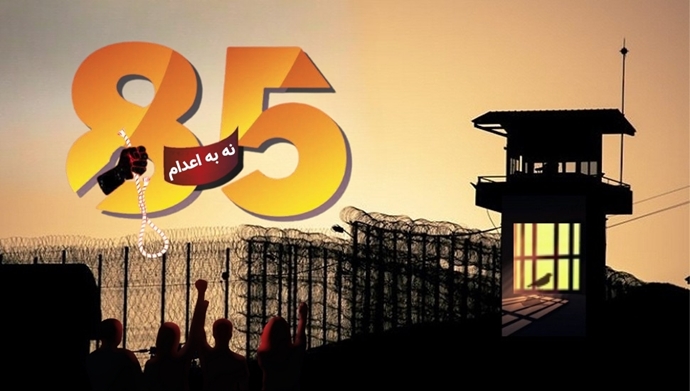

On Tuesday, September 9, 2025, Iran’s nationwide “No to Executions Tuesdays” campaign marked its 85th consecutive week with a significant expansion of organized defiance, demonstrating a powerful link between resistance inside prison walls and growing outrage on the streets. Prisoners in Sabzevar prison joined the weekly hunger strike, bringing the total number of participating facilities to 52, while simultaneous protests erupted in dozens of cities, turning a prisoner-led initiative into a national movement against the regime’s machinery of death.
A grim backdrop of escalating state-sanctioned killings
The protests come amid a horrifying acceleration in the regime’s use of capital punishment. According to the campaign’s latest statement, authorities have executed a staggering 756 people since the beginning of the Persian year in March 2025. The pace has intensified dramatically in September, with 92 hangings recorded in the first nine days of Sharivar (starting on August 23), including four women. In the past week, the regime has taken the lives of 46 individuals.
Among the recent victims was political prisoner Mehran Bahramian, whose execution in Semirom sparked immediate outrage, leading to a defiant strike by local shopkeepers and residents. In another instance, the regime executed two Sunni prisoners, Eskandar Bazmandegan and Mohammad Kashefi, in Shiraz’s Adel Abad prison. The data also reveals that Ghezel Hesar prison has become a major execution hub, accounting for 100 of this year’s 756 executions, or over 13% of the total.
Prisoners lead the defiance from behind bars
In their 85th weekly statement, the political prisoners leading the campaign condemned the regime’s policies in the strongest terms. “Execution is a tool for the blatant violation of human rights and the suppression of freedoms,” the prisoners declared. Their statement conveyed an unwavering resolve, asserting their core demands: “We demand the immediate and complete halt to executions across the country.”
The prisoners’ message has resonated far beyond their cells, framing the struggle in universal terms. “Life is the fundamental right of every human being, and no government has the right to take it away from anyone,” their statement affirmed. The weekly hunger strike is now observed in the following 52 prisons: Evin, Ghezel Hesar (Units 3 & 4), Karaj Central, Fardis, Greater Tehran, Qarchak, Khorin, Choubindar, Ahar, Arak, Langroud, Khorramabad, Yasuj, Asadabad, Dastgerd, Sheiban, Sepidar (men’s and women’s wards), Nezam, Adel Abad (men’s and women’s wards), Firouzabad, Dehdasht, Zahedan (women’s ward), Borazjan, Ramhormoz, Behbahan, Bam, Yazd, Kahnuj, Tabas, Mashhad, Gonbad-e Kavus, Ghaemshahr, Rasht (men’s and women’s wards), Roudsar, Havigh, Azbaram, Dizel Abad, Ardabil, Tabriz, Urmia, Salmas, Khoy, Naqadeh, Miandoab, Mahabad, Bukan, Saqqez, Baneh, Marivan, Sanandaj, Kamyaran, and Sabzevar.
Streets across Iran answer the prisoners’ call
September 9—Iran
In tandem with the 85th week of the "No to Executions" campaign in 52 prisons across Iran, families of death-row political prisoners rally to support the campaign and call for an end to executions in Iran.pic.twitter.com/nujLRSRKVe— People's Mojahedin Organization of Iran (PMOI/MEK) (@Mojahedineng) September 9, 2025
The prisoners’ steadfast resistance was met with a powerful echo on the streets. In cities from Tehran and Kermanshah to Sabzevar, Zanjan, and Chalus, families of prisoners and defiant citizens held coordinated protests. Demonstrators held images of executed prisoners, particularly Mehran Bahramian, whose name has become a rallying cry against state brutality.
The air in these cities was filled with chants that directly challenged the regime’s authority and pledged continued resistance. Slogans included: “Political prisoner must be freed,” “We swear on the blood of our comrades, we will stand until the end.”
The seamless coordination between the hunger strikes inside Iran’s most notorious prisons and the public demonstrations outside marks a critical phase for the opposition. What began as an act of defiance by political prisoners has now visibly transformed into what observers call a “national and social demand.” The regime’s primary tool of intimidation is now fueling a unified and organized movement, with the prisoners’ final declaration serving as its mission: “No to executions, no to dictatorship and oppression, yes to justice and the sovereignty of the people.”