

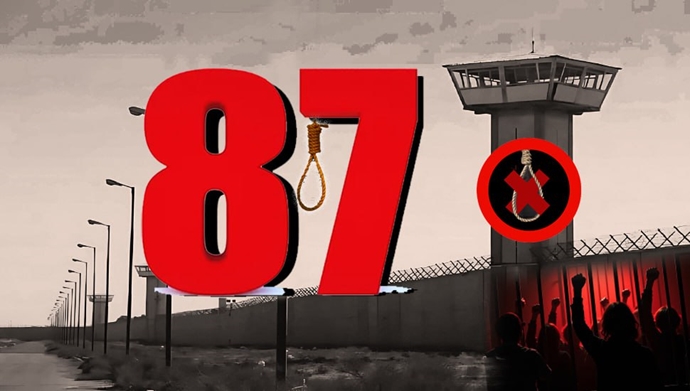

As the Iranian regime accelerates its use of capital punishment, the nationwide “No to Executions Tuesdays” campaign entered its 87th consecutive week on September 23, 2025, with a coordinated display of defiance inside and outside prison walls. On Tuesday, political prisoners across 52 of the country’s most notorious prisons began a hunger strike, while citizens in over a dozen cities took to the streets in solidarity, challenging the regime’s campaign of fear with a unified call for life and liberty.
The campaign, which began in January 2024, has become a potent symbol of organized resistance against the state’s execution machine. Its 87th week unfolds against a backdrop of what the campaign described as an “unprecedented increase” in state-sanctioned killings. According to reports, the regime has executed at least 46 people since September 16, including two women and six Balochi citizens. In the month leading up to this week’s protest, a total of 186 individuals, including seven women, were sent to the gallows.
A flashpoint in Ghezel Hesar prison
The regime’s brutality was starkly illustrated by the recent execution of Babak Shahbazi, himself a member of the “No to Executions Tuesdays” campaign inside Ghezel Hesar prison. He was executed on the anniversary of the 2022 nationwide uprising and was denied a final meeting with his family. Reports indicate that Shahbazi was secretly taken from his ward for execution, an act that prompted an immediate protest and sit-in by his fellow inmates.
The campaign’s weekly statement condemned the regime’s duplicity, stating, “A government that on the one hand speaks of ‘pardoning’ prisoners, on the other hand, reveals its bitter and anti-human reality by increasing the number of executions every week.”
A nationwide hunger strike that echoes in the streets
In their statement, the prisoners declared their unwavering commitment to confronting the regime’s policies. “In the face of these violent and anti-human policies, silence is not permissible. Our voice must be stronger than any oppression and tyranny,” the statement read. It affirmed a core principle of their struggle: “Life is the fundamental right of every human being, and execution is an unjustifiable violence against this right.”
Simultaneously, the prisoners’ hunger strike was amplified by street protests in cities including Tehran, Yasuj, Mashhad, Karaj, Sanandaj, Isfahan, and Birjand. Protesters, including the families of political prisoners, held signs with images of the condemned and chanted slogans that directly challenged the regime’s authority. Chants like “Political prisoners must be freed,” “Fire is the answer to execution,” and the stark warning, “This is the final message, if you execute, there will be an uprising,” echoed through the streets.
The families of prisoners have been a driving force in the campaign. One mother at a recent gathering stated, “We are here for the lives of our children. Every noose that goes up burns a mother’s heart and wounds society.” This sustained, two-front resistance movement illustrates a critical shift, turning the regime’s primary tool of intimidation into a catalyst for unified, nationwide defiance.
The prisoners participating in the 87th week of the “No to Executions Tuesdays” hunger strike are from the following 52 prisons:
Evin Prison, Ghezel Hesar Prison (Units 3 and 4), Karaj Central Prison, Fardis Prison of Karaj, Greater Tehran Prison, Qarchak Prison, Khorin Prison of Varamin, Choubindar Prison of Qazvin, Ahar Prison, Arak Prison, Langarud Prison of Qom, Khorramabad Prison, Yasuj Prison, Asadabad Prison of Isfahan, Dastgerd Prison of Isfahan, Sheiban Prison of Ahvaz, Sepidar Prison of Ahvaz (men’s and women’s wards), Nezam Prison of Shiraz, Adelabad Prison of Shiraz (men’s and women’s wards), Firuzabad Prison of Fars, Dehdasht Prison, Zahedan Prison (women’s ward), Borazjan Prison, Ramhormoz Prison, Behbahan Prison, Bam Prison, Yazd Prison, Kahnuj Prison, Tabas Prison, Mashhad Prison, Sabzevar Prison, Gonbad-e Kavus Prison, Ghaemshahr Prison, Rasht Prison (men’s and women’s wards), Rudsar Prison, Havigh Prison of Talesh, Azbaram Prison of Lahijan, Dizel Abad Prison of Kermanshah, Ardabil Prison, Tabriz Prison, Urmia Prison, Salmas Prison, Khoy Prison, Naqadeh Prison, Miandoab Prison, Mahabad Prison, Bukan Prison, Saqqez Prison, Baneh Prison, Marivan Prison, Sanandaj Prison, and Kamyaran Prison.