

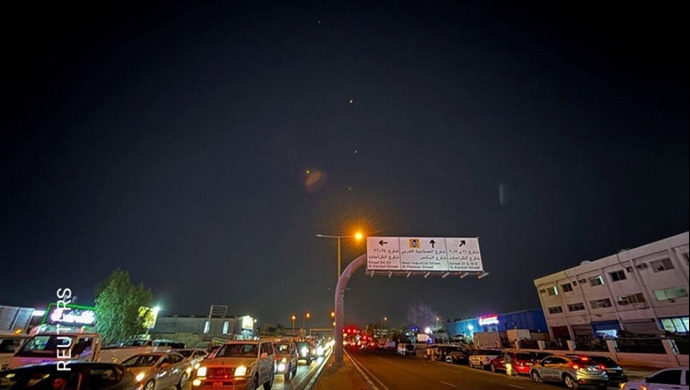

On Monday, June 23, the eleventh day of the conflict in the region, tensions surged as Iran launched a retaliatory missile strike against a major U.S. airbase in Qatar, while Israeli forces simultaneously conducted what was described as the most intense bombing yet of the Iranian capital, Tehran.
The direct Iran-U.S. military exchange came a day after the United States intervened by striking several of Iran’s key nuclear facilities, turning threats of retaliation from the Iranian regime into military action and raising fears of a wider regional war. Key developments included Iran’s attack on the U.S. base, a targeted Israeli strike on Tehran’s notorious Evin Prison, renewed attacks on nuclear sites, and significant disruptions to global energy markets.
The U.S. State Department doubled its emergency evacuation flights for American citizens in Israel and ordered the departure of nonessential staff from its embassy in Lebanon. The U.S. had previously cited concerns of Iranian retaliation, which materialized with the attack on the base in Qatar. A worldwide alert was issued advising all U.S. citizens abroad to exercise increased caution due to potential demonstrations and travel disruptions.
Aftermath of U.S. airstrikes on Iranian nuclear facilities
Following the U.S. attacks on Iranian nuclear sites on Sunday, June 22, the White House defended the operation as a necessary measure. Press Secretary Karoline Leavitt told ABC News that Iran posed an “imminent threat” and that the strikes had “took away Iran’s ability to create a nuclear bomb.” She added that the administration had a “high degree of confidence” that enriched uranium was stored at the targeted locations (Associated Press).
The Iranian regime responded with threats of retaliation. Regime President Masoud Pezeshkian told French President Emmanuel Macron that the United States “must receive a response” for its aggression (DW). Foreign Minister Abbas Araghchi condemned the strikes, stated that the time for diplomacy was over, and called for an emergency session of the UN Security Council, asserting Iran’s right to self-defense under the UN Charter (Euronews).
Adding to the condemnation, the Iranian regime’s ambassador to the International Atomic Energy Agency (IAEA), Reza Najafi, described the attack as an “unprecedented act of aggression” that delivered an “irreparable blow” to the global non-proliferation treaty (Associated Press).
Mohammad Eslami, the head of the Iranian regime’s Atomic Energy Organization, sent two letters to IAEA Director General Rafael Grossi, warning that if he did not condemn the attacks, the consequences would fall on the agency. Eslami also vowed that “the growth of Iran’s nuclear industry will become exponential” following the incident.
Russian President Vladimir Putin, meeting with Araghchi in Moscow, labeled the U.S. strikes an “absolutely unprovoked aggression” (Associated Press). Meanwhile, IAEA Director General Grossi called for a “cessation of hostilities” to allow inspectors to return to Iran and verify the status of the country’s 400kg stockpile of uranium enriched to 60% purity, which was last seen on June 10 (CNN).
IAEA inspectors are in Iran, and they must do their job, including verifying 400kg of uranium enriched to 60%.
For that, we need a cessation of hostilities. Any arrangement requires establishing the facts on the ground, which can be done only through IAEA inspections.— Rafael Mariano Grossi (@rafaelmgrossi) June 22, 2025
The conflict’s economic impact was immediate. Oil prices hit a five-month high, with Brent crude reaching $77.86 a barrel (Reuters). The head of the International Monetary Fund, Kristalina Georgieva, warned that the strikes had amplified an already “highly uncertain environment” for the global economy (CNN). Fears of supply disruption were heightened as at least two supertankers were observed making U-turns near the Strait of Hormuz, a critical chokepoint for global oil transit (Reuters).
Iran’s Retaliation Against U.S. Forces in Qatar
On Monday, Iran’s military followed through on its threats by carrying out a missile attack on the Al Udeid U.S. airbase in Qatar, the largest American military installation in the Middle East (Reuters). The IRGC claimed it had launched a “devastating and powerful missile attack” against the base, which it called the “headquarters of the Air Force and the largest strategic asset of the US terrorist army in the West Asia region” (Axios).
However, U.S. officials reported that there were no American casualties or injuries in the attack (Reuters, Axios). Qatar’s defense minister stated that its air defenses had intercepted the missiles, and its foreign ministry confirmed the attack was thwarted with no casualties (Reuters, Axios).
https://twitter.com/en_simayazadi/status/1937200893281087696
The strike appeared to be a carefully calibrated and telegraphed action. A source familiar with the matter told Axios that Iran was in contact with Qatar before the attack and that the Trump administration had “good advance warning” (Axios). In a statement, Iran’s Supreme National Security Council claimed the number of missiles fired was equal to the number of bombs the U.S. used in its strike on Saturday. The statement also noted that the targeted base was “far from urban facilities and residential areas in Qatar” (Axios).
Following the attack, both Qatar and Bahrain shut their airspace, and the U.S. Ain al-Asad air base in Iraq activated its air defense systems as a precaution (Reuters).
The Iranian strike drew swift and widespread condemnation from across the Arab world. Egypt called the attack a “violation of (Qatar’s) sovereignty” and a “breach of international law.” Saudi Arabia deemed it an “entirely unacceptable act,” while Jordan condemned the “aggression launched by Iran against the sisterly state of Qatar.” Bahrain, Oman, and the office of the Palestinian Authority President also issued statements condemning the attack and the regional escalation (CNN).
The attack on Evin Prison
In a significant escalation, Israeli forces targeted Evin Prison in Tehran, one of the most potent symbols of the Iranian regime’s system of repression (Reuters). Israel’s Defense Ministry confirmed it was attacking the prison, among other governmental targets in the capital (Associated Press). Iran’s judiciary acknowledged the attack via its Mizan news agency, stating that “the situation in the prison is under control” despite parts of the facility being damaged (Associated Press). Video footage reportedly showed a gate at the site being blasted open (Associated Press).
#Breaking #evinprison The doors of all halls and wards are closed to the outside, and the prisoners have no way out.
The Evin prison infirmary has also been targeted, and its building is burning.
Parts of the prison buildings have burned and been destroyed to the extent that… https://t.co/M4TbCqT8Ia— SIMAY AZADI TV (@en_simayazadi) June 23, 2025
According to reports from inside Iran indicate that the attack, which occurred around 11:30 AM Iran time, targeted the prison’s administrative and guard sections, including the judiciary and interrogation offices of the notorious Ward 209. As a result, all doors to the prison’s halls and wards were sealed, trapping inmates inside.
Significant damage was reported across the complex. The explosion shattered windows in multiple wards, partially destroyed a wall in the women’s ward, and caused injuries to a number of female prisoners and inmates in Ward 4. The prison’s clinic was reportedly on fire, and the roof of the sports hall between Wards 7 and 8 collapsed and also caught fire, with prisoners attempting to extinguish the flames. Guards were seen evacuating political prisoners from Ward 209 to an unknown location. Farshid Tavassoli, the deputy for health at the prison, was reportedly killed in the attack.
#Breaking: Our sources confirm that the regime has fully evacuated Ward 209 of Evin Prison. Some inmates have been relocated to the prison yard.
Footage below shows the fire at Evin Prison pic.twitter.com/8ETSqu7RRz
— SIMAY AZADI TV (@en_simayazadi) June 23, 2025
Other Israeli military operations against Iran
Beyond Evin Prison, Israel’s Defense Ministry announced strikes on the security headquarters of the Revolutionary Guards (IRGC), Palestine Square, and the paramilitary Basij volunteer corps in Tehran (Associated Press). State-run media reported explosions and air defense activity in Karaj, Shiraz, and Qom, with additional Israeli airstrikes hitting Parchin, southeast of Tehran (state-run Chand Sanieh Telegram channel). Columns of smoke were seen rising from the city of Tabriz, and the Israeli army released images it said showed attacks on six airports across western, eastern, and central Iran (Al Arabiya).
For the second time in as many days, Iran’s underground Fordo enrichment site was attacked on Monday, according to Iranian state television (Associated Press). This followed the major U.S. attack on the site Sunday, which utilized sophisticated bunker-buster bombs (Associated Press).
The attacks resulted in casualties across the country. An Israeli attack in Yazd province killed 10 people, according to the public relations of the IRGC in Yazd Province. In Tehran, nuclear expert Mostafa Sadati Armaki was killed in an Israeli strike, according to the state-run Khabar Online. Separately, Brigadier General Ali Hossein Mohammadi, commander of the 71st Mechanized Infantry Brigade, and five of his troops were killed in western Iran according to Tasnim News Agency.
Iranian regime’s military and internal security response
The regime’s leadership projected a defiant stance. Supreme Leader Ali Khamenei posted on X, “The punishment continues,” adding, “The Zionist enemy has made a big mistake… it must be punished and it is being punished.”
The Chief of Staff of the Armed Forces, Abdolrahim Mousavi, declared, “We will act against the Americans in proportion to their actions,” and vowed that the “punishment of Netanyahu will continue with force until he is brought to misery.”
In terms of military action, the regime’s Tasnim News Agency claimed that its “Operation True Promise 3” had struck an Israeli army command center in northern Israel.
Power outages were reported in northern Tehran following the attacks. Police announced the arrest of a network that had been flying drones from the mountains northwest of the capital (state-run Telegram Chand Sanieh channel).
In Bushehr province, the intelligence department announced that several individuals had voluntarily surrendered their drones following a deadline set by the Supreme National Security Council for Sunday, June 22, according to Bushehr Province General Directorate of Intelligence.
Meanwhile, the leader of Lebanon’s Hezbollah, Naim Kassem, indicated the group would not join the war for now, stating it would back any decision by the Lebanese state to pressure Israel to stop the war (Associated Press).