


On Sunday, August 6, a group of residents of Baghmisheh district of Tabriz, northwest Iran, protested against a week-long water outage in this city by holding a protest rally in Vanak Square chanting: “We want to drink water!”
The water crisis in Tabriz has entered its second week, while East Azerbaijan province is one of the watershed provinces of Iran.
August 6—Tabriz, northwest #Iran
Locals hold protests and block roads as they have been facing water outages for one week.#IranProtestspic.twitter.com/OHlzgKpyoZ— People's Mojahedin Organization of Iran (PMOI/MEK) (@Mojahedineng) August 6, 2023
According to local sources, at least a dozen neighborhoods in Tabriz are facing water outages. Also, over the past three days, drinking water in Erem, Nasr and Marzdaran settlements and many areas, neighborhoods and large towns of Tabriz has been completely cut off, or the residents only had access to water at low pressure during limited hours of the day.
The drought crisis has been one of the most important challenges in Iran in recent years. Following the drought crisis and inefficient water management that now covers large areas of Iran, people in the eastern and western provinces of the country took to the streets again and announced their protests. On July 31, a large number of residents of Zabol city, Sistan and Baluchestan province, protested water shortages. And on the previous day, the people of Divandarreh in Kurdistan province chanted anti-government slogans on the streets after three days of definite drinking water.
More footage of yesterday's protest rally in Divandarreh. According to reports, security forces shot tear gas cannisters into the crowd, injuring at least four people. The rally was in protest to the constant water outages in the scorching summer heat.pic.twitter.com/HGb7eKR0A0
— People's Mojahedin Organization of Iran (PMOI/MEK) (@Mojahedineng) August 1, 2023
Protests also continue in other sectors of the country as the regime’s destructive policies continue to drive the economy into bankruptcy. Sunday and Monday saw two days of widespread protests by retirees and pensioners.
On Sunday, the pensioners of the regime’s Social Security Organization held protests in several cities including Kermanshah, Shushtar, Ahvaz, Dezful, and Shush.
August 5—Shush, southwest #Iran
Retired workers of Shush and Haft Tappeh resume their protests, demanding higher pensions and other basic needs that the regime has denied them.#IranProtests pic.twitter.com/2MrFhWyiQR— People's Mojahedin Organization of Iran (PMOI/MEK) (@Mojahedineng) August 6, 2023
In the past few years, retirees across Iran have been protesting their deteriorating living conditions, especially as the government refuses to adjust their pensions based on the inflation rate and fluctuations in the price of the rial, Iran’s national currency. The price of most basic goods have spiked severalfold while pensioners continue to receive the same stipends as before.
In Shushtar, the protesters were chanting, “Yesterday’s soldiers are today’s hungry!” Many of these people are veterans and victims of the regime’s eight-year war with Iraq. The Social Security Organization had promised to provide their basic needs. But today, they have to shout for their basic needs in the streets.
One of the protesters said, “They don’t see us. They don’t see the poverty, the people, the poverty of the father who feels ashamed in front of his children because he can’t pay rent.”
One of the protesters at the rally of retirees of Shush:
"They don't see us. They don't see the poverty, the people, the poverty of the father who feels ashamed in front of his children because he can't pay rent."pic.twitter.com/QvrX6Wd8os— People's Mojahedin Organization of Iran (PMOI/MEK) (@Mojahedineng) August 6, 2023
One of the recurring themes in the protests by the retirees is demanding the regime to implement the laws that its own parliament has passed. There are several laws for more than a decade ago that require the government to adjust the pensions of retirees based on inflation rates and to make sure that their needs are met. But every administration promises to address the needs of the retirees, only to dither and delay until the next government comes into office.
The regime has continuously refrained from raising pensions according to rising inflation rates and prices. Having not received any response from the regime, the retirees continue to hold their weekly rallies. Many protesters held placards that read, “We will only obtain our rights in the streets.”
August 6—Ahvaz, southwest #Iran
Retirees of the Social Security Organization resume their protests, demanding higher pensions and other basic needs that the regime has denied them. #IranProtests pic.twitter.com/QUb4Qt1QXW— People's Mojahedin Organization of Iran (PMOI/MEK) (@Mojahedineng) August 6, 2023
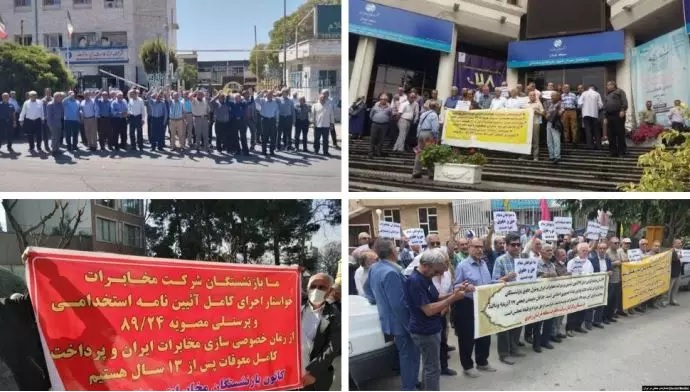
On Monday, the retirees of the telecom industry resumed their weekly protests, holding rallies in more many cities, including Mashhad, Qazvin, Arak, Shahrekord, Borujerd, Shiraz, Rasht, Ahvaz, Isfahan, Kermanshah, Tabriz, Zanjan, Urmia, and Sanandaj.
The protesters are demanding basic needs that they have raised for more than 13 years and the regime has constantly ignored. This includes a law that was passed in 2010 and requires the state-run telecom company to raise the pensions of retirees and provide them with their basic needs.
August 7—Ilam, western #Iran
Retirees of the telecom industry hold protest rally in front of the offices telecom company, demanding higher pensions and other basic needs.#IranProtestspic.twitter.com/IU5kOj32bk— People's Mojahedin Organization of Iran (PMOI/MEK) (@Mojahedineng) August 7, 2023
In Isfahan, the protesters called out regime officials, the government, and the parliament for ignoring their demands. They called out the regime’s broadcasting corporation, which has been censoring their protests to prevent their voices from being heard. They chanted slogans against the shareholders of the telecom company, which are linked to the regime and are implementing policies that are making regime officials rich at the expense of the employees and retirees of the company.
The protesters also chanted slogans against Majid Soltani, the CEO of the state telecom company. Soltani, who took charge of the company in 2020, was previously the head of technology and communications of the repressive State Security Forces (SSF).
August 7—Isfahan, central #Iran
Retirees of the telecom industry hold protest rally, demanding 13 years of overdue payments and chanting slogans against regime officials who are ignoring their demands.#IranProtestspic.twitter.com/nwYsHczL3K— People's Mojahedin Organization of Iran (PMOI/MEK) (@Mojahedineng) August 7, 2023
Also on Monday, the defrauded customers of the state-run Bahman Khodro car company in Bandar Abbas held a protest rally in front of the justice ministry to protest the company refraining from delivering their purchases and refunding them. Bahman Khodro is one of several state-run car companies that have become a symbol of the corruption of the vehicle industry that has regime officials’ fingerprints all over it.
August 7—Bandar Abbas, southern #Iran
Protest rally by the defrauded customers of the state-run Behnam Khodro car company.#IranProtestspic.twitter.com/QBXnYt0bCs— People's Mojahedin Organization of Iran (PMOI/MEK) (@Mojahedineng) August 7, 2023
In Borujerd, the workers of the local textile company held strikes and protests. The workers are protesting the layoff of 25 of their coworkers. They are demanding the clarification of the status of our delayed wages.
In Tabriz, home buyers of Khavaran Phase 2 held a protest rally. They had made down payments for their homes 12 years ago, but regime authorities and contractors have not yet delivered their homes. Like the car industry, housing has become a source of fraud and embezzlement by regime officials and a sinkhole for the savings of people who want to buy homes.
August 7—Tabriz, northwest #Iran
Home buyers of Khavaran Phase 2 hold protest rally. They had made down payments for their homes 12 years ago, but regime authorities and contractors have not yet delivered their homes.#IranProtests pic.twitter.com/ltuI25Bh6z— People's Mojahedin Organization of Iran (PMOI/MEK) (@Mojahedineng) August 7, 2023