

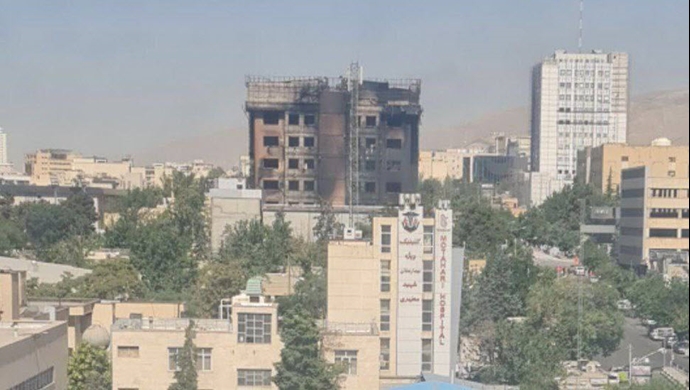

The conflict between Iran’s regime and Israel intensified on its ninth day, Saturday, June 21, with both sides launching significant new waves of attacks. Israel announced it had killed senior Iranian commanders and struck a nuclear facility, while Iran’s regime retaliated with missile and drone barrages. These military escalations unfolded as high-level diplomatic efforts by European powers failed to produce a breakthrough, with both Tehran and Washington holding firm to their conflicting demands.
Israel’s intensified air campaign inside Iran
Israel’s military campaign on Saturday appeared to focus on high-value targets within Iran’s military and nuclear infrastructure. Israeli Defense Minister Israel Katz announced that an airstrike in the city of Qom had killed Saeed Izadi, the commander of the Palestine Corps of the Islamic Revolutionary Guard Corps (IRGC) Quds Force (Reuters). Israel also claimed to have killed a second Quds Force commander, identified as Behnam Shariyari, in an overnight strike. The IRGC’s public relations office confirmed that attacks in Khorramabad killed five of its members (Mehr News Agency).
Israeli forces also targeted key infrastructure. The Israeli air force stated it had launched a new wave of attacks against missile storage and launch facilities in central Iran (DW). In Isfahan, a senior official for the governorate confirmed that the Isfahan nuclear facility was hit by an Israeli attack on Saturday morning, but claimed that no hazardous materials had leaked (Tabnak, Fars News Agency). Additional strikes were reported on Iranian military bases near the Iraqi border (Al-Arabiya) and a Basij militia base in Behbehan.
The human cost of the conflict continues to rise. Iran’s regime’s Health Minister, Mohammadreza Zafarqandi, accused Israel of attacking three hospitals, killing two health workers and a child, and targeting six ambulances (Fars News Agency). The ministry stated that since the conflict began on June 13, at least 430 people have been killed and 3,500 injured in Iran (Nour News via Reuters). The U.S.-based Human Rights Activists News Agency reported a higher death toll, putting the number of killed at 639 (Reuters).
Iran’s retaliatory attacks and domestic response
In response, Iran’s regime launched its 18th wave of attacks under “Operation True Promise 3” (Mehr News Agency). The IRGC claimed it targeted Israel’s Ben Gurion Airport and other military support centers with Shahed-136 drones and precision-guided missiles (Tasnim News Agency). Early on Saturday, air raid sirens were activated across parts of central Israel. Israeli emergency services released images of a fire on the rooftop of a residential building in central Israel, which it said was caused by debris from an intercepted rocket (Reuters, Israeli Emergency Services).
Inside Iran, air defense systems were activated in multiple cities, including Tehran, Qom, Isfahan, and Karaj, starting in the early hours of Saturday morning (Chand Sanieh).
The digital rights monitor NetBlocks reported that a “nation-scale internet shutdown” has been in effect for 60 hours, severely limiting residents’ ability to communicate and access information.
⚠️ Update: Internet connectivity has again collapsed in #Iran following a brief period when residents could exchange messages with the outside world; Iran's nation-scale internet shutdown remains in effect, limiting access to information as the conflict with Israel continues pic.twitter.com/rtRvktC8Wg
— NetBlocks (@netblocks) June 21, 2025
Amidst the conflict, the regime has intensified its internal security measures. The head of the judiciary, Gholam-Hossein Mohseni-Eje’i, announced that individuals arrested on accusations of collaborating with Israel will face swift and harsh punishment. “We are in a state of war and we don’t have time to let a case drag on for two months,” he said after visiting a detention center for those arrested (Chand Sanieh).
On Friday, Amnesty International issued a statement urging Iranian authorities to “halt all plans to carry out arbitrary executions” and protect those arrested on espionage charges from torture and ill-treatment.
Iranian authorities must halt all plans to carry out arbitrary executions and protect all those arrested over accusations of espionage for Israel from enforced disappearance, torture and other ill-treatment. https://t.co/l4pT6X4HW8
— Amnesty Iran (@AmnestyIran) June 20, 2025
Diplomatic efforts stall as positions harden
Diplomatic initiatives ran in parallel to the military conflict but yielded little progress. In Istanbul for a meeting of the Organisation of Islamic Cooperation, the Iranian regime’s Foreign Minister Abbas Araghchi stated that diplomacy could only resume once Israel’s attacks stopped. “It is obvious that I can’t go to negotiations with the U.S. when our people are under bombardments,” he told reporters (Reuters). He reiterated Iran’s position that it would never agree to the U.S. demand for a complete halt to uranium enrichment (Tasnim News Agency).
In Geneva on Friday, Araghchi met with the foreign ministers of France, Germany, and the U.K., who urged him to engage directly with the Trump administration. Araghchi refused the proposal, according to European diplomats (Axios).
U.S. President Donald Trump expressed skepticism about a diplomatic resolution, stating, “Iran doesn’t want to speak to Europe. They want to speak to us” (Reuters). He said he was unlikely to press Israel to scale back its attacks, “in part because it was ‘winning'” (Reuters).
A day earlier, Trump announced he would decide “within the next two weeks” whether to authorize military strikes on Iran’s nuclear program (Axios). French President Emmanuel Macron spoke with the Iranian regime’s President Masoud Pezeshkian, reiterating that “Iran must never acquire nuclear weapons” and demanding the release of French detainees.
The Iranian President @drpezeshkian called me.
I reiterated my firm demand: Cécile Kohler and Jacques Paris must be released. Their inhumane detention is unjust. I expect them to return to France.
I also expressed my deep concern about Iran’s nuclear program.…
— Emmanuel Macron (@EmmanuelMacron) June 21, 2025
International bodies also weighed in. The Director General of the International Atomic Energy Agency (IAEA), Rafael Grossi, told the UN Security Council that the attacks on nuclear sites have caused a “sharp degradation in nuclear safety and security in Iran” (IAEA). The Arab League issued a statement condemning Israel’s “aggression” and calling for an immediate ceasefire (Anadolu Agency).