

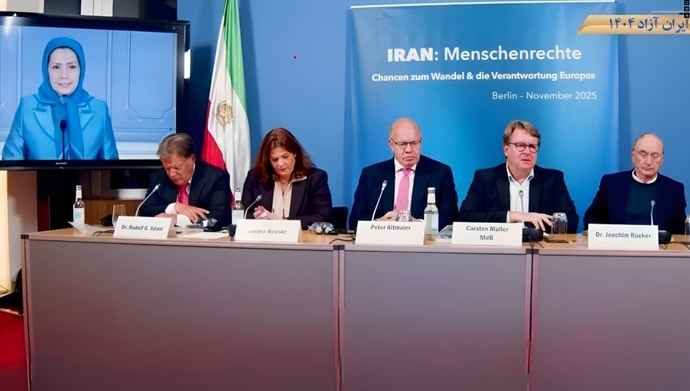

Against the backdrop of an alarming surge in executions by the Iranian regime, a prominent conference in Berlin brought together German parliamentarians, former senior officials, and human rights advocates to demand a firm international policy and voice support for the Iranian people’s organized Resistance movement. The event, which featured a keynote address by Mrs. Maryam Rajavi, President-elect of the National Council of Resistance of Iran (NCRI), focused on the regime’s escalating domestic repression and transnational terrorism as signs of its profound instability, and underscored the necessity of supporting the democratic alternative presented by the NCRI.
Maryam Rajavi: A Call for International Action Against the Massacre in Prisons
In her speech broadcast to the conference, Mrs. Maryam Rajavi painted a grim picture of the human rights catastrophe unfolding in Iran, highlighting the regime’s record-breaking use of the death penalty as a tool to stave off popular uprisings. She revealed that in October 2025 alone, “the clerical regime hanged at least 285 prisoners… including 7 women, and one minor.” Mrs. Rajavi explained that this brutality is a direct response to Supreme Leader Ali Khamenei’s fear of the Iranian people’s growing anger over repression, poverty, and corruption. She emphasized that the regime is fundamentally unstable, incapable of reform, and resorts to executions to terrorize the public and confront the progress of the Resistance.
Addressing the #HumanRights Conference in Germany
Horrifying massacre of prisoners in Iran and the need for action by the International community
The Iranian Resistance has since long ago called for an international campaign against executions.
Prisoners in 54 prisons have been… pic.twitter.com/f5TyearKDT— Maryam Rajavi (@Maryam_Rajavi) November 5, 2025
Mrs. Rajavi called on the international community to take concrete steps, urging them to refer Iran’s human rights dossier to the UN Security Council, hold regime leaders accountable for crimes against humanity through universal jurisdiction, and pressure Tehran to allow international observers into its prisons. She concluded with a powerful assertion of the Iranian people’s right to resist tyranny: “When prisons have become killing fields, the young people who have risen up have the right to defend their people… We urge the governments of the European Union and all world governments to recognize this just and long-ignored right.”
A Regime Terrified: The Unprecedented Wave of Executions
Speaker after speaker condemned the Iranian regime’s horrifying reliance on capital punishment, framing it not as a judicial process but as a political weapon of a cornered and fearful dictatorship. Dr. Joachim Rücker, former President of the UN Human Rights Council, noted that the current wave of violence is “unprecedented in the past 37 years,” with over 1,400 executions since the beginning of 2025. He stated unequivocally that the death penalty “is not an accident but a deliberate tool of political oppression. It serves to intimidate society and the opposition, to stifle protests, and to compel loyalty.”
The conference highlighted the specific targeting of political prisoners affiliated with the People’s Mojahedin Organization of Iran (PMOI/MEK). Mrs. Rajavi and Dr. Rücker recalled the recent executions of Behrouz Ehsani and Mehdi Hassani, who were hanged for their support of the PMOI. The plight of Mrs. Zahra Tabari, a 67-year-old mother sentenced to death, was raised as a stark example of the regime’s injustice. Sandra Weeser, a former German MP, described her case: “She was sentenced to death in mid-October—after a ten-minute procedure without a lawyer, without the rule of law. Her crime was that she allegedly hung up a banner with the words: ‘Woman, Resistance, Freedom.’”
Peter Altmaier, former German Federal Minister for Economic Affairs and Energy, delivered a blistering critique of the regime’s brutality, declaring, “The Mullahs’ regime is currently the cruelest regime in the world.” He drew parallels to the darkest regimes of the 20th century, stating that the executions are “the immediate manifestation of the fear of those responsible in the regime.”
In the face of this terror, Mrs. Rajavi noted the resilience of the Iranian people, pointing to the “No to Execution Tuesdays” hunger strikes held by prisoners in 54 prisons for 93 consecutive weeks and the defiance of protesters who chant, “Do not try to scare us by executing prisoners before our eyes.”
Konferenz- Berlin#Iran: Hinrichtungswelle und verstärkte Geheimdienstaktivitäten in Deutschland – Verantwortung Europas/Deutschlands
Mit MdB Carsten Müller, Bundesminister a.D. Peter Altmaier und erfahrene Diplomaten#StopExecutionsInIran #NCRIAlternative https://t.co/LmSQLsucUT— Javad Dabiran (@JavadDabiran) November 5, 2025
An Axis of Evil: The Call for a Decisive International Policy
A strong consensus emerged among the speakers that years of appeasement have failed and that a tough, principled policy is urgently needed. A central demand was the designation of the Islamic Revolutionary Guard Corps (IRGC) as a terrorist organization by the European Union. Carsten Müller, Chair of the Bundestag’s Legal Affairs Committee, who hosted the event, asked forcefully, “Honestly, what reason is there today not to carry out this classification as a terrorist organization? It is not discernible at all. Action must finally be taken here.”
This call was echoed by Detlef Seif, a member of the Bundestag’s Interior Committee, who made a personal commitment to advance the issue. “That is at least one of the bodies where we have to discuss the listing of the Revolutionary Guards,” he said. “We must start a new initiative here once again, and I take this as a very concrete task for myself here today.”
Speakers framed the Iranian regime not only as a domestic oppressor but as a global threat. Mr. Müller identified Tehran as a key player in a global axis challenging world peace.
Dr. Rudolf Adam, former Vice President of Germany’s Federal Intelligence Service (BND), warned that despite recent setbacks, the regime’s nuclear ambitions remain. He argued that lasting peace in the Middle East is impossible without fundamental change in Iran. “Peace, even in Gaza, will only come when Iran gives up seeing Hamas as an extended arm of its own anti-Israeli policy,” he stated.
The Regime’s Long Arm: Transnational Repression and Espionage
The conference shed light on the regime’s extensive campaign of intelligence gathering, harassment, and terrorism on European soil, particularly in Germany. Mr. Müller warned that the regime’s repression “also takes place in Germany,” stating, “The arm of this mullah regime is long and reaches right into Germany.”
Hanif Mahoutchian, an Iranian activist and law graduate, provided a chilling, detailed account of this campaign. He explained how the regime’s intelligence services target PMOI/MEK supporters and their families with threats of murder, kidnapping, and torture to deter their activism and coerce them into espionage. He described the regime’s escalating efforts as “an unprecedented intensification of Iranian intelligence activity in Germany.” He also highlighted a show trial in Tehran against 104 NCRI members, including Germany’s NCRI Representative, Dr. Massoumeh Bolourchi, in which a judge threatened to “become active and carry out these executions independently in Europe.”
Dr. Ulrich Seidt, a former German Ambassador, reinforced this point by quoting a joint declaration from July 2025 in which 14 Western nations, including Germany, condemned “the increasing number of threats emanating from the Iranian state through its intelligence services in our respective territories.” He argued that this declaration demands action, starting with the sanctioning of the IRGC.
Martin Patzelt, a former German MP, recounted his own close call with the regime’s terrorism, referencing a 2018 plot where an Iranian diplomat smuggled a bomb intended for an NCRI rally in Paris. “If he hadn’t been discovered, then Madam President Rajavi and I would probably be dead,” he recalled.
A Viable Alternative: Bipartisan Support for the NCRI and the Ten-Point Plan
The German politicians and dignitaries present were united in their support for the NCRI as a credible and democratic alternative to the clerical regime. Peter Altmaier spoke with great admiration about Mrs. Rajavi’s Ten-Point Plan for a future Iran, calling it “unique in the opposition against the Mullahs’ regime because it is a clear statement and a clear commitment.” He praised its vision for a secular republic, gender equality, the rule of law, and the abolition of the death penalty, concluding that the NCRI “is seeking to join the democratic traditions of humanity.”
Sandra Weeser described the Ten-Point Plan as “a very good vision of a secular, law-based, and free Iran,” while Dr. Adam noted that the NCRI “stands ready” with a “highly promising roadmap for the future.” This cross-party support, as noted by Mr. Müller, is “important for the whole cause.”
Rejecting False Dichotomies: No to Shah, No to Mullahs
Speakers also addressed and dismissed the notion of returning to the past monarchy as a solution for Iran. Martin Patzelt directly countered the promotion of the Shah’s son, Reza Pahlavi, as a false alternative. He described such figures as “actors without a documented history of struggle, without structure, without a program, without serious societal basis or background.” He argued that these figures are promoted by foreign circles “only because the strength and organized resistance of the PMOI are feared,” which he identified as “recognizably the only alternative that can take over a government and lead the country into the free world.”
The People’s Right to Rise: A Call to Recognize the Iranian Resistance
The conference culminated in a powerful endorsement of the Iranian people’s right to overthrow the theocratic dictatorship. Mrs. Rajavi’s argument that the regime’s designation as a threat to peace under Chapter VII of the UN Charter must be accompanied by the recognition of its people’s right to self-defense resonated throughout the event.
This struggle was given a human face by young Iranian activists. Sahar Sanaei, a psychotherapist whose father and uncles were executed by the regime, declared, “For us, democratic change is the only option.”
Sanya Mohammadi, a 22-year-old who grew up in Iran with a political prisoner father, spoke of the hope that the organized Resistance provides to people inside the country. “I remember the hopelessness that the regime tried to convey to us. But the activities of the Iranian Resistance gave us a lot of courage and hope,” she testified. “That is why it is so important that we are active here in Germany. Your support is so encouraging for all the people in Iran.”
As Carsten Müller concluded in his opening remarks, those who advocate for freedom in Iran, especially within the country, are doing so “at risk to their lives.” The clear message from Berlin was that the international community has a moral and strategic imperative to stand with them, abandon failed policies, and support their quest for a democratic, secular, and free republic.