

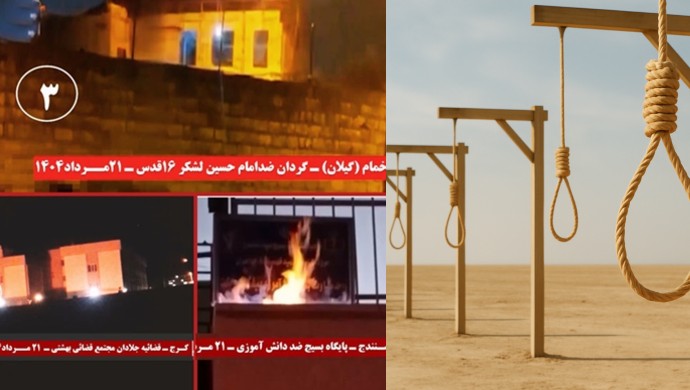

While Iran’s regime has besieged the people with water and power cuts and soaring inflation, the cycle of executions and the relentless killing of prisoners continues.
On Tuesday, August 12, 2025, Iran’s heroic rebellious youth responded to 113 executions in the first 20 days of the Persian month of Mordad (July 22 – August 10, 2025) and 1,571 executions during the tenure of the regime’s president, Masoud Pezeshkian. They set fire to images of regime founder Ruhollah Khomeini, current supreme leader Ali Khamenei, and other regime leaders, and struck at the regime’s centers of suppression and crime.
On this day, the rebellious youth, issuing a warning to the executioners and commanders responsible for the suppression of prisoners, attacked the regime’s bases and symbols of suppression and crime as follows:
- Two incendiary attacks at a regime building for torture and execution of dissidents and innocent people in Karaj
- Three incendiary attacks at the IRGC Basij headquarters in Sepidan, Fars province
- Three incendiary attacks at the so-called Imam Hussein battalion of the 16th Quds Division in Khomam
- Setting fire to an IRGC Basij base in Tehran
- Setting fire to a Basij base tasked with suppressing students in Sanandaj
- Setting fire to government banners and posters with images of Khomeini, Khamenei, Qassem Soleimani, and IRGC commanders in Mashhad, Isfahan, Kerman, Urmia, Shahrekord, Behshahr, Chenaran, Delijan, and Khash
In this manner, the rebellious youth, with their fiery responses to the regime of execution and massacre and by striking at the symbols of suppression and repression, lit the guiding beacon of “fire answers execution” for the heroic people and uprising creators.
The increase in executions, at a time when the clerical regime is grappling with a series of internal and social crises, is a desperate and deliberate attempt to block a popular uprising.
These daring acts are happening as the Iranian regime is poised to repeat its past atrocities. In recent weeks, Iranian regime courts have sentenced three political prisoners, Farshad Etemadifar, Masoud Jamei, and Alireza Mardasi, to double executions and additional prison terms after years of torture and solitary confinement. Their charge is affiliation with the People’s Mojahedin Organization of Iran (PMOI/MEK). Other prisoners with similar charges were sentenced to long prison terms. Dozens of political prisoners are currently on death row, with seven already having their sentences confirmed by the regime’s Supreme Court. This is not a random spike in repression. Rather, it is a calculated campaign to instill fear and quash dissent. Regime officials and state-run media have openly lauded the 1988 massacre as a ‘successful precedent’ and called for its repetition. Prisoners inside Iran’s prisons face an immediate and growing threat.
The Iranian regime, by Khomeini’s decree and fatwa in 1988, executed over 30,000 political prisoners, most of whom were affiliated with the People’s Mojahedin Organization of Iran (PMOI/MEK). According to a report by Javaid Rehman, the former UN Special Rapporteur on Iran, last July, this crime was equivalent to genocide. The Iranian regime continues to refuse to administer justice, persists in harassing the victims’ relatives, and endorses the massacre as a “historic success.”
But while the regime thinks that it can silence dissent through brutal executions and suppression, the activities of Iran’s heroic rebellious youth are proof that the Iranian people are determined to overthrow the regime and will answer executions with fire.