

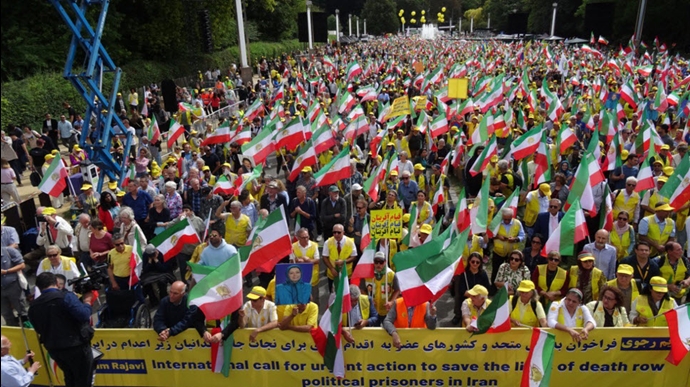

On Saturday, September 6, 2025, tens of thousands of Iranians and their international supporters gathered at Atomium Square in Brussels for a mass rally and march calling for a democratic republic in Iran. Organized by the National Council of Resistance of Iran (NCRI) and over 300 Iranian communities, the event marked the 60th anniversary of the founding of the People’s Mojahedin Organization of Iran (PMOI/MEK), the principal opposition movement to the ruling regime. The rally featured speeches from prominent international dignitaries and Iranian activists, all united in their support for a free, secular, and non-nuclear Iran and demanding a firm international policy against the theocracy in Tehran.
Free Iran rally in Brussels
Marking 60th founding anniversary of the PMOI and six decades of relentless resistance against two dictatorships of the Shah and the mullahs. #MEK60 #WeSupportMEK https://t.co/1HEMyiZVIO— People's Mojahedin Organization of Iran (PMOI/MEK) (@Mojahedineng) September 6, 2025
Maryam Rajavi: The PMOI’s 60-year struggle is the key to a free Iran
Maryam Rajavi, the President-elect of the NCRI, delivered the keynote address, describing the PMOI’s 60-year history as a relentless and unbroken struggle against two dictatorships—the Shah’s monarchy and the mullahs’ religious tyranny. She honored the movement’s martyrs, from its earliest days to the present, and emphasized that the PMOI’s endurance is rooted in its commitment to “the freedom of the Iranian people against the gravest conspiracies.”
Mrs. Rajavi detailed the PMOI’s core principles, including the union of politics with honor and its opposition to fundamentalist Islam. She asserted that this unwavering stance is why the movement has survived and grown despite immense repression and demonization. “The Shah fell, and the mullahs will fall as well,” she declared, highlighting the PMOI’s resilience. The PMOI, within the NCRI coalition, she stated, has presented the “only democratic and independent alternative, carrying forward the 120-year struggle of the Iranian people for freedom.”
Free Iran 2025 Onward to a Democratic Republic-Brussels
The PMOI/MEK was founded 60 years ago, fighting 14 years against the Shah’s tyranny, and 46 years against the mullahs, without even an hour of pause. It is hard to believe but it is true. Today, the PMOI lights 60 shining… pic.twitter.com/5aoKzSP6Q3— Maryam Rajavi (@Maryam_Rajavi) September 6, 2025
She outlined the specific, long-standing duties of a six-month interim government as defined by the NCRI in 1982, which include holding free elections, dissolving repressive institutions like the IRGC, guaranteeing women’s rights and gender equality, and formally recognizing the Universal Declaration of Human Rights. These commitments, she noted, were later codified in the NCRI’s Ten-Point Plan. In a direct challenge to the regime’s recent sham trials against PMOI members, she listed the movement’s supposed “crimes,” including exposing the regime’s nuclear program, creating Resistance Units, and championing women’s leadership. Concluding with a call for a “Democratic Revolution” and a “Democratic Republic,” she urged Western nations to abandon delays and take decisive action. “The only solution is the Third Option, neither appeasement nor war, but regime change by the people and their organized resistance!” she stated emphatically.
Six decades of selfless struggle for freedom
Speaker after speaker commemorated the PMOI’s 60-year legacy of sacrifice in the pursuit of a free and democratic Iran. The movement’s unwavering commitment through decades of brutal oppression under both the Shah and the mullahs was a central theme of the rally.
Former U.S. Vice President Mike Pence described the PMOI as a movement “born deep in the hearts of the Iranian people” that has endured “the brutality of the Shah’s dictatorship and the unspeakable cruelty of the theocracy that replaced it.” He celebrated it as an “unstoppable movement for freedom called the MEK,” which is now “bigger and stronger and more inspired and powerful than ever before.”
John Bercow, former Speaker of the UK House of Commons, lauded the resistance movement’s “six-decade record of service, of sacrifice, and of selfless struggle for the triumph of liberty, freedom, democracy, and the rule of law against all who despise it, whether they be monarchs or religious zealots and bigots.”
Honored to Address Tens of Thousands at the #FreeIran2025 Rally in Belgium today! Thank You @Maryam_Rajavi and Freedom loving Iranians everywhere for your courageous stand for a Free and Democratic Iran. Friends of Freedom Around the World Are With You! #BrusselsFreeIranRally pic.twitter.com/P7g1er0gO2
— Mike Pence (@Mike_Pence) September 6, 2025
Former U.S. Congressman Patrick Kennedy highlighted the PMOI’s historical resilience, noting, “Every single year, the MEK has been tortured, has been jailed, has been murdered. But has that stopped the MEK? No, it hasn’t.” He added that the movement stood up to “the Shah’s secret police” and has continued to stand up to “the mullahs’ secret terrorists, both in Iran and around the world.”
This legacy of resistance was brought to life by Iranian activists from different generations. Andrin Mohseni, representing the youth, noted that 60 years after its founding by a 27-year-old Mohammad Hanifnejad, the PMOI “is stronger than ever. It has faced prisons, torture, and executions, yet it is a powerful force of resistance.”
Farzaneh Hosseini spoke as the child of a generation whose hopes were stolen but who resisted courageously. She shared her personal connection to the struggle, with two uncles murdered by the regime after being imprisoned under the Shah, and an aunt killed in the 2013 massacre at Camp Ashraf. “Today, as the MEK marks its 60th anniversary, we celebrate a movement that has carried the torch of freedom through countless betrayals, making the greatest of sacrifices along the way,” she affirmed.
The failure of appeasement and the need for a new strategy
A strong consensus emerged among international speakers that the long-standing policy of appeasement toward the Iranian regime has failed and must be replaced by a strategy of firmness and support for the democratic opposition.
Guy Verhofstadt, former Prime Minister of Belgium, delivered a blistering critique of Western policy. “The fact that the mullahs’ regime is still in Iran, [that it] can still continue its crimes, is proof of the failure of the strategy of appeasement that the international community, the West, and especially Europe, has followed until now,” he stated. He argued that this policy has made things worse for the Iranian people, for regional stability, and for global security, citing the regime’s backing of terrorist groups in the Middle East and its military support for Russia’s war in Ukraine. “Instead of a strategy of appeasement, we need a new strategy,” Verhofstadt urged. “A strategy of engagement. Positive engagement with the Iranian people, with the democratic opposition, and with the organized Resistance.”
.@guyverhofstadt at #BrusselsFreelranRally:
"The mullahs' regime is proof of the failure of the strategy of appeasement… Iran under the mullahs has become the world record holder for the death penalty and for criminality"#MEK60 https://t.co/6cEgqNthic— People's Mojahedin Organization of Iran (PMOI/MEK) (@Mojahedineng) September 6, 2025
This new strategy, speakers argued, must include concrete actions. Mr. Verhofstadt outlined three core elements: designating the Islamic Revolutionary Guard Corps (IRGC) as a terrorist organization, increasing sanctions against the regime’s leaders and economic backbone, and starting a “structural dialogue with the democratic opposition… using the Ten-Point Plan of Mrs. Rajavi as the start.”
Kris Van Dijck, a Belgian Member of European Parliament, echoed this call, stating that the policy of Flanders and Belgium is clear: “no more hostage diplomacy and [we are] pushing the EU to blacklist the IRGC as a terrorist organization.”
A viable alternative: The NCRI’s Ten-Point Plan and the Third Option
Speakers repeatedly dismantled the regime’s propaganda that there is no viable alternative to the current dictatorship. They pointed to the NCRI and Mrs. Rajavi’s Ten-Point Plan as a clear, democratic, and well-organized alternative ready to lead Iran to a better future.
Vice President Pence directly challenged this narrative, recalling his visit to Ashraf 3 in Albania. He quoted his own words from three years prior, stating, “One of the biggest lies the ruling regime sold to the wider world is that there is no alternative to the status quo. But you all know there is an alternative, well-organized, fully prepared, perfectly qualified.” He reaffirmed this conviction, declaring, “That alternative is the NCRI and the MEK!” Mr. Pence praised Mrs. Rajavi’s Ten-Point Plan for its vision of “individual freedom, democracy, freedom of religion for all faiths, freedom of speech and the press, an independent judiciary, and an end of absolute clerical rule once and for all.”
.@VidalQuadras at #BrusselsFreelranRally
"[The mullahs' regime] can kill us, torture us, imprison us, but they must also know that we will never, never, ever give up."#MEK60 https://t.co/G1QCHzjJ07— People's Mojahedin Organization of Iran (PMOI/MEK) (@Mojahedineng) September 6, 2025
Mr. Verhofstadt also dismissed the notion of no alternative. “We in the West, we in Europe, have to stop saying that there is no alternative to the mullahs,” he said, gesturing to the massive crowd. “Your massive presence here today is the proof of the contrary. You are the alternative to the mullahs in Tehran.”
Alejo Vidal-Quadras, former Vice-President of the European Parliament and a survivor of a regime-sponsored assassination attempt, passionately reinforced this point. “The future of Iran is not a dream. It is standing before us right now,” he proclaimed. “You, the brave, the committed, are the living embodiment of the Iranian people’s will for change… You are the voice of millions of Iranians. You are the heartbeat of a nation.” He described the rally as a “living referendum” and a “thunderous voice for your democratic vision expressed in your Ten-Point Plan.”
The power within: Resistance Units and the people’s uprising
The critical role of the Resistance Units inside Iran, the PMOI’s network of activists who challenge the regime’s authority on the ground, was highlighted as the engine of change and the embodiment of the people’s will.
Vice President Pence paid special tribute to their bravery. “All across Iran today, young men and women in Resistance Units risk their lives to keep the flame of liberty alive,” he said. “The Resistance Units inside Iran are the beating heart of hope for the Iranian people, and an inspiration to the world. They are the driving engine of change, igniting uprisings and sustaining protests with courage that inspires the world.”
.@Mike_Pence at #BrusselsFreelranRally:
"All across Iran today, young men and women in Resistance Units risk their lives to keep the flame of liberty alive. The Resistance Units inside Iran are the beating heart of hope for the Iranian people."#MEK60 https://t.co/aEhJauIPRF— People's Mojahedin Organization of Iran (PMOI/MEK) (@Mojahedineng) September 6, 2025
Mr. Vidal-Quadras spoke of their impact with admiration: “I have seen the Resistance Units inside Iran. Fearless, challenging, marking the PMOI’s 60th anniversary with fire, determination, and faith. Tell me, is there any other movement with such courage burning in its core?”
Andrin Mohseni, speaking for the younger generation, addressed the units directly: “Inside Iran, to the fearless Resistance Units who keep the sacred flame alive, I say, ‘Your defiance shakes the regime and echoes the martyrs’ sacrifice.’ Though we are far from Iran, our hearts beat with yours. Your bravery empowers us, and your sacrifice lights the path to freedom.”
Rejecting all forms of dictatorship: No to the Shah, No to the mullahs
A clear and unified message from the rally was the absolute rejection of any return to monarchical dictatorship, positioning the Iranian people’s struggle as one for a genuine democratic republic, free from the tyranny of both the Shah and the mullahs.
Vice President Pence explicitly addressed this, stating, “The regime in Tehran wants to trick the world into believing that the Iranian protesters want to return to the dictatorship of the Shah as well. But we are not confused by their lies… The Iranian people will not return to tyranny in any form in Tehran. They will claim democracy and freedom.”
John Bercow at #BrusselsFreelranRally:
"We witness in Tehran repression as evidence not of strength, but of weakness. Dictators do what they do—killing people, torturing people, locking people up—not because they are strong, but because they are weak."https://t.co/mnWYXtZxSC— People's Mojahedin Organization of Iran (PMOI/MEK) (@Mojahedineng) September 6, 2025
John Bercow delivered the most forceful repudiation of a return to monarchy. “We should not be under any illusions about what that freedom-loving, democracy-championing, rule of law-supporting alternative is,” he said. “We don’t mean some baby Shah. We don’t mean some clown prince. We don’t mean someone who’s lived off the fat of the land for decades, a kind of playboy prince over the water… Not needed, not wanted, not of any use whatsoever.” He contrasted this with the selfless dedication of Mrs. Rajavi and the NCRI.
Vida Niktalean, representing the generation of the 1979 revolution, articulated this principle from personal experience. “Our fiery demarcation of ‘Neither the Shah nor the Mullahs’ began with our generation under the guidance of Massoud Rajavi,” she said. “We are a generation that has felt the poison of royal despotism and the chains of clerical oppression with our own flesh and blood.” She concluded her speech with the powerful chant, “Death to the oppressor, be it the Shah or the Supreme Leader!”
Andrin Mohseni also voiced this conviction: “Even if my generation did not live under the Shah’s monarchy, history has taught us its atrocities. Religious tyranny will not be replaced by a monarchy. It is time for a real democracy.”
The rally in Brussels was more than an anniversary celebration; it was a powerful demonstration of an organized, enduring, and internationally supported democratic movement. With a clear vision articulated in the Ten-Point Plan and a resilient network of activists inside Iran, the NCRI and its supporters sent an unequivocal message: the Iranian people reject all forms of dictatorship and are determined to establish a free and democratic republic. The speakers’ calls for a new international strategy of firmness, coupled with the passionate commitment of generations of Iranians, underscored the central theme of the day—that after sixty years of struggle, the movement for a free Iran is closer than ever to achieving its goal.