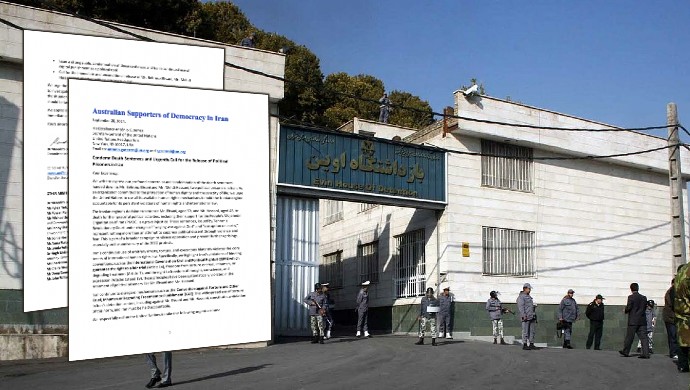

A recent statement by the “Australian Supporters of Democracy in Iran” has expressed deep condemnation of the Iranian judiciary’s decision to issue death sentences to two political prisoners, Behrouz Ehsani and Mehdi Hassani. The group calls on the United Nations, specifically addressing UN Secretary-General António Guterres, to intervene and demand the immediate release of these prisoners.
Behrouz Ehsani, 69, and Mehdi Hassani, 48, were both sentenced to death for charges including “waging war against God” and “corruption on Earth” due to their affiliation with the People’s Mojahedin Organization of Iran (PMOI/MEK). Both men, arrested in late 2022, have been subjected to torture during their detentions in Evin Prison.
The statement urges the UN to “issue a strong public condemnation of these sentences and Iran’s continued use of capital punishment as a political tool.” It highlights the Iranian regime’s violations of the International Covenant on Civil and Political Rights and the Convention against Torture.
The Australian organization insists the international community must “hold the Iranian regime accountable for its persistent violations of human rights and international law.” The letter also requests an investigation by the UN Human Rights Council into Iran’s execution practices and broader repression.
The full text of the statement is included below.
Your Excellency,
We write to express our profound concern at and condemnation of the death sentences handed down to Mr. Behrouz Ehsani and Mr. Mehdi Hassani, two political prisoners in Iran. As an organization committed to the protection of human dignity and the sanctity of life, we urge the United Nations to use all its available human rights mechanisms to hold the Iranian regime accountable for its persistent violations of human rights and international law.
The Iranian regime’s decision to sentence Mr. Ehsani, aged 69, and Mr. Hassani, aged 48, to death for their peaceful political activities, including their support for the People’s Mojahedin Organization of Iran (PMOI), is a grave injustice. These sentences, issued by Tehran’s Revolutionary Court under charges of “waging war against God” and “corruption on earth,” represent nothing more than an attempt to suppress political dissent through violence and fear. This is part of a broader campaign to silence opposition and prevent further uprisings, especially on the anniversary of the 2022 protests.
Iran’s continuous use of arbitrary arrests, torture, and executions blatantly violates the core tenets of international human rights law. Specifically, we highlight Iran’s violations of binding conventions, such as the International Covenant on Civil and Political Rights (ICCPR) which guarantee the right to a fair trial (Article 14), freedom from torture or cruel, inhuman, or degrading treatment (Article 7), and the right to freedom of thought, conscience, and expression (Articles 18 and 19).These principles have been systematically violated in the treatment of political prisoners like Mr. Ehsani and Mr. Hassani.
Iran continues to disregard mechanisms such as the Convention against Torture and Other Cruel, Inhuman or Degrading Treatment or Punishment (CAT). The widespread use of torture in Iran’s detention centers, including against Mr. Ehsani and Mr. Hassani, constitutes a violation of this norm, and Iran must be held accountable. We respectfully call on the United Nations to take the following urgent actions:
- Issue a strong public condemnation of these sentences and Iran’s continued use of capital punishment as a political tool.
- Call for the immediate and unconditional release of Mr. Behrouz Ehsani, Mr. Mehdi Hassani, and all other political prisoners in Iran.
We urge the UN to activate its human rights mechanisms, including the Human Rights Council, to investigate these executions and Iran’s wider pattern of repression. Special Rapporteurs on the situation of human rights in Iran and on extrajudicial, summary, or arbitrary executions should be tasked with further investigations.
We appreciate your attention to this urgent matter and trust that the United Nations will take immediate and necessary actions.