

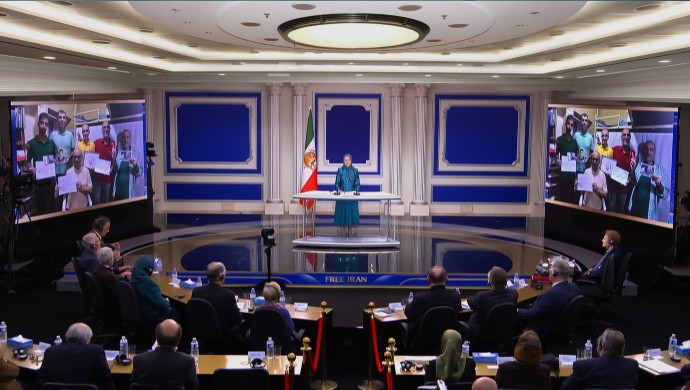

On Friday, April 10, 2026, a major international conference convened under the title, “A Call for Immediate Action to Halt the Executions of PMOI and dissident political prisoners, and courageous protesters”. The event featured the online participation of members of the People’s Mojahedin Organization of Iran (PMOI) residing at Ashraf-3, alongside a distinguished panel of European political figures, human rights activists, and former political prisoners. The gathering took place against the backdrop of a fragile ceasefire and a brutal execution spree carried out by the Iranian regime in recent weeks.
Participants gathered to honor the memory of thirteen freedom fighters who recently fell victim to the regime’s execution machinery. These individuals included six PMOI members—Vahid Bani Amerian, Abolhassan Montazer, Mohammad Taghavi, Ali Akbar Daneshvarkar, Pouya Ghobadi, and Babak Alipour—who were put to death for their steadfast resistance.
Important conference on political executions in Iran and the need for intervene to save the lives of political prisoners.#StopExecutionsInIranhttps://t.co/gL2zj8oFjk
— People's Mojahedin Organization of Iran (PMOI/MEK) (@Mojahedineng) April 10, 2026
The conference also honored seven courageous young protesters who participated in the sweeping December 2025–January 2026 uprising: Amirhossein Hatami, Shahin Vahedparast, Mohammad Amin Biglari, Ali Fahim, and three individuals executed just prior to Nowruz: Saleh Mohammadi, Mehdi Ghassemi, and Saeed Davoudi. Through poignant testimonies and analytical addresses, the conference illuminated the reality of the Iranian landscape, emphasizing that genuine democratic change cannot be imposed from the outside, but must be forged by the Iranian people and their organized resistance.
A Vision of Peace and Freedom
In a powerful and defining keynote address, Maryam Rajavi, President-elect of the National Council of Resistance of Iran (NCRI), outlined the trajectory of the Iranian struggle and the regime’s desperate attempts to cling to power amid external conflicts and internal uprisings. Stressing the ultimate price paid by the thirteen recently executed heroes, Mrs. Rajavi declared them to be “martyrs of peace and freedom,” asserting that their sacrifice has “upended the calculations of the regime, the remnants of the monarchy, and the fabricated, anti-democratic alternatives”.
Mrs. Rajavi highlighted the stark reality of the regime’s vulnerabilities, noting that its leadership rushed to carry out these executions to protect its crumbling authority from the inevitable uprisings that follow war. “By executing these heroes amid an external war, the regime has shown that it considers the arisen people and their organized resistance to be its true enemy,” she stated. Rather than quelling dissent, Mrs. Rajavi predicted that these acts of state violence will “only fuel the flames of future uprisings more than ever before”.
Commemoration of Executed PMOI Members and Protesters
The price of freedom and an enduring peace in Iran and the entire Middle East
By executing PMOI members—Mohammad Taghavi, Akbar Daneshvarkar, Babak Alipour, Pouya Ghobadi, Abolhassan Montazar, and Vahid Bani Amerian—who at the… pic.twitter.com/WWYxUvXjUm— Maryam Rajavi (@Maryam_Rajavi) April 10, 2026
Addressing the current geopolitical landscape and the recently announced 15-day ceasefire, Mrs. Rajavi maintained a principled stance on the necessity of internal democratic transformation. “We welcomed the ceasefire, especially the halt to attacks on civilian infrastructure and facilities,” she remarked, expressing hope that the halt in hostilities would pave the way for peace and freedom.
However, she remained adamant that the international community must prioritize human rights. “I stress that ending executions in Iran, as a demand of the entire Iranian nation, must be included in any international agreement,” she demanded, pointing directly to the fact that Khamenei’s son has continued the “daily execution of Iran’s youth to preserve the moribund regime’s grip on power”.
Mrs. Rajavi concluded by reaffirming the PMOI’s deep roots within the populace, noting that the regime’s 45 years of smear campaigns have failed. “Today, more clearly than ever, it has been proven that the solution lies neither in appeasement nor in war, but in the overthrow of the regime by the people and their organized resistance,” she affirmed.
A Spree of Executions and Severe Human Rights Abuses
A central focus of the conference was the sheer brutality of the regime’s execution machinery, which has accelerated significantly following the recent nationwide uprisings and the subsequent foreign military strikes. The executions of the thirteen political prisoners served as a grim reminder of the mullahs’ reliance on the gallows to enforce submission.
Former German Minister of Justice, Prof. Dr. Herta Däubler-Gmelin, expressed profound sorrow and anger over the loss of these young lives, comparing their bravery to the shining lights of the anti-Nazi resistance, such as Dietrich Bonhoeffer and Georg Elser. “They have been murdered by the criminal mullahs’ regime,” she noted, highlighting the additional injustice of the torture and solitary confinement they endured at the hands of a “killing machine” operated by individuals who “cynically call themselves justices”. Däubler-Gmelin expressed confidence that, much like the Nuremberg trials, “these criminals… will be brought to court in a free and just society”.
John Bercow: The future of Iran depends on whether this regime clings to power or whether we win. I feel absolute confidence that those who have sacrificed their lives for #freedom will be seen as the only legitimate alternative to the bestial dictatorship in Tehran.…
— NCRI-FAC (@iran_policy) April 10, 2026
John Bercow, former Speaker of the UK House of Commons, emphasized the ideological failure of the regime’s reliance on executions. “You cannot execute an idea,” Bercow powerfully stated. He characterized the regime as fundamentally cowardly and lacking in emotional intelligence, failing to grasp that “no matter how long they murder, no matter how long they maim, no matter how long they threaten and intimidate… they will not extinguish the flame of freedom”.
The lived realities of these human rights abuses were brought sharply into focus by former political prisoners. Nasrollah Marandi, who survived the horrific “Death Corridor” of Gohardasht Prison during the 1980s, recalled his time in Evin Prison alongside the martyred Mohammad Taghavi. Marandi noted that Taghavi had defiantly told his executioners: “I connected to the Organization, I continued, and if I go out again, I will continue this same path”. Reza Shemirani, another survivor who spent over 4,000 days in the regime’s prisons, reflected on how these youth found the truth amidst absolute censorship. “In a world that tries to bury the truth, how are there still those who discover it?” Shemirani asked, answering that it stems from an “awareness that emerges from the heart of the people’s suffering”.
Human rights activist Minoosh Mashhadi brought attention to the final video message recorded by Vahid Bani Amerian before his execution. “He knew what was coming, and still, he spoke,” Mashhadi recounted, quoting Bani Amerian’s plea: “How much more suffering must there be before the world moves to practical action? The world cannot remain silent”.
The Democratic Solution: The People and the Resistance
A prevailing consensus among the international dignitaries was that while the regime has been weakened by recent events, true democratic transformation will not arrive via foreign intervention. The speakers universally cautioned that external wars and bombings cannot dismantle a dictatorship; that task rests solely with the Iranian people and their established resistance movement.
Prof. Daubler-Gmelin: Mrs. President @Maryam_Rajavi, your comments on the truce announcement were responsible, wise, and prudent. We deeply welcome your balanced statement. #NCRIAlternative https://t.co/OXEhC6dcrP
— NCRI-FAC (@iran_policy) April 10, 2026
Franz Josef Jung, former German Federal Minister of Defence, articulated this dynamic clearly. “The recent war has once again made one thing clear: a war does not lead to the overthrow of a dictatorship; rather, a transition to democracy only succeeds if it comes from within the country—from the people, from the courage of the younger generation, and from their organized resistance,” Jung observed. He added that the regime’s frantic execution of dissidents “is not a sign of strength, but rather the regime’s fear of the spread of an organized resistance in Iran”.
Jean-François Legaret, former mayor of Paris’ 1st Arrondissement, warned against the “fake news” suggesting that diplomatic channels could successfully negotiate a new future with the current state. With Masoud Pezeshkian functioning merely as a “puppet president devoid of any power” and the Revolutionary Guards tightening their stranglehold, Legaret emphasized that the regime has only hardened. He reiterated the Resistance’s long-standing position: “it is not Israeli-American strikes—or from wherever they may come—that will put an end to the mullahs’ regime… Freedom… can only be achieved at the cost of the insurrection of the Iranian people.”
Jean-Pierre Béquet, a former member of the French Parliament, echoed this sentiment, noting that the “great forgotten one” in the narratives of foreign powers is the Iranian people themselves. “The only way to bring democracy is not through bombs, but through the daily struggle of the Iranian people with the international support of all those who want freedom and democracy,” Béquet affirmed.
Prominent French lawyer Jean-Pierre Spitzer, who spent decades defending the PMOI against unjust terrorist designations, delivered a stirring call for self-reliance. Addressing international leaders who historically sought to appease the mullahs, Spitzer demanded they stop fearing the regime. To the Resistance, he affirmed that the fight for freedom is a just cause, stating unequivocally, “you must be the ones to lead it. You and the people of Iran”.
Rejecting All Dictatorships: Neither Shah Nor Mullahs
The conference also served as a definitive repudiation of all forms of tyranny, firmly rejecting both the current religious dictatorship and the remnants of the ousted Pahlavi monarchy. Speakers expressed strong support for the National Council of Resistance of Iran and Maryam Rajavi’s Ten-Point Plan as the only legitimate, democratic alternative for the future of the nation.
Several speakers dismantled the narrative surrounding the son of the deposed Shah, Reza Pahlavi, who has sought to position himself as a figurehead for transition. John Bercow delivered a searing critique of Pahlavi, describing him as a “gigantic, monumental, everlasting sideshow”. Highlighting Pahlavi’s lack of political substance and historical baggage, Bercow stated: “The idea that the mass of the people of Iran are going to say to the son of the most appalling autocrat who pillaged the country and presided over mass destruction: ‘Please sir… we’d really like you to be our next leader.’ Mr. Pahlavi, it isn’t going to happen”.
Jean-François Legaret similarly dismissed Pahlavi’s promises of future referendums, noting that “his father had already made the same promises without ever keeping them. Can we give him the slightest credit?”. Prof. Dr. Däubler-Gmelin contrasted Rajavi’s balanced and prudent diplomacy with Pahlavi’s “so-called transformation plan,” characterizing the latter as a “very conceited document whose political intentions and morals seem to adapt to those of his political backers and sponsors”.
In stark contrast to the hollow promises of the monarchy, the international dignitaries rallied behind the substantive platform offered by the NCRI. Franz Josef Jung meticulously outlined the tenets of Maryam Rajavi’s Ten-Point Plan, which calls for “free and secret elections, for freedom of speech… dissolution of the Revolutionary Guards, the prohibition of torture and the abolition of the death penalty, the separation of religion and state, gender equality, an independent judiciary, and a non-nuclear Iran”.
Youth activist Mohsen Kasechi emphasized that the PMOI’s ideals have deeply resonated with the younger demographics, specifically Generation Z and Millennials, who form the backbone of the expanding Resistance Units across Iranian cities. The ideal they carry, Kasechi noted, is aimed at “the transfer of sovereignty to the people, the republic of the people, and the establishment of social justice”.
As the conference drew to a close, the overwhelming sentiment was one of enduring resolve. Despite the profound grief for the thirteen martyrs and the thousands who perished in the recent uprisings, their sacrifices are viewed not as defeats, but as vital catalysts for impending change.
The voices gathered—ranging from parliamentarians to former prisoners who endured the horrors of Evin and Gohardasht—made it clear that the regime in Tehran cannot execute its way out of its terminal crisis. The path forward relies not on the destructive capabilities of foreign militaries, nor on the revival of a despised monarchy, but on the unyielding courage of the Resistance Units and the Iranian populace. As John Bercow aptly concluded regarding the inevitable triumph of the Iranian resistance, “Our cause will not die. Our cause will continue. Our cause, my friends, will prevail”.