

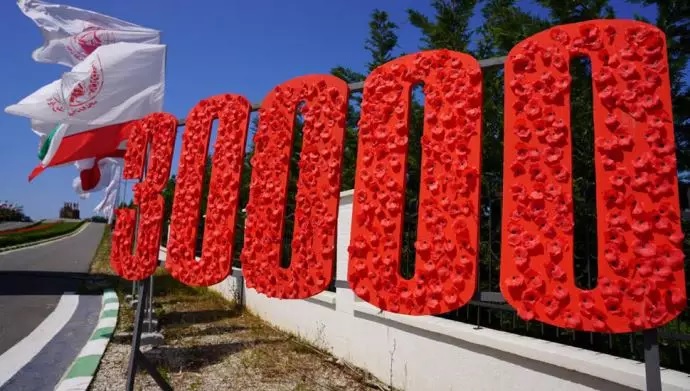

In the summer of 1988, Iran’s regime committed one of the worst crimes against humanity by executing more than 30,000 political prisoners in the span of a few months. The event, which became known as the “1988 massacre,” remained mostly ignored for more than three decades, partly due to the regime’s repression and secrecy and partly due to the global policy of appeasement toward the regime and the tendency to turn a blind eye to its crimes.
In 2016, the Iranian Resistance launched the Justice Movement to break the 30-year silence on the 1988 massacre and bring that crime against humanity to light.
In 2017, the late UN Special Rapporteur on the Human Rights Situation in Iran Asma Jahangir issued a report in which she wrote, “Between July and August 1988, thousands of political prisoners, men, women and teen-agers, were reportedly executed pursuant to a fatwa issued by the then Supreme Leader, Ayatollah Khomeini.” She also acknowledged that “overwhelming evidence shows that thousands of persons were summarily killed” and added, “The families of the victims have a right to know the truth about these events and the fate of their loved ones without risking reprisal. They have the right to a remedy, which includes the right to an effective investigation of the facts and public disclosure of the truth; and the right to reparation.”
In those days, during his tenure, the regime’s general prosecutor Jafari Dolatabadi said, “Every now and then, a report is presented against Iran, including the recent report by the Special Rapporteur on Human Rights, whose main source is the claims of the [People’s Mojahedin Organization of Iran (PMOI/MEK)].”
Since then, the Justice Movement has come a long way. On Saturday, October 27, 2023, a group of senior UN experts participated in a conference held in New York at the initiative of the organization Justice for the Victims of the 1988 Massacre in Iran (JVMI). They called on member states of the United Nations to emphasize the need for accountability of the perpetrators and orchestrators of the 1988 massacre, and to reject the culture of impunity toward the Iranian regime’s crimes.
In this session, Professor Javaid Rehman, the UN Special Rapporteur on the Human Rights Situation in Iran, referred to the mass killings of PMOI members and said, “The gravest tragedy which we have witnessed since the Islamic revolution – the most painful one – remains that of the enforced disappearances and the summary and arbitrary executions of thousands of individuals in 1988.
“In 1988, thousands of prisoners were extrajudicially executed pursuant to a fatwa issued by the then-Supreme Leader and implemented across prisons in the country.”
Professor Rehman, emphasizing the regime’s systematic efforts to destroy mass graves, distort the truth, stated, “Systematic concealment of the fate of the victims, not providing the location of their remains, or not providing family members information about the causes of death is deeply troubling. Such concealment, in my judgment, also constitutes enforced disappearances and a crime against humanity. The massacres resulting in the summary and arbitrary executions as well as enforced disappearances have been a source of very serious concern for my mandate as well as several other UN Special Procedures.”
In his remarks, former US Ambassador-at-Large for War Crimes Issues, Stephen Rapp described that there was no judicial process in the course of the 1988 massacre and said, There was essentially an inquisition where people, some of whom had even completed their sentences for so-called political crimes, were summarily executed in a way in which all the facts and circumstances, the names of the victims, the place of interment, all of those things were hidden so that we have these violations of international human rights law, enforced disappearances and extrajudicial killings.”
Referring to the PMOI who did not surrender to Khomeini and stood their ground, he added, “It couldn’t be said that it was even done because these people were not Shia Muslims; frankly, 90 percent of the victims were. What this involved was individuals who objected to this theocratic autocracy in Iran.”
Dr. Grazyna Baranowska, a member of the United Nations Working Group on Enforced Disappearances, referred to the ongoing nature of the regime’s crimes and stated, “Enforced disappearances are an ongoing violation. It is a continuous human rights violation. … That is to say, until the state acknowledges the detention or releases information pertaining to the fate and whereabouts of the individual. Looking at the situation that we’re discussing today, it is clear that this crime is not complete, meaning that the state has not acknowledged it or not released information about the fate and whereabouts of the individuals.”
Ana Sami, the representative of JVMI, highlighted the significance of this conference in the path to justice and said the culture of impunity existing in Iran today stems from the “failure to hold Iranian officials accountable for committing crimes against their own citizenry, chief among them the 1988 extrajudicial executions and enforced disappearances of political prisoners.”
The impunity enjoyed by the perpetrators, who, as stated by the Special Rapporteur on Human Rights, have now reached higher positions, was one of the focal points of discussion at the New York conference.
The President of the International Association of Genocide Scholars, Professor Melanie O’Brien, remarked, “The impunity surrounding these crimes has only emboldened the perpetrators. With Ebrahim Raisi in power, it is clear that, within Iran, there will not be justice for victims, and that the violence only continues. ”
Stephen Rapp said, “We’ve seen the effect of the impunity that has occurred in basically the absence of justice for these crimes. Impunity breeds impunity. So we have a regime that went on to commit horrendous crimes thereafter in 2019 and the suppression of demonstrations and people exercising their rights to assembly and protest and now these horrendous crimes largely against women since last year in 2022, and in each of these situations there’s impunity and the expectation that this regime can get away with it “.
Sami said, ” We are concerned that the lack of accountability for the perpetrators of the 1988 massacre by the international community emboldens the Iranian authorities to commit further atrocities against dissident protesters and political prisoners… The culture of impunity within the Iranian government, exemplified by the 1988 executions and many other instances of human rights abuses, is a stain on our collective conscience. We cannot stand idly by while injustice and suffering persist…”
The spirit of who did not surrender to Khomeini and sacrificed their lives for freedom lives in the Justice Movement that has spread from Tehran to Stockholm and from London to New York. Therefore, in the face of the relentless pursuit of justice and accountability for these martyrs, Khamenei and those responsible for these crimes will be brought to justice. Justice will prevail.