

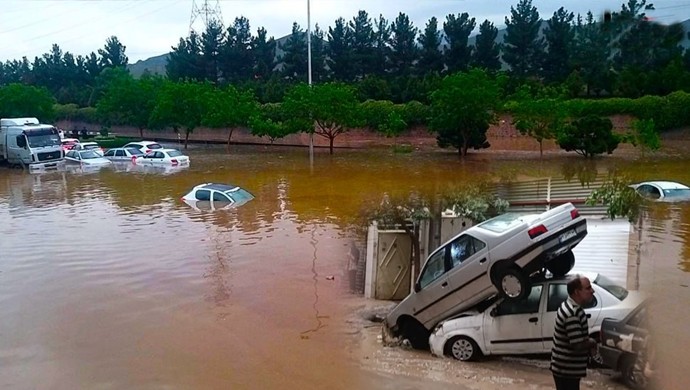

Raging waves of flood, this recurring tragedy in the geography of Iran, has brought tears to the eyes of Iranians and ignited the burning pain in their hearts. This time it was Mashhad’s turn, which had no escape from the cries. But the leaders and officials of the regime are not disturbed by the images of floating and swirling cars in the muddy floodwater and the cries of trapped children inside them.
From concealing the flood to blaming nature
If we ask the officials and supporters of this regime why a 30-minute rainfall in Mashhad caused such devastating floods, they immediately attribute the answer to God’s wrath and say that the cause is immodesty, unveiled women, and an increase in immoral behavior, which must be a result of the distance young people have taken from the sacred and divine system of the Islamic Republic. They attribute the catastrophic effects of their brutal rule over Iran for more than four decades to God and the people, to shirk responsibility for their crimes.
The depth of the tragedy lies in the fact that in the age of global communication and under the watchful eyes of satellites, they shamelessly conceal the occurrence of floods in Mashhad and downplay them, fearing that the spark of people’s anger might ignite their dynasty.
On May 17, the state-run Etemad newspaper quoted Hassan Kalidari, the head of the Civil Defense and Crisis Management Group of Mashhad Municipality, as saying, “No, no, no! There is no flood; it’s just partial flooding.
No, my dear, it’s not like that; it’s the cardboard cars that got washed away, not the people’s iron cars!
Send us a video of these incidents so that we can see too!
The normal course of people’s lives is ongoing.”
A similar tragedy
The mullahs’ regime cannot claim to be caught off guard. Five years ago, in March 2019, the first incident of this kind occurred at Darvaze Quran, the Icon of city of Shiraz. At that time, despite neglecting and attributing the flood to natural causes, it became clear that due to the greed of the regime, the traditional and old riverbed of Shiraz had been turned into a highway. When the flood occurred, many cars, especially those of Nowruz travelers and residents from other cities, were present at the site. The flood engulfed them and created those painful scenes. From that time until now, the government had five years to repair the infrastructure and devise strategic plans to prevent the destruction caused by natural disasters. Why haven’t they done this?
Admission to a fraction of the tragedy
After several days of concealing and downplaying the flood in Mashhad, due to the revelations of Iranians on social media, a regime official admitted to a small part of the cause of this disaster.
On May 16, the state-run Entekhab news website quoted Mousa Alireza Hajibeiglou, a Member of the Supervisory Commission of Mashhad City Council, as saying, “One of the fundamental factors of this flood, which resulted in the loss of lives and disrupted traffic, is related to unauthorized construction, specifically the construction of the southern beltway in Koohshad. They have cut into the mountains and built a road within the mountain… The similarity between this flood and Shiraz is that it came down from higher elevations, and the lack of water reservoirs has caused.”
This is while the only favor that Minister of Interior Ahmad Vahidi has shown toward the victims is ordering the free burial of the flood victims, perhaps to quickly resolve and close the issue.
The damage to the people of Mashhad due to the flood is occurring under the circumstances where the Astan Quds Razavi, this empire associated with the Iranian regime supreme leader Ali Khamenei and his followers in Khorasan, owns more than 13,000 hectares, which is over 49% of the total area of the city of Mashhad. Throughout Iran, from East Azerbaijan to other cities like Yazd and Kerman, lands have been registered under the name of Imam Reza (eighth Imam of Shia Islam) but to the benefit of Khamenei’s office. This wealth of approximately $20 billion is only a part of their assets. The approximate value of cultivated lands associated with this regime-owned organization is estimated to be over $120 billion. They manage 89 companies and institutions. Their share in 44 companies and institutions is over 50%. Where is this mythical wealth being spent? Why do Mashhad and other cities and provinces in Iran remain defenseless when facing natural disasters? Is there an answer?
More than ever, the people of Iran are determined to overthrow this corrupt regime and establish a democratic state is a definite goal to accomplished.
The answer: As rebellious youths are chanting in every corner of Iran, “It is time for a revolution.”