

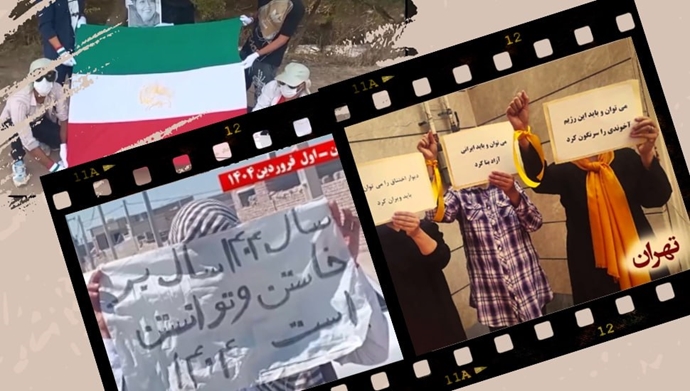

In Persian Calendar year 1403 (March 2024–March 2025), PMOI Resistance Units played an unparalleled role in confronting the tyranny of the mullahs’ regime ruling Iran. These units, inspired by the decades-long resistance deeply rooted in Iranian society, managed to survive under extreme repression and experienced significant quantitative and qualitative growth.
Over the past year, by increasing the number of their activities, they demonstrated that they can challenge the dictatorship anywhere in Iran, from Zahedan to Tehran. The statistics testify to this quantitative and qualitative rise.
With over 39,000 anti-regime activities across 31 provinces and 135 cities, the Resistance Units made a remarkable record over the past year. This level of activity signifies substantial quantitative growth compared to previous years.
The quality of operations: from boldness to impact
The qualitative improvement in the activities of Resistance Units in 1403 (March 2024–March 2025) is evident in their more precise planning and deeper impact. These actions have broken through the frozen social atmosphere imposed by repression and censorship, instilling hope and belief in change among the people.
A prominent example of this qualitative advancement is the ongoing protest campaigns in Zahedan. Since December 2022, these campaigns have continued for over 120 weeks despite arrests and brutal crackdowns. This persistence reflects the flexibility and agility of the Resistance Units, who have managed to maintain and expand their networks under the regime’s intense pressure. This adaptability has confronted the regime with an unpredictable and nimble force that it cannot easily contain.
The role of Resistance Units in guiding uprisings
Resistance Units are small but organized groups of youth and activists working toward overthrowing the religious dictatorship. By creating a revolutionary atmosphere in cities, neighborhoods, universities, and factories, they guide scattered social protests toward effective organization. Through their bold, anti-regime activities across Iran, they drain the regime’s suppressive capacity. These acts not only put the regime on the defensive but also demonstrate to the public that the ruling repression is more fragile than state propaganda suggests.
Recruitment and network expansion
One of the key achievements of the Resistance Units in 1403 was their increased recruitment. Their ongoing defiance of repression has heightened the rate of social protests, paving the way for new recruits. Youth exhausted by the regime’s suppression find in these units an outlet to express their desire for freedom. This growth goes beyond mere numbers—it indicates the expansion of operational networks across the country. Their presence in 135 cities shows their deep societal penetration and their ability to fortify structures against regime suppression.
The alternative and physical presence on the ground
The truth is that without a fighting and self-sacrificing force on the ground, speaking of a political alternative is merely an empty claim. This is the element that distinguishes the Resistance Units and the People’s Mojahedin Organization of Iran (PMOI/MEK) from other groups. While many operate from abroad in media and theory, the Resistance Units inside Iran have elevated the struggle with real operations and physical presence. Their practical engagement has introduced them into Iran’s political discourse as symbols of resistance, boldness, risk-taking, and sacrifice for the cause of freedom.
International impact
The activities of Resistance Units in 1403 were not limited to inside Iran—they also attracted international supporters of the Iranian resistance. In numerous speeches by political and human rights figures at global gatherings, the Resistance Units were cited as one of the most significant driving forces behind the uprisings and change in Iran. This global attention underscores the credibility and strategic importance of these units in the fight against the religious dictatorship.
In summary, in 1403 the Resistance Units proved through their quantitative and qualitative growth that it is possible to resist and advance even under intense repression. Through bold operations, recruitment, network expansion, and deep societal impact, they have given the Iranian people hope and motivation for change. As the beating heart of the uprisings, they demonstrated that with determination and sacrifice, dictatorship can be brought to its knees, paving the way for a democratic alternative.
From this perspective, the year 1403 (March 2024–March 2025) can be seen as a turning point in the history of the Resistance Units’ struggle. Without a doubt, if this trend continues, a brighter future will unfold for the land of Iran.